

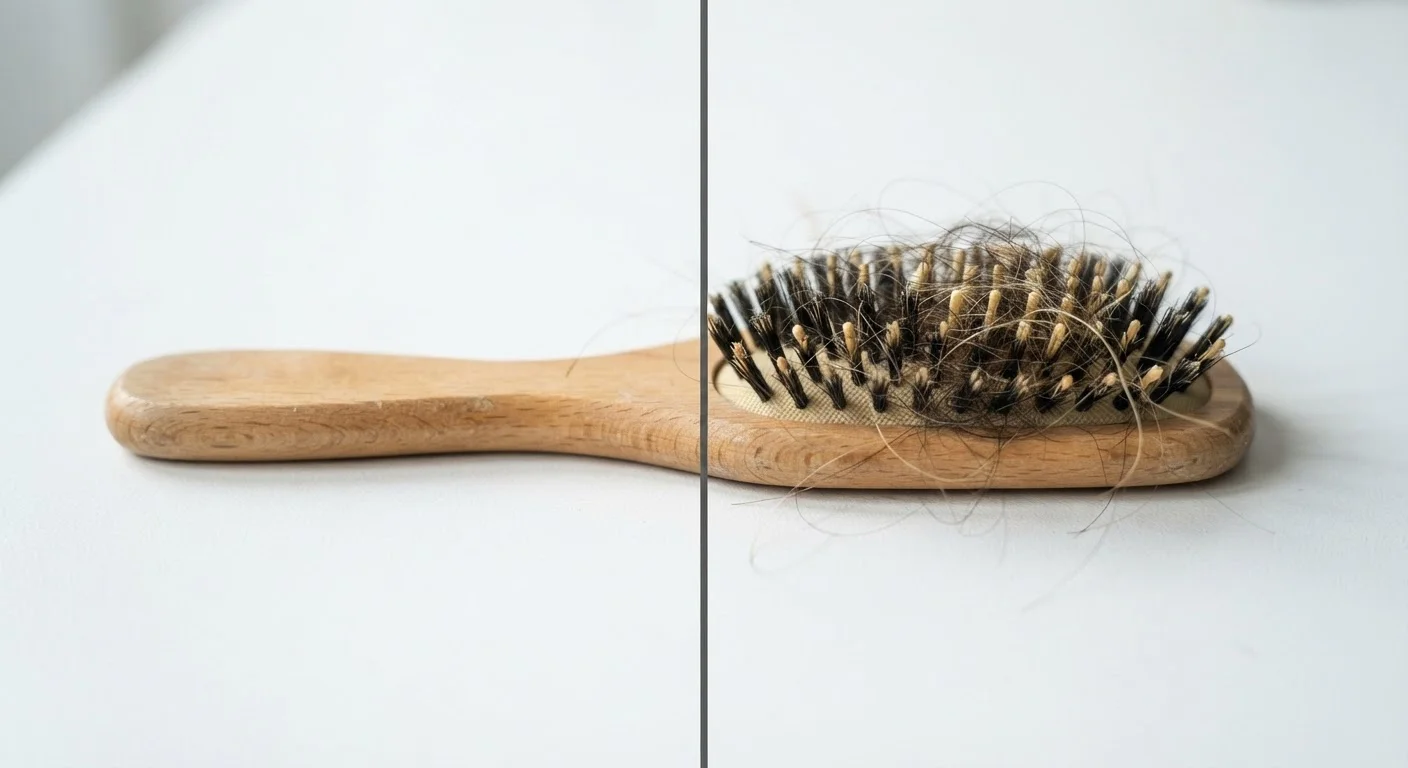
Option A
Hair Breakage
Damage along the strand, not at the root.
Best for: Understanding when hair care habits, heat, or chemical treatments are weakening the hair shaft itself.
Option B
Hair Loss (Shedding)
A follicle-level issue that begins at the scalp.
Best for: Recognizing when internal factors - hormones, nutrition, or health conditions - may be disrupting the normal hair growth cycle.
How to Tell Them Apart
Hair breakage and hair loss can look deceptively similar in your brush or on the shower floor, but they are fundamentally different events happening at different points along the strand. The fastest way to distinguish them is to examine the individual hairs you shed.
Breakage produces short, uneven fragments - often with tapered or split ends - that have clearly snapped somewhere along the shaft. These pieces have no root attached. Hair loss, by contrast, typically involves a full-length strand with a small white or translucent bulb at one end. That bulb is the hair root, meaning the entire follicle cycle has completed (or been disrupted) and the hair has detached from the scalp.
Shedding 50-100 hairs per day is generally considered within the normal range for most adults, though this figure can vary based on hair density and cycle stage. What matters more than an exact count is whether you're noticing a meaningful change from your personal baseline.
| Criterion | Hair Breakage | Hair Loss (Shedding) |
|---|---|---|
| Where it originates | Along the hair shaft | At the scalp / follicle |
| Appearance of shed hair | Short fragments, no root | Full-length strand with white bulb |
| Primary causes | Heat, chemicals, mechanical stress | Hormones, nutrition, health conditions |
| Visible signs | Split ends, rough texture, short pieces | Thinning, widening part, scalp visibility |
| Main care approach | Moisture, protein balance, gentle handling | Identify and address root cause; medical review if persistent |
| Reversibility | Improves with changed habits; damaged hair must grow out | Often temporary; chronic types may need treatment |
What Causes Breakage
Hair breakage is almost always an external story - it's about what's happening to the strand after it has grown. The hair shaft is made of keratin, a protein arranged in overlapping cuticle layers. When those layers are compromised, the strand loses elasticity and becomes prone to snapping under everyday tension.
Common drivers include:
- Heat styling: Repeated high-temperature use can degrade the cuticle and reduce moisture content within the cortex.
- Chemical processing: Bleaching, relaxing, and perming alter the protein bonds inside the shaft, weakening structural integrity over time.
- Mechanical stress: Aggressive brushing on wet hair, tight hairstyles (like high ponytails or braids worn too tightly), and rough towel-drying all create friction or tension that snaps vulnerable strands.
- Dryness and low porosity imbalance: Hair that can't retain moisture becomes brittle. Understanding how your hair's porosity works helps you choose products that actually penetrate and hold hydration where it's needed.
The good news is that because breakage is externally driven, adjusting your hair care practices - reducing heat, incorporating a deep conditioner or hair mask regularly, and detangling gently - can make a measurable difference over time.
What Causes Hair Loss
True hair loss involves the follicle itself - either the growth cycle is disrupted, the follicle is inflamed or scarred, or shedding is accelerated beyond what regrowth can keep pace with. This is an internal story, and the causes range from temporary to chronic.
Common contributors include:
- Telogen effluvium: A temporary but often dramatic increase in shedding triggered by a significant physical or emotional stressor - illness, surgery, childbirth, or prolonged stress. Hairs are pushed into the resting (telogen) phase en masse, then shed two to four months after the triggering event.
- Nutritional deficiencies: Low levels of iron, ferritin, zinc, or biotin are frequently associated with increased shedding. These relationships are well-documented, though supplementing without a confirmed deficiency is generally not recommended without professional guidance.
- Hormonal changes: Thyroid dysfunction, postpartum shifts, and hormonal transitions associated with menopause can all affect the hair cycle. Scalp changes that accompany hair loss - tenderness, redness, or scaling - can offer additional clues worth discussing with a provider.
- Androgenetic alopecia: A hereditary condition affecting both men and women, characterized by gradual follicle miniaturization and predictable pattern thinning.
When to See a Professional
Sudden, significant increases in shedding - especially accompanied by scalp changes, patchy loss, or symptoms elsewhere in the body - are worth discussing with a dermatologist. Many underlying causes of hair loss are treatable, but accurate diagnosis requires professional evaluation. Do not assume a specific cause or begin treatment without guidance.
This article is for general informational purposes only and does not constitute medical advice. If you are experiencing significant or sudden hair loss, consult a board-certified dermatologist or your healthcare provider to identify the underlying cause.
Addressing Each Problem Differently
Because the causes are distinct, so are the solutions. Treating hair loss with deep conditioning won't address a nutritional shortfall, and a dermatologist-prescribed intervention won't repair a heat-damaged cuticle.
For breakage: Focus on reducing stressors and rebuilding the hair's structural integrity. Use heat protectants consistently before styling, lower heat tool temperatures, and follow a shampoo routine suited to your hair type to avoid stripping natural oils. Protein treatments can help reinforce weakened strands, but balance matters - too much protein without adequate moisture creates its own brittleness.
For hair loss: Address the root cause. If shedding increased after a major stressor, regrowth often follows naturally once the body stabilizes - though this can take several months. If a nutritional deficiency or hormonal imbalance is suspected, blood work and professional evaluation are the appropriate first steps rather than self-supplementation.
In both cases, avoiding harsh mechanical treatment - tight elastics, rough detangling, excessive manipulation - supports whatever other care approach you're taking. Healthy hair habits benefit both shedding and breakage concerns even when the underlying causes differ.
50-100
Hairs shed per day in normal range
Dermatologists generally cite this range as typical for adults, though individual variation exists based on hair density and cycle stage.
2-4 months
Delay between trigger and telogen effluvium shedding
Shedding from telogen effluvium typically becomes noticeable two to four months after the triggering physical or emotional stressor.
The content on this site is for informational purposes only and is not a substitute for professional advice. Always consult a qualified professional for guidance specific to your situation.