

The Two Categories Every Budget Starts With
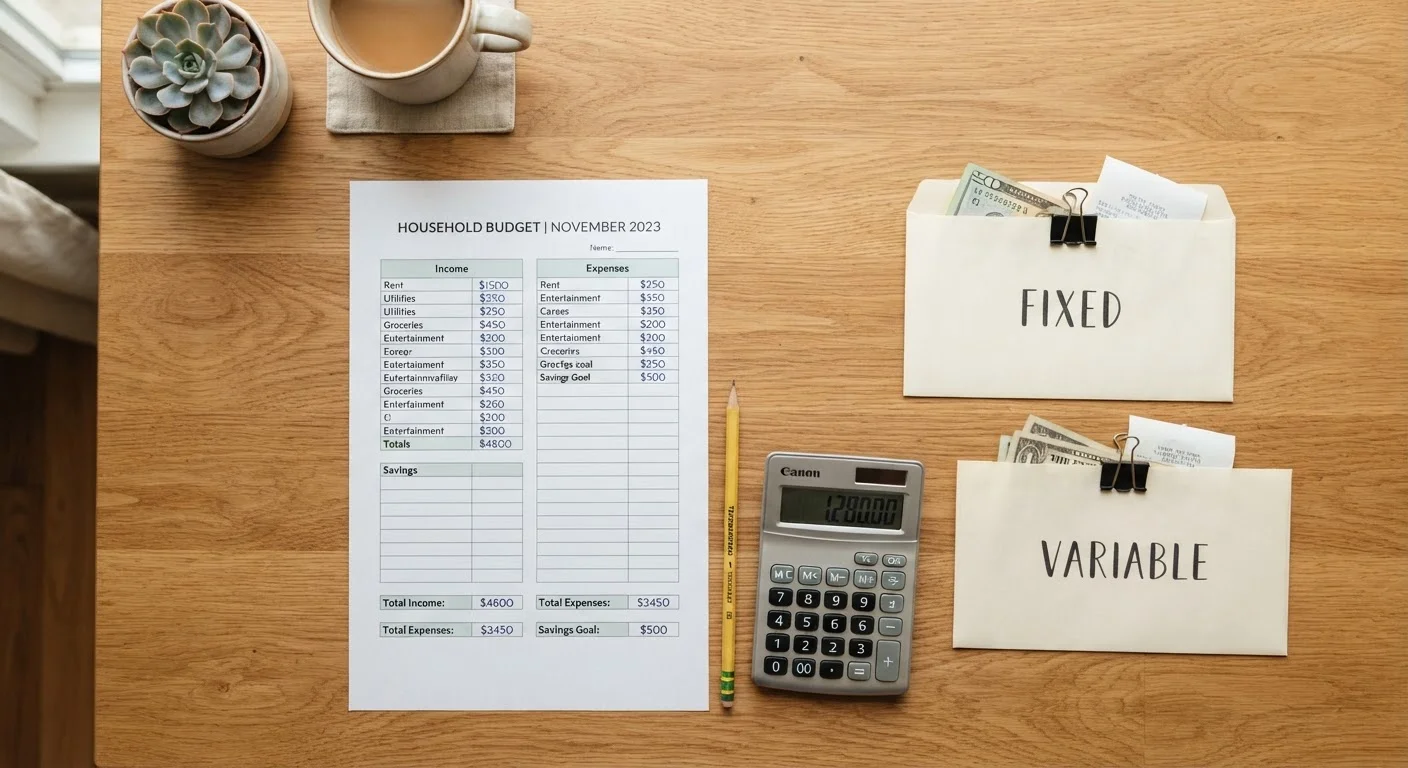
Before you can manage your money effectively, you need to know what kind of expenses you're working with. Every cost in your financial life falls into one of two broad buckets: fixed or variable.
Fixed expenses are predictable. They hit your account at the same time each month for the same amount. Examples include:
- Rent or mortgage payment
- Auto loan payment
- Health or renters insurance premium
- Subscription services billed at a flat monthly rate
Variable expenses shift from month to month. They depend on usage, behavior, or external factors you don't always control. Examples include:
- Groceries and household supplies
- Gas and transportation costs
- Utility bills (electricity, water, gas)
- Dining out and entertainment
For a broader look at the vocabulary you'll encounter as you build your budget, see our plain-language budgeting glossary.
~33%
Average share of income spent on housing
The U.S. Bureau of Labor Statistics Consumer Expenditure Survey consistently finds housing accounts for roughly one-third of American household spending — making it the largest single fixed expense for most families.
60%+
Americans living paycheck to paycheck
Multiple annual surveys of U.S. consumers have found a majority report having little financial cushion, underscoring why understanding and managing variable expenses is critical to financial stability.
$200–$500
Typical monthly variance in household variable spending
Financial planning research suggests most households see their variable spending fluctuate by hundreds of dollars month to month, making estimation and tracking essential for budget accuracy.
Why the Distinction Actually Matters
Sorting your expenses into the right category isn't just an organizational exercise — it directly shapes how you plan and where you can realistically cut.
Because fixed expenses don't change, you can list them at the top of your budget with confidence. Once rent, insurance, and loan payments are accounted for, what's left tells you how much you have for everything else. There's no guessing.
Variable expenses require a different approach: estimation. You look at what you've spent in recent months, identify a reasonable average, and use that as your monthly target. This is where most budget surprises come from — not because people are irresponsible, but because variable costs are genuinely harder to predict.
Use Averages for Variable Cost Estimates
To estimate a variable expense, add up what you spent in that category over the past three to six months and divide by the number of months. That average becomes your monthly budget target. Revisit it every few months as your habits or circumstances change.
Understanding which of your costs are fixed also tells you where flexibility exists. Lowering a fixed expense typically requires a significant action — renegotiating a lease, refinancing a loan, or canceling a service. Lowering a variable expense can often happen with smaller daily decisions. That distinction matters when your budget is under pressure.
This same fixed-versus-variable logic applies in other financial contexts too. If you're a homeowner, for example, your mortgage payment may be fixed while property taxes and maintenance costs are variable — an important reality covered in our homeownership costs hub.
The Middle Ground: Semi-Variable Expenses
Not every cost fits neatly into one box. Semi-variable expenses (sometimes called mixed expenses) have a fixed floor and a variable ceiling. Your electricity bill, for example, may never drop below a certain service fee, but it rises or falls based on usage.
Other common semi-variable costs include:
- Cell phone plans with a base rate plus per-use charges
- Internet plans with overage fees
- Credit card minimum payments (fixed minimum, but the actual balance owed varies)
For budgeting purposes, treat the fixed portion as a committed cost and estimate the variable portion using your average from prior months. Tracking these separately from purely fixed or purely variable expenses helps you spot where small usage changes can add up.
Putting It Into Practice: Building Your Expense Map
Start by pulling two to three months of bank and credit card statements. Go line by line and label each charge: Fixed, Variable, or Semi-Variable. Once categorized, total each group.
Your fixed total represents your non-negotiable monthly floor — the minimum you need to cover regardless of what happens. Your variable total is your adjustment zone. If income is tight, variable spending is where you have the most immediate control.
Don't forget costs that arrive less than monthly. Annual subscriptions, car registration fees, and periodic medical copays don't show up every month, but they're real expenses. Divide any annual or quarterly cost by 12 and add it as a monthly line item so it doesn't blindside you. Our article on spending categories most budgets overlook covers exactly these easy-to-miss costs.
If your income itself fluctuates — common for freelancers, gig workers, or hourly employees — knowing your fixed expense floor is even more critical. See our guide on budgeting on an irregular income for strategies tailored to variable paychecks.
“A budget is telling your money where to go instead of wondering where it went. Knowing whether a cost is fixed or flexible is what makes that possible.”
— Dave Ramsey, Personal finance author and radio host
This article is for general informational and educational purposes only and does not constitute personalized financial advice. Consult a qualified financial professional for guidance specific to your situation.
Frequently Asked Questions
Fixed expenses are the same amount every billing cycle — think rent, mortgage payments, or insurance premiums. Variable expenses change based on how much you use or spend — like groceries, dining out, or electricity. Both categories need a place in your budget, but they require different planning approaches.
A standard auto loan payment is a fixed expense because the same amount is due each month for the life of the loan. However, costs related to owning the car — gas, maintenance, and repairs — are variable because they change depending on how much you drive and what the car needs.
Review three to six months of past spending in each variable category and calculate the average. Use that average as your monthly target. For categories that spike seasonally — like heating bills in winter — build a small buffer into your estimate.
Yes. If you refinance a mortgage, change insurance coverage, or switch to a variable-rate loan, a previously fixed cost can begin to fluctuate. Review your expense categories any time you make a significant financial change.
Variable expenses are generally easier to trim because they're tied to daily choices — dining out, subscriptions you rarely use, or impulse purchases. Fixed expenses require a bigger change, such as moving to a less expensive home or refinancing a loan, to reduce.
Annual fees, car registration, and similar costs are technically fixed in amount but irregular in timing. Budget for them by dividing the annual total by 12 and setting that amount aside each month so the expense doesn't catch you off guard.
The content on this site is for informational purposes only and is not a substitute for professional advice. Always consult a qualified professional for guidance specific to your situation.