

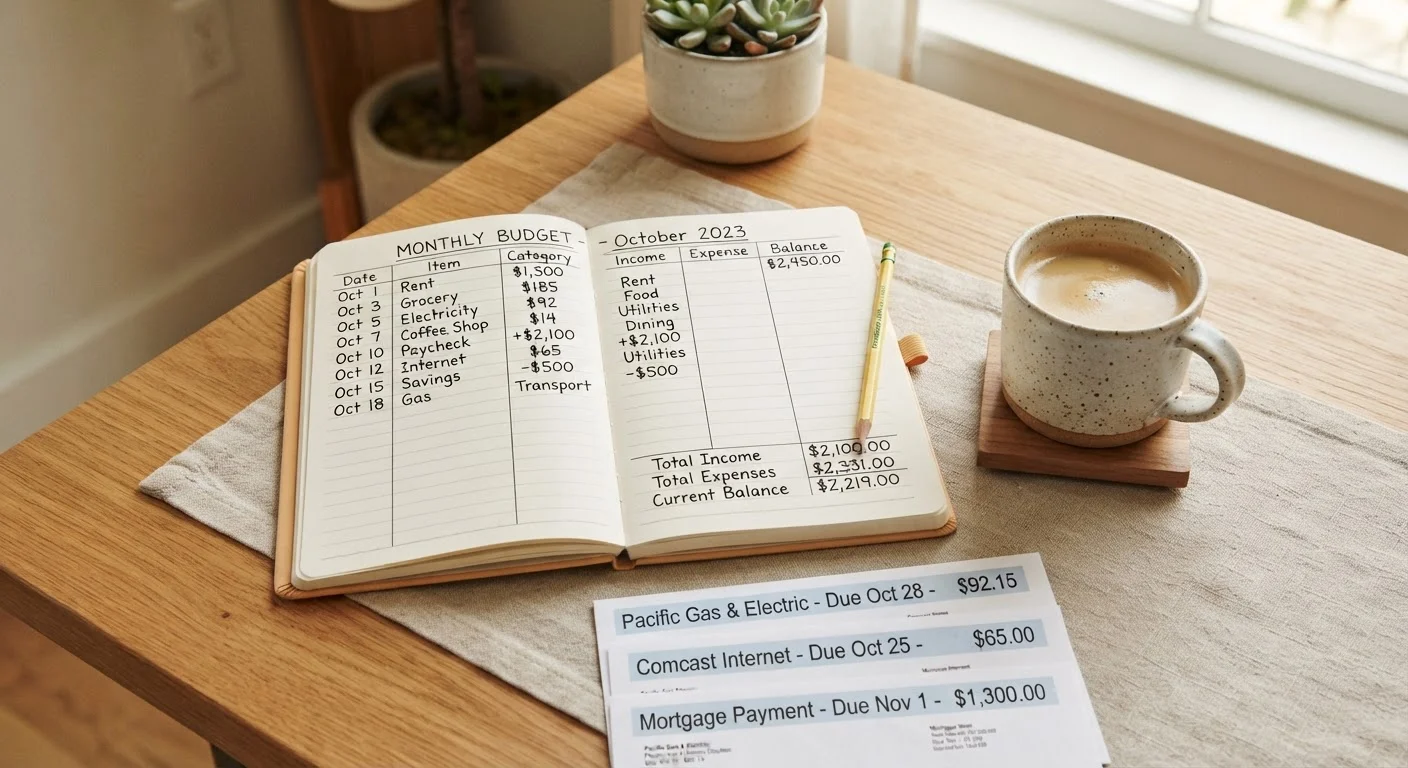
The Real Definition of a Household Budget
Strip away the anxiety and the spreadsheets, and a household budget is simply this: a plan for your money before you spend it. You write down what you expect to earn in a given period, list what you intend to spend, and verify that those two numbers can coexist — ideally with something left over for savings or debt repayment.
That's it. There's no requirement for color-coded categories, specialized software, or an accounting degree. A household budget can live in a notebook, a free app, or a plain text file. What matters is that it exists and that you consult it regularly.
For a quick reference on the vocabulary you'll encounter as you build one, the plain-language glossary of budgeting terms breaks down concepts like net income, discretionary spending, and fixed versus variable expenses.
Budget vs. Spending Plan: A Subtle but Real Distinction
Some financial educators draw a line between a 'budget' (which can feel restrictive) and a 'spending plan' (which emphasizes active allocation). The mechanics are nearly identical, but the framing can affect how consistently you stick to it. If the word 'budget' feels discouraging, calling it a spending plan is a perfectly legitimate reframe — what matters is the practice, not the label.
Why the Concept Gets Misread So Often
The most pervasive misunderstanding is that a budget is a form of financial punishment — proof that you're bad with money or that fun is officially over. This framing causes many people to avoid budgeting entirely, which only deepens the problems they're trying to avoid.
A budget doesn't tell you what you can't have. It tells you what you can afford and when. That's a meaningful distinction. Someone who budgets intentionally for a vacation is making an active choice; someone who overspends without a plan is making an accidental one.
A second common misconception is that budgets are only for people with low incomes or financial problems. In reality, higher earners without a budget are just as susceptible to lifestyle creep — where spending quietly expands to match income — leaving little to show for a good salary. Budgets are tools of intention, not tools of scarcity.
“A budget is telling your money where to go instead of wondering where it went.”
— John C. Maxwell, Leadership author and speaker, widely cited in personal finance contexts
If these myths sound familiar, they're more widespread than you might think. Our article on budgeting myths that keep people from starting addresses the most common ones directly.
What a Budget Actually Contains
A functional household budget has three components:
- Income: All money coming in — wages, freelance earnings, benefits, or any other regular source. Use your net income (after taxes and deductions), because that's what actually lands in your account.
- Fixed expenses: Costs that stay the same each month — rent or mortgage, loan payments, insurance premiums, subscriptions.
- Variable expenses: Costs that shift month to month — groceries, utilities, fuel, dining, entertainment, and personal care.
The math is straightforward: income minus all expenses equals your surplus or deficit. A surplus gives you options — savings, debt payoff, or a financial cushion. A deficit tells you something needs to change before the month is over, not after.
~1 in 3
Americans who track spending in a formal budget
Surveys from organizations including Gallup have consistently found that fewer than half of U.S. households maintain a detailed household budget.
$1,400+
Average monthly non-mortgage debt payment per U.S. household
Federal Reserve consumer credit data illustrates how significant fixed debt obligations are in a typical household spending picture.
3–6 months
Emergency fund target most financial guidance recommends
Building this cushion is one of the most commonly cited goals that a structured monthly budget makes achievable over time.
One often-overlooked dimension is irregular expenses — costs that don't appear every month but are entirely predictable: car registration, annual subscriptions, holiday spending, or a dental visit. Spreading these across your monthly budget prevents them from feeling like emergencies. For a full rundown of what most first budgets miss, see our guide on spending categories most household budgets overlook.
Start With Just One Month of Real Numbers
Before building a budget from scratch, spend 30 days recording every dollar you spend — no judgment, just observation. Your actual spending patterns will reveal far more useful category estimates than any generic template. This one step closes the gap between what people think they spend and what they actually spend.
Starting Simple and Building From There
The most effective budget is the one you'll actually maintain. That might mean starting with a single sheet of paper and five spending categories. Precision comes with practice — your first budget is about building the habit, not perfecting the numbers.
Over time, you can add detail, adjust categories, and refine estimates based on real spending history. A monthly check-in — comparing what you planned to what you actually spent — is where most of the learning happens. Gaps between planned and actual spending are information, not failures.
For a structured path from your first budget through long-term financial goals, the complete household budgeting roadmap walks through each stage in practical terms.
This article is for general informational purposes only and does not constitute personalized financial advice. Readers should consult a qualified financial professional for guidance specific to their circumstances.
Frequently Asked Questions
No. A budget can be as simple as listing your monthly income and subtracting your known expenses. The goal is clarity about your money, not perfection. A basic plan you actually follow consistently will outperform an elaborate spreadsheet you abandon after a week.
Budgets are useful at every income level. They help you align spending with your priorities, avoid lifestyle creep, and make intentional choices about saving and investing — regardless of whether you're in financial difficulty.
Revisit your budget at least once a month to compare planned versus actual spending. Review it more thoroughly whenever your income, expenses, or financial goals change significantly — such as a new job, a baby, or a move.
The terms are often used interchangeably, but they can reflect different mindsets. A budget is typically constraint-focused, while a spending plan emphasizes intentional allocation. For a deeper look at the distinction, see our article on <a href="/money-finance/saving-and-debt/the-difference-between-a-budget-and-a-spending-plan-and-why-it-matters">the difference between a budget and a spending plan</a>.
Yes. Variable-income budgeting typically involves using your lowest expected monthly income as the baseline, then prioritizing essential expenses first. Any additional income above that baseline can be allocated once it arrives.
Annual fees, vehicle maintenance, medical copays, and personal care costs are frequently missed. Our guide to <a href="/money-finance/budgeting-basics/spending-categories-most-household-budgets-overlook">spending categories most budgets overlook</a> covers these in detail.
The content on this site is for informational purposes only and is not a substitute for professional advice. Always consult a qualified professional for guidance specific to your situation.