

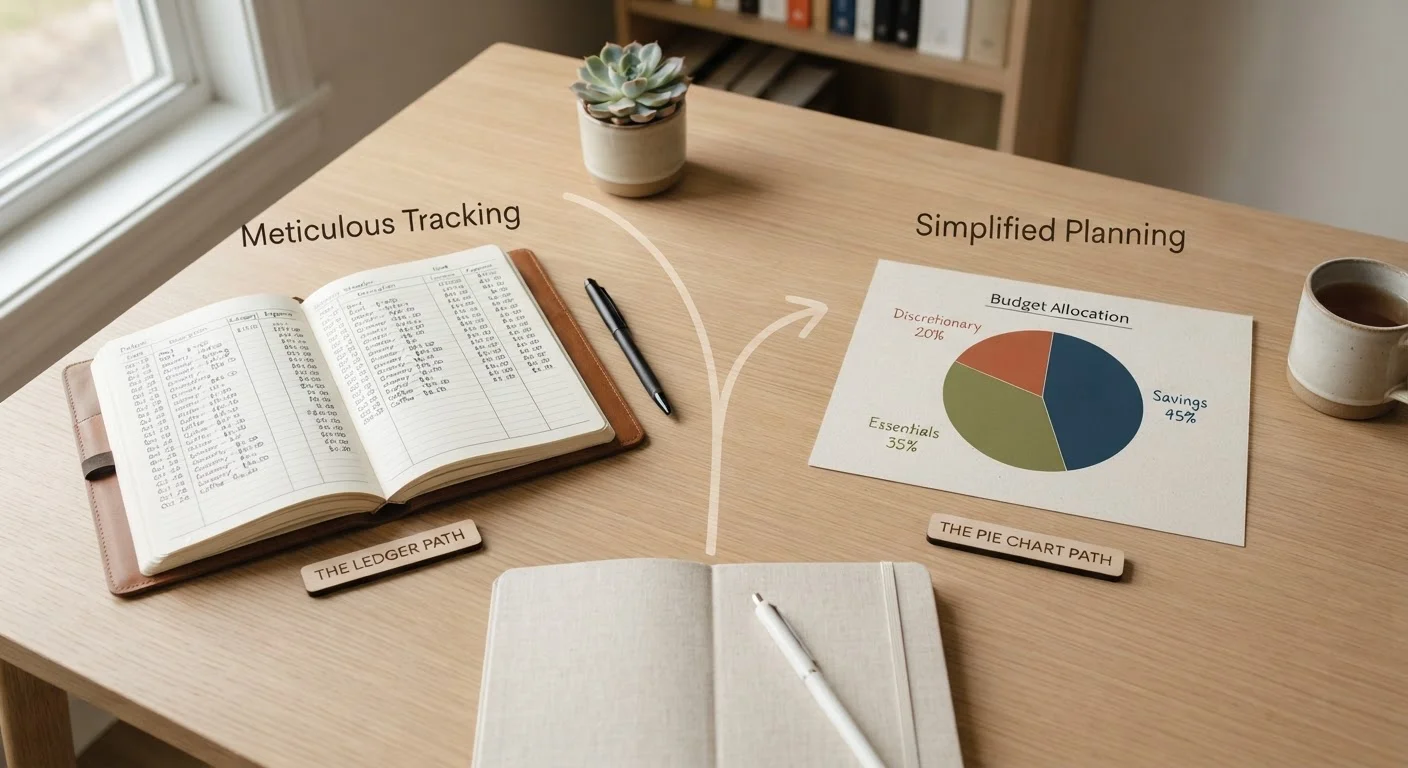
Option A
Zero-Based Budgeting
The meticulous, dollar-by-dollar approach.
Best for: People who want complete control over every spending category and are willing to invest time each month to track it.
Option B
The 50/30/20 Rule
The streamlined, percentage-based framework.
Best for: People who want a simple structure to guide their money without tracking every individual transaction.
How Each Method Actually Works
Understanding both systems at a mechanical level helps you see why they produce such different results in practice.
Zero-based budgeting starts with your take-home income for the month. You then assign every single dollar to a category — rent, groceries, utilities, subscriptions, savings, debt payments — until your income minus your total allocations equals zero. That zero doesn't mean you've spent everything; it means every dollar has a named purpose, including dollars parked in savings or an emergency fund. You repeat this process every month, which means the budget responds to your actual income and real expenses rather than last month's assumptions.
The 50/30/20 rule works differently. It divides your after-tax income into three percentage-based categories: 50% toward needs (housing, utilities, groceries, insurance), 30% toward wants (dining out, entertainment, hobbies), and 20% toward savings and debt repayment beyond minimums. You don't track individual transactions as long as you stay within each bucket. The framework was popularized in personal finance literature as a simple way to bring structure to spending without a detailed ledger.
For a broader look at how these two methods compare to other frameworks, see our overview of common budgeting frameworks.
| Criterion | Zero-Based Budgeting | 50/30/20 Rule |
|---|---|---|
| Core concept | Every dollar assigned a job | Income split by percentages |
| Setup time | High — rebuilt each month | Low — set once, revisit occasionally |
| Ongoing effort | High — detailed tracking required | Low — broad category monitoring |
| Flexibility for variable income | Strong — adapts monthly | Weaker — percentages assume stable income |
| Visibility into spending | Very detailed | High-level only |
| Best for debt payoff | Yes — highly targeted | Moderate — 20% bucket is blended |
| Learning curve | Steeper | Gentle |
| Works with budgeting apps | Yes, many apps support it | Yes, easy to track in any app |
Effort, Flexibility, and Where Each System Can Break Down
The biggest practical difference between these two methods is the ongoing time commitment they demand.
Zero-based budgeting is labor-intensive by design. Setting up a new budget each month, categorizing every expense, and reconciling your spending against your plan takes consistent effort. Many people use spreadsheets or dedicated budgeting apps to manage this. The upside is granular visibility: you see exactly where your money went and can make precise adjustments. The downside is that even a few missed weeks can cause the whole system to feel overwhelming.
The 50/30/20 rule has a much lower barrier to entry. Once you know your after-tax monthly income, the math takes minutes. However, its broad categories can obscure real problems. If your housing costs alone consume 45% of your income, fitting everything else into the remaining percentages becomes nearly impossible — and the framework doesn't offer much guidance on what to do next. The rule also assumes a level of income stability that not everyone has.
~33%
Americans with a detailed monthly budget
Gallup polling has consistently found that roughly one-third of U.S. adults maintain a detailed household budget, suggesting most people rely on informal spending habits.
50%
Workers living paycheck to paycheck
Multiple annual surveys, including those conducted by LendingClub and PYMNTS, have found roughly half of American consumers report spending most or all of their income each month.
20%
Target savings rate in the 50/30/20 rule
Personal finance educators generally recommend directing at least 20% of after-tax income toward savings and debt reduction, though the right target varies by individual circumstances.
It's also worth considering that the 50/30/20 rule's percentages were developed with a particular income range in mind. For people living in high-cost cities or earning near the median income, the 50% needs bucket can feel impossibly tight. Zero-based budgeting, by contrast, works with whatever numbers you actually have. If you're also navigating shared finances, these structural differences matter even more — our guide on budgeting as a couple explores how to adapt either method to joint finances.
When Neither System Fits Neatly
If your housing costs, childcare, or medical expenses consume an unusually large share of your income, both systems may need adjustment. The 50/30/20 percentages aren't regulatory requirements — they're guidelines. Similarly, zero-based budgeting doesn't require tracking every individual purchase; categorizing spending in daily or weekly batches can reduce the burden. The goal of any budget is sustainable behavior change, not perfect adherence to a formula. Consider reading about envelope-style alternatives: our article on envelope budgeting in the digital age covers another approach worth comparing.
Choosing the Right System for Where You Are Now
Neither budgeting method is objectively better. The one that works is the one you'll actually use consistently.
If you're carrying high-interest debt, rebuilding an emergency fund from zero, or have income that changes each month, zero-based budgeting tends to produce better results because it forces intentionality every time money comes in. The extra effort pays off when every dollar has a specific destination rather than drifting into vague discretionary spending.
If your income is steady, your essentials are covered, and you're mainly looking to avoid spending more than you earn while building savings gradually, the 50/30/20 rule provides enough structure without requiring a monthly deep dive. It's also a reasonable starting point if you've never budgeted before and find detailed systems discouraging.
Some people find it useful to start with the 50/30/20 rule to build the habit, then shift to zero-based budgeting when they're ready for more control. Others run a hybrid: zero-based for fixed and savings categories, percentage targets for discretionary spending. For a deeper look at how these and other methods compare, our guide to the 50/30/20 rule and its alternatives walks through additional variations. You can also explore foundational planning concepts through our financial planning hub.
This article is for general informational and educational purposes only and does not constitute personalized financial advice. Consult a licensed financial professional for guidance specific to your situation.
The content on this site is for informational purposes only and is not a substitute for professional advice. Always consult a qualified professional for guidance specific to your situation.