

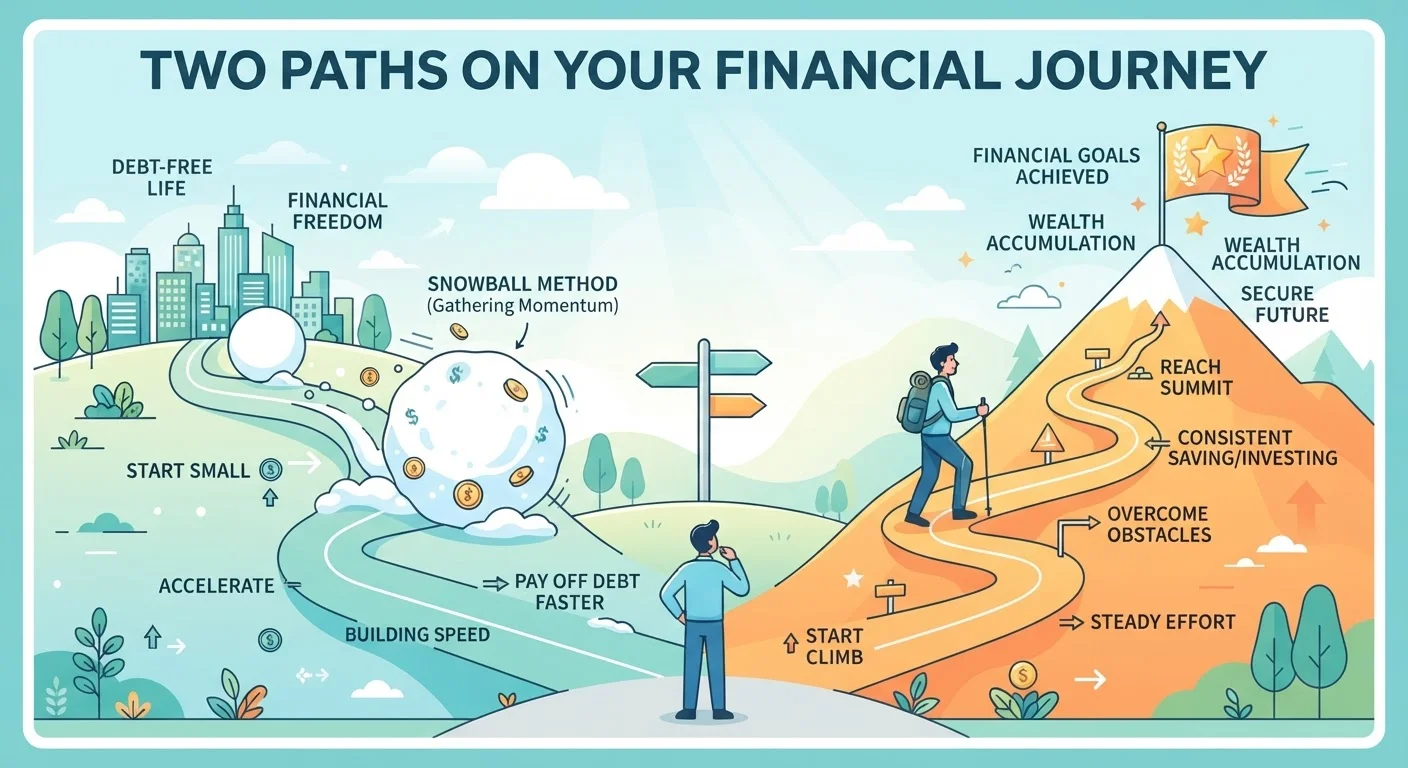
Option A
Debt Avalanche
The mathematically optimal, interest-first approach.
Best for: Borrowers who are motivated by long-term savings and can stay disciplined without frequent quick wins.
Option B
Debt Snowball
The psychologically rewarding, balance-first approach.
Best for: Borrowers who need early momentum and find motivation through crossing accounts off their list.
How Each Method Works
Both the avalanche and snowball methods share the same core mechanic: you make minimum payments on all your debts every month, then direct any extra money toward one specific target account. The difference is how you choose that target.
With the Debt Avalanche, you rank your debts by interest rate — highest to lowest — and pour extra payments into the highest-rate balance first. Once that's gone, you redirect what you were paying on it to the next-highest rate, and so on. The avalanche's logic is purely financial: interest is the cost of carrying debt, so eliminating it at the source is the fastest way to reduce what you ultimately owe.
With the Debt Snowball, you rank debts by balance — smallest to largest — and attack the smallest balance first, regardless of its interest rate. Each account you close frees up that minimum payment, which rolls into the next target like a growing snowball. The driving force here is behavioral: knocking out individual accounts quickly provides a psychological reward that sustains motivation.
| Criterion | Debt Avalanche | Debt Snowball |
|---|---|---|
| Payoff order | Highest interest rate first | Smallest balance first |
| Total interest paid | Lower (often significantly) | Slightly higher in most cases |
| Time to first payoff | Longer (if highest rate = large balance) | Shorter — quick early wins |
| Motivation style | Driven by financial logic | Driven by visible progress milestones |
| Best debt profile | Wide rate spread across accounts | Many small accounts or similar rates |
| Risk of abandoning the plan | Higher if early progress feels slow | Lower due to frequent account closures |
For a deeper side-by-side look at how each plays out across different debt scenarios, see this detailed comparison of the two methods.
The Real Cost Difference
In strictly financial terms, the avalanche method wins. Because high-interest balances compound faster, eliminating them first reduces the total interest you pay across the life of your debt. Depending on your rate spread and balance mix, the savings can be substantial — sometimes thousands of dollars.
~$1,000+
Potential interest savings with avalanche method
Financial planning educators note that on typical mixed credit card debt, the avalanche method can save over $1,000 compared to the snowball, though the exact figure varies by balance size and rate spread.
$6,000+
Average American household revolving debt
Federal Reserve data indicates average revolving credit balances per household often exceed $6,000, making interest-rate strategy a meaningful financial lever.
20%+
Typical credit card APR in recent years
The Federal Reserve has reported average credit card interest rates above 20% APR in recent reporting periods, highlighting why high-rate balances compound quickly.
However, the snowball method isn't financially wasteful in most real-world debt portfolios. When interest rates across your debts are close together — say, 18% versus 22% — the total interest difference between the two methods may be modest. The practical cost of choosing snowball over avalanche is often smaller than people expect, particularly if the momentum it provides keeps you from giving up entirely.
Where the avalanche clearly earns its edge is when one or two accounts carry significantly higher rates than the rest — think payday loans, certain store cards, or variable-rate debt that has climbed over time. In those situations, every extra day that balance sits unpaid is genuinely expensive. For guidance on the habits that make payoff harder regardless of the method you choose, see financial habits that quietly keep debt growing.
Psychology, Consistency, and What Actually Gets You Debt-Free
Financial research consistently shows that the best debt payoff strategy is the one you actually follow through on. Behavioral economists have documented that people derive outsized satisfaction from completing discrete tasks — closing an account produces a stronger sense of progress than reducing a large balance by an equivalent dollar amount. This is the snowball's real advantage: it's engineered around how people actually behave, not just how the math works.
That said, discipline and structure matter enormously for either approach. Both methods require you to free up extra money each month — without that, you're only making minimum payments, and interest continues compounding. Building consistent habits around your monthly cash flow is a prerequisite. Research on people who pay off debt ahead of schedule points to a recurring set of behaviors; those habits are worth reviewing once you've chosen your method.
You Can Blend Both Approaches
Some financial counselors suggest a hybrid: start with the snowball to close one or two small accounts quickly, then switch to the avalanche once motivation is established. This isn't a formal strategy, but for some people it bridges the gap between behavioral need and financial efficiency. The most important thing is that you commit to a consistent extra payment each month — the method is secondary to the habit.
If you're also trying to save while managing debt, these strategies don't have to be mutually exclusive. The complete guide to managing savings and debt simultaneously covers how to balance both goals based on your income and interest rates. And if managing multiple separate debts feels unmanageable, it may be worth understanding how debt consolidation fits into the picture — though consolidation has its own trade-offs to weigh carefully.
This article is for general informational purposes only and does not constitute personalized financial or legal advice. Consult a qualified financial professional for guidance specific to your situation.
The content on this site is for informational purposes only and is not a substitute for professional advice. Always consult a qualified professional for guidance specific to your situation.