

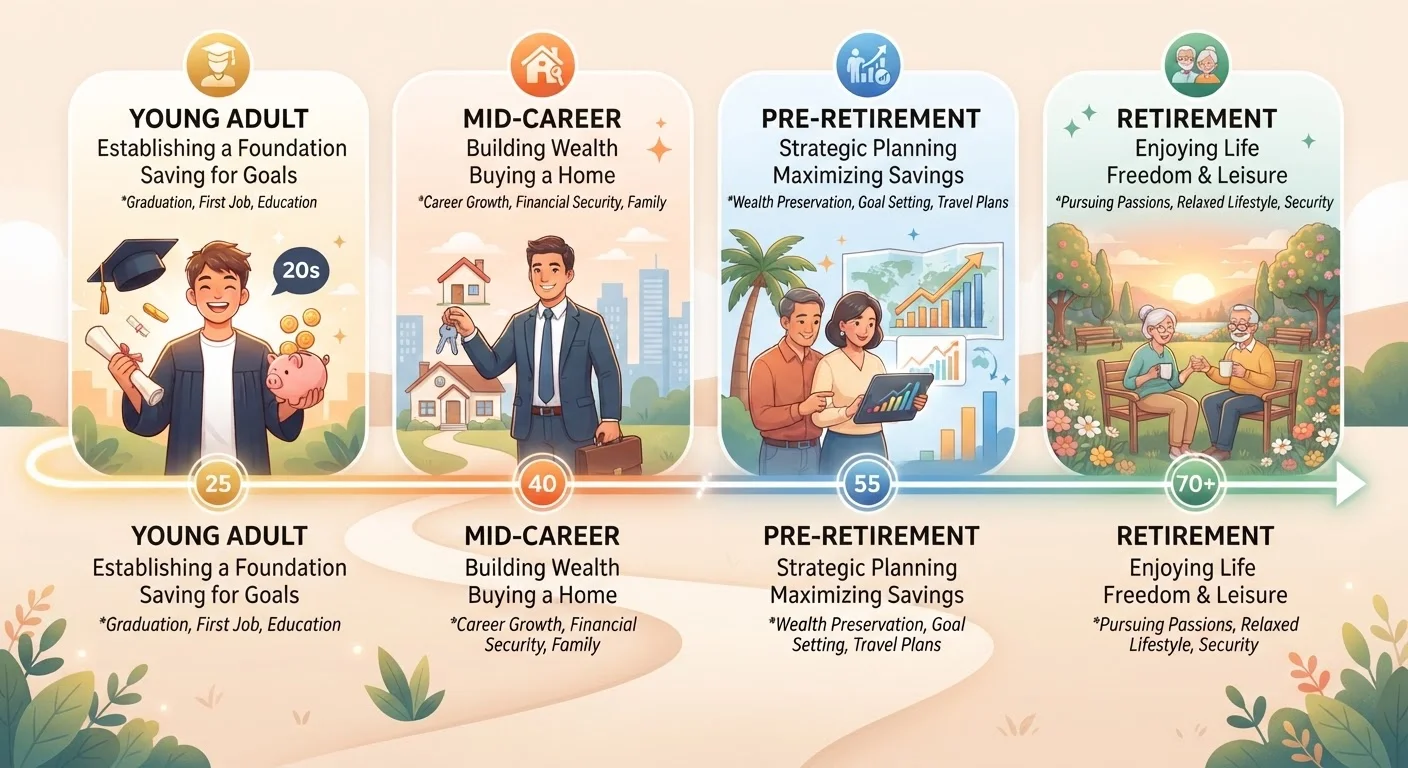
Why Life Stage Matters in Financial Planning
A 25-year-old and a 60-year-old can both be "doing the right things" financially — but those things look completely different. Financial planning is not a one-size-fits-all checklist; it's a living framework that should evolve as your income, responsibilities, and time horizon change.
Understanding which stage you're in helps you prioritize correctly. Paying off credit card debt matters at every age, but it means something different when you have 40 years of earning ahead versus 5. This article breaks down the four major financial life stages and what each one typically demands. For a deeper look at what a complete financial plan actually includes, see what a financial plan really contains.
| Recommended emergency fund | 3–6 months of essential expenses |
| 401(k) catch-up contribution age | 50 and older (IRS rules) (IRS Publication 560) |
| Medicare eligibility age | 65 (U.S. Centers for Medicare & Medicaid Services) |
| Common savings rate target | 15% of gross income toward retirement (General financial planning guideline; individual needs vary) |
| Social Security earliest claiming age | 62 (with reduced benefit) (Social Security Administration) |
| Full retirement age (born 1960 or later) | 67 (Social Security Administration) |
This article is for general informational purposes only and does not constitute personalized financial, tax, or investment advice. Consult a qualified financial professional for guidance specific to your situation.
Your 20s: Build the Foundation
The most powerful asset in your 20s is time. Starting to save and invest early — even modest amounts — gives compound growth decades to work. The foundational priorities at this stage typically include:
- Emergency fund: Aim to build 3–6 months of essential living expenses in a liquid savings account before investing aggressively.
- Employer retirement match: If your employer offers a 401(k) match, contribute at least enough to capture the full match — this is a direct return on your money.
- High-interest debt: Credit card balances with double-digit interest rates are a financial drag that compounds against you. Prioritize clearing them.
- Budget literacy: Learning to track your spending now builds habits that pay dividends for life. Visit the budgeting basics hub for practical frameworks.
This is also the time to begin setting concrete, revisable goals. Setting goals you'll actually stick to requires a structured approach — not just a number written on a napkin.
Your 30s and 40s: Grow and Protect
Mid-career typically brings higher income — and higher complexity. A mortgage, children, career transitions, and aging parents can all compete for the same dollars. The core focus shifts to growth and protection:
- Increase retirement contributions: Aim to increase savings rates as income grows, targeting accounts like 401(k)s and IRAs.
- Life and disability insurance: If others depend on your income, adequate coverage becomes essential, not optional.
- Debt management: Mortgages are generally lower-priority to aggressively pay off compared to high-interest debt, but total debt load should stay manageable relative to income.
- Education savings: If children are in the picture, 529 plans allow tax-advantaged savings for future education costs.
Major life changes — a new job, a move, a growing family — often make previous budgets obsolete. Resetting your budget for major life events is a skill worth developing now. Also worth noting: core financial principles like living within your means and diversifying risk don't change with life stage — only the application does.
Compound growth
The process by which investment returns generate their own returns over time. Starting early dramatically increases the long-term effect, making time one of the most valuable factors in building wealth.
401(k) match
A contribution your employer makes to your retirement account that matches a portion of what you contribute. It is effectively additional compensation — not capturing it means leaving money on the table.
529 plan
A tax-advantaged savings account designed for education expenses. Contributions grow tax-free when used for qualified educational costs, and many states offer additional tax benefits for residents.
Catch-up contribution
An additional amount that workers aged 50 and older are permitted to contribute to retirement accounts above the standard annual IRS limit, allowing those who started saving late to accelerate their savings.
Withdrawal strategy
A plan for which retirement accounts to draw from, in what order, and at what amounts during retirement — designed to minimize tax liability and make savings last as long as possible.
Your 50s and Beyond: Preserve and Transition
As retirement moves from abstract to real, the emphasis shifts from accumulation to preservation and transition planning.
~50%
Americans behind on retirement savings
Various surveys consistently find roughly half of working-age Americans feel they are not on track with retirement savings, underscoring the urgency of accelerating in your 50s.
8% per year
Increase in Social Security benefit per delayed year
According to the Social Security Administration, delaying benefits past full retirement age increases your monthly benefit by approximately 8% for each year of delay, up to age 70.
$315,000+
Estimated healthcare costs in retirement per couple
Fidelity's annual Retiree Health Care Cost Estimate consistently projects that a retired couple may need over $300,000 to cover healthcare expenses not covered by Medicare.
- Catch-up contributions: Once you reach 50, the IRS allows additional contributions to 401(k)s and IRAs above the standard limit — a meaningful opportunity to accelerate savings.
- Social Security strategy: Claiming age significantly affects your monthly benefit. Delaying benefits past full retirement age increases the monthly amount, though the right timing depends on individual health and income needs.
- Healthcare costs: Plan explicitly for out-of-pocket healthcare expenses, which tend to rise significantly in retirement. Medicare eligibility begins at 65, but coverage gaps and costs require planning ahead.
- Withdrawal strategy: Determine which accounts to draw from and in what order to manage tax exposure in retirement. This is an area where professional guidance adds real value.
This stage is also a natural point to revisit whether a professional adviser makes sense for your situation. Working with a financial planner has genuine benefits, especially as complexity increases. And for a comprehensive overview of all the moving parts, our complete planning reference covers the full landscape in one place.
The content on this site is for informational purposes only and is not a substitute for professional advice. Always consult a qualified professional for guidance specific to your situation.