

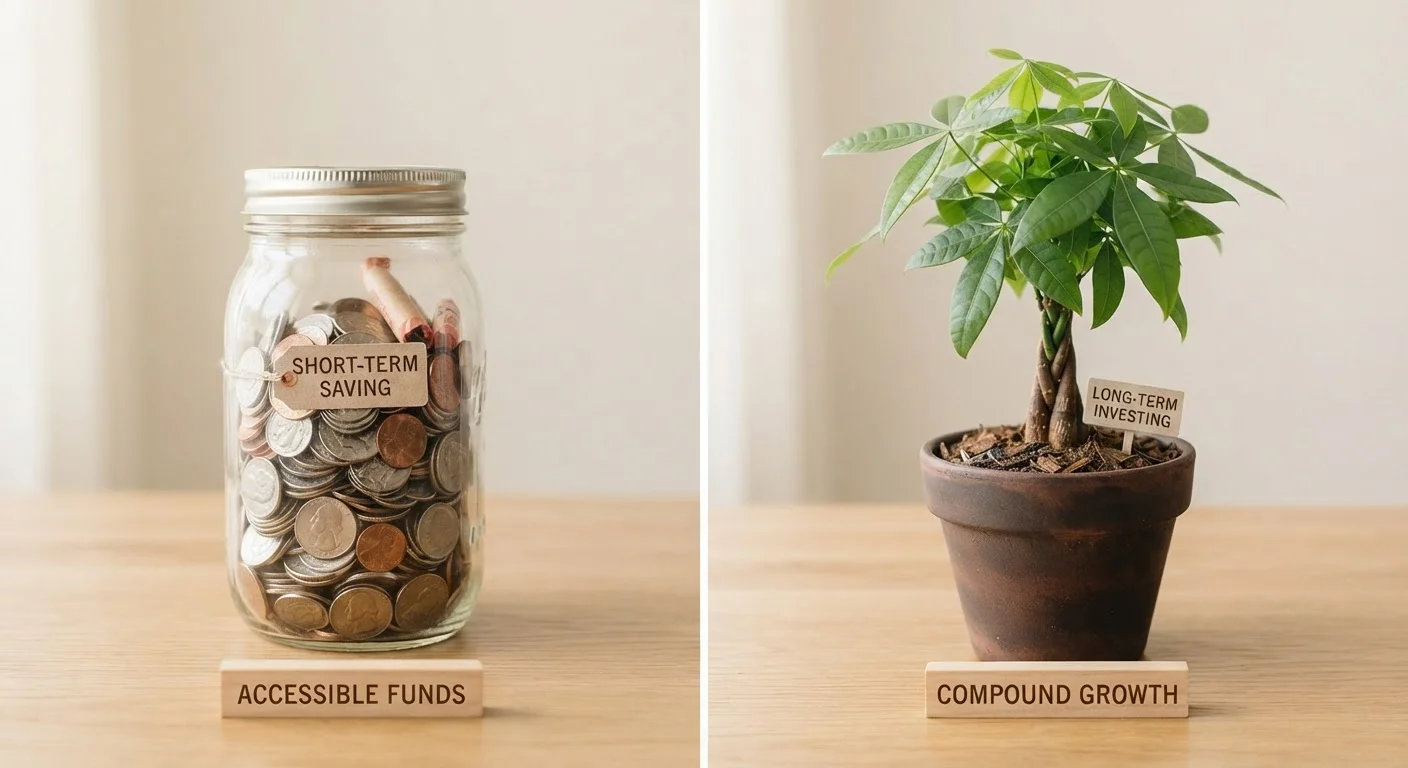
Option A
Short-Term Savings
The safety net you can reach when you need it.
Best for: Covering near-term expenses, emergencies, and goals you plan to fund within one to five years.
Option B
Long-Term Investing
The engine that builds wealth over decades.
Best for: Growing money for retirement, a child's education, or any goal at least five or more years away.
What Separates Saving from Investing
Saving and investing are often used interchangeably, but they describe fundamentally different activities with different purposes, risk profiles, and tools. Understanding that difference is the first step toward using both effectively.
Short-term savings means setting aside money in low-risk, liquid accounts — places where the balance is stable and accessible. Common vehicles include savings accounts, money market accounts, and certificates of deposit (CDs). The trade-off: your money is safe but grows slowly. For context on how account type affects your rate, see this comparison of high-yield vs. traditional savings accounts.
Long-term investing means putting money into assets — such as stocks, bonds, or diversified index funds through a brokerage or retirement account — that carry more short-term volatility but offer higher growth potential over time. The key trade-off is that invested money can lose value in the short run, making it unsuitable for goals you need to fund soon.
The dividing line most financial educators use: if you need the money within five years, keep it in savings. If the goal is five or more years away, investing is typically more appropriate. This rule of thumb isn't universal, but it offers a sensible starting point for most consumers.
| Criterion | Short-Term Savings | Long-Term Investing |
|---|---|---|
| Primary goal | Preserve money, stay accessible | Grow money over time |
| Typical time horizon | Under 5 years | 5+ years (often decades) |
| Risk level | Very low | Moderate to higher |
| Liquidity | High — funds readily accessible | Lower — selling may take time or trigger penalties |
| Common accounts | Savings account, money market, CDs | 401(k), IRA, brokerage account |
| Growth potential | Limited (modest interest) | Higher (market-linked returns, not guaranteed) |
| Best used for | Emergency fund, near-term goals | Retirement, education, long-horizon wealth |
How to Decide What Goes Where
The right allocation between savings and investing depends on three things: your timeline, your liquidity needs, and your risk tolerance — meaning your ability to stay calm if the value of your money temporarily drops.
Start with an emergency fund. Before directing significant money toward investments, most financial guidance suggests building three to six months of essential living expenses in an accessible savings account. This prevents you from having to sell investments at a loss during a personal financial crisis. Check out the complete guide to managing savings and debt together for a fuller breakdown of sequencing priorities.
Then clarify your goals. A structured approach to setting financial goals can help you sort which goals belong in a savings account and which belong in an investment account. A vacation fund for next year? Savings. Retirement 30 years out? Investing.
~56%
Americans with less than 3 months' emergency savings
Federal Reserve survey data has consistently shown that a majority of U.S. adults would face financial hardship covering an unexpected large expense.
10x+
Potential growth difference over 30 years
Illustrative compound-growth comparisons show that money invested at historical average market returns can grow many times more than money held in a typical savings account over the same period — though past performance does not guarantee future results.
Use tax-advantaged accounts where possible. Employer-sponsored retirement plans (like a 401(k)) and individual retirement accounts (IRAs) provide tax benefits that can meaningfully accelerate long-term wealth building. These are general educational notes — consult a licensed financial adviser about what fits your specific situation.
Making Both Strategies Work Together
The most practical insight here is that savings and investing are not competing priorities — they serve different layers of your financial life. The goal is to build both simultaneously rather than waiting until one bucket is "full" before starting the other.
One effective method is automating contributions to both. If transfers happen automatically on payday, you remove the temptation to spend the money first. For a step-by-step approach, the guide on automating your savings walks through practical setup strategies.
Revisit Your Allocation Annually
Your savings-to-investing ratio is not a set-it-and-forget-it decision. Life events — a new job, a growing family, an upcoming large purchase — all signal a good moment to reassess where your money is going. A simple annual review of your financial goals and current allocations can keep your plan aligned with your actual circumstances. A licensed financial adviser can help if the tradeoffs feel complex.
It is also worth revisiting your allocation as your life changes. Someone in their 20s with stable employment might direct more toward investing. Someone approaching a home purchase might temporarily shift more to savings. Neither posture is permanently correct — the right mix evolves.
Finally, watch out for common mental traps. The belief that you need a large sum to start investing, or that savings rates are "too low to matter," can quietly stall progress. The article on savings myths that keep Americans broke addresses several of these misconceptions directly.
This article is for general informational and educational purposes only. It does not constitute personalised financial, investment, tax, or legal advice. Consult a qualified, licensed financial professional before making decisions about your own savings or investment strategy.
The content on this site is for informational purposes only and is not a substitute for professional advice. Always consult a qualified professional for guidance specific to your situation.