

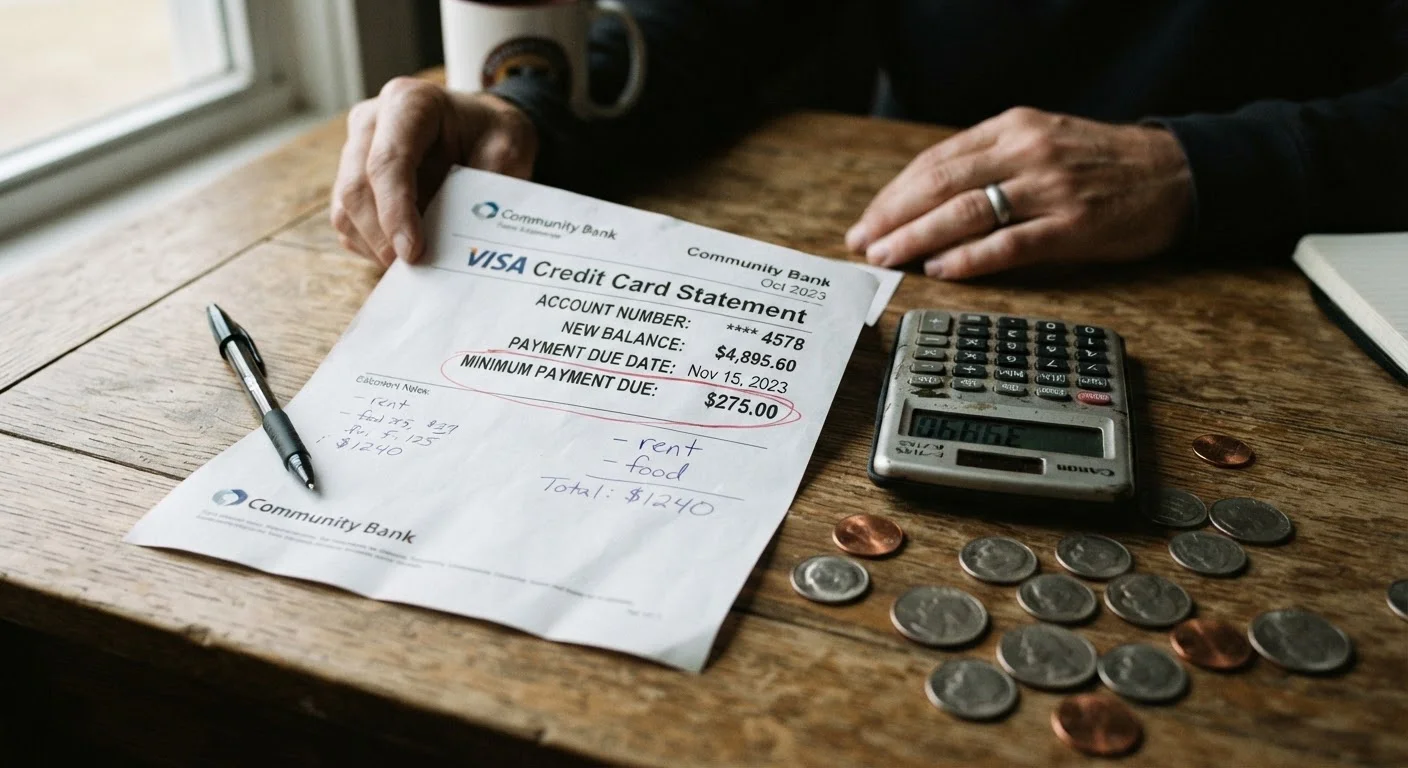
How Minimum Payments Actually Work
Credit card minimum payments are typically calculated as either a flat dollar amount (often $25–$35) or a small percentage of your outstanding balance — usually 1% to 3% — whichever is greater. At a 20% annual percentage rate (APR), a substantial portion of each minimum payment is consumed by interest charges before a single dollar touches your principal.
Here's a simplified illustration: on a $3,000 balance at 20% APR, the monthly interest charge alone is roughly $50. If your minimum payment is $60, only $10 reduces what you actually owe. That's not a typo. The balance shrinks by ten dollars while you hand over sixty.
20%+
Average credit card APR in the U.S.
The Federal Reserve has reported average credit card interest rates above 20% in recent years, one of the highest levels in decades.
10+ years
Estimated payoff time at minimums only
Consumer Financial Protection Bureau data illustrates that a typical $3,000 balance at high APR, paid at minimums alone, can take well over a decade to eliminate.
~$1,000+
Extra interest on a $3,000 balance
Depending on the rate, minimum-only payers on a $3,000 balance can end up paying more than the original amount again in interest charges alone.
Over time, as the balance slowly decreases, so does the minimum payment — which means the payoff timeline stretches further. This structure is mathematically efficient for the lender and costly for the cardholder.
This article provides general financial information for educational purposes only and does not constitute personalized financial advice. Consult a qualified financial professional for guidance specific to your situation.
Common Mistakes That Keep You Stuck
Understanding the math is step one. But most people don't stay in minimum-payment mode because they lack information — they stay there because of specific, avoidable habits and misconceptions. Below are the five most common mistakes cardholders make, and what to do instead.
Treating the minimum payment as a normal monthly bill rather than the bare legal threshold.
Why it happens: Card statements make the minimum amount visually prominent, and paying it feels like fulfilling the obligation. It prevents a late fee, so it reads as 'done.'
Continuing to spend on a card while carrying a balance and making minimum payments.
Why it happens: People often view available credit as a safety net for everyday purchases, unaware that new charges compound on top of an already-growing balance.
Misunderstanding how compound interest turns a modest balance into a long-term liability.
Why it happens: Most people think of interest as a flat monthly fee rather than a percentage recalculated on a daily or monthly basis against the outstanding balance.
Focusing only on the monthly payment amount rather than the total cost of carrying the debt.
Why it happens: A minimum payment of $45 feels affordable in isolation. The total interest paid over years of minimums — often exceeding the original balance — is never front of mind. This same 'monthly payment tunnel vision' shows up in other financial decisions too, as outlined in financing vs. leasing comparisons.
Ignoring small recurring charges that prevent the balance from ever actually dropping.
Why it happens: Subscriptions, convenience fees, and impulse purchases can collectively add more to a balance each month than the minimum payment removes. The net effect: balances drift upward despite regular payments.
Minimum Payments Are Not a Debt Strategy
Credit card minimum payments are designed to keep your account in good standing — not to help you become debt-free. Relying on minimums as a long-term approach means you will pay far more in interest than the original balance. Treat the minimum as a floor, not a target.
A Practical Path Forward
You don't need to pay off your entire balance at once to make meaningful progress. The goal is to consistently pay more than the minimum — and to stop adding to the balance while you do it.
A straightforward starting point: round your minimum payment up to the nearest $50 or $100. If the minimum is $45, pay $100. That difference compounds in your favor over time, reducing both the principal and the interest charged next month.
Missing the Real Cost on Your Statement
Federal law requires credit card issuers to print a 'Minimum Payment Warning' box on every statement, showing how long payoff takes and the total interest if you only pay the minimum. Many cardholders skip right past it. That box contains genuinely useful numbers — take 30 seconds to read it before paying.
If you carry balances on multiple cards, consider the avalanche method — directing extra payments to the highest-APR card first while paying minimums on the rest. This minimizes total interest paid. Alternatively, the snowball method — paying off the smallest balance first — can provide momentum if motivation is the bigger challenge.
What matters most is consistency. Small, sustained increases in monthly payments beat irregular large payments over time. Build the habit, automate what you can, and revisit the plan every few months as balances change.
The content on this site is for informational purposes only and is not a substitute for professional advice. Always consult a qualified professional for guidance specific to your situation.