

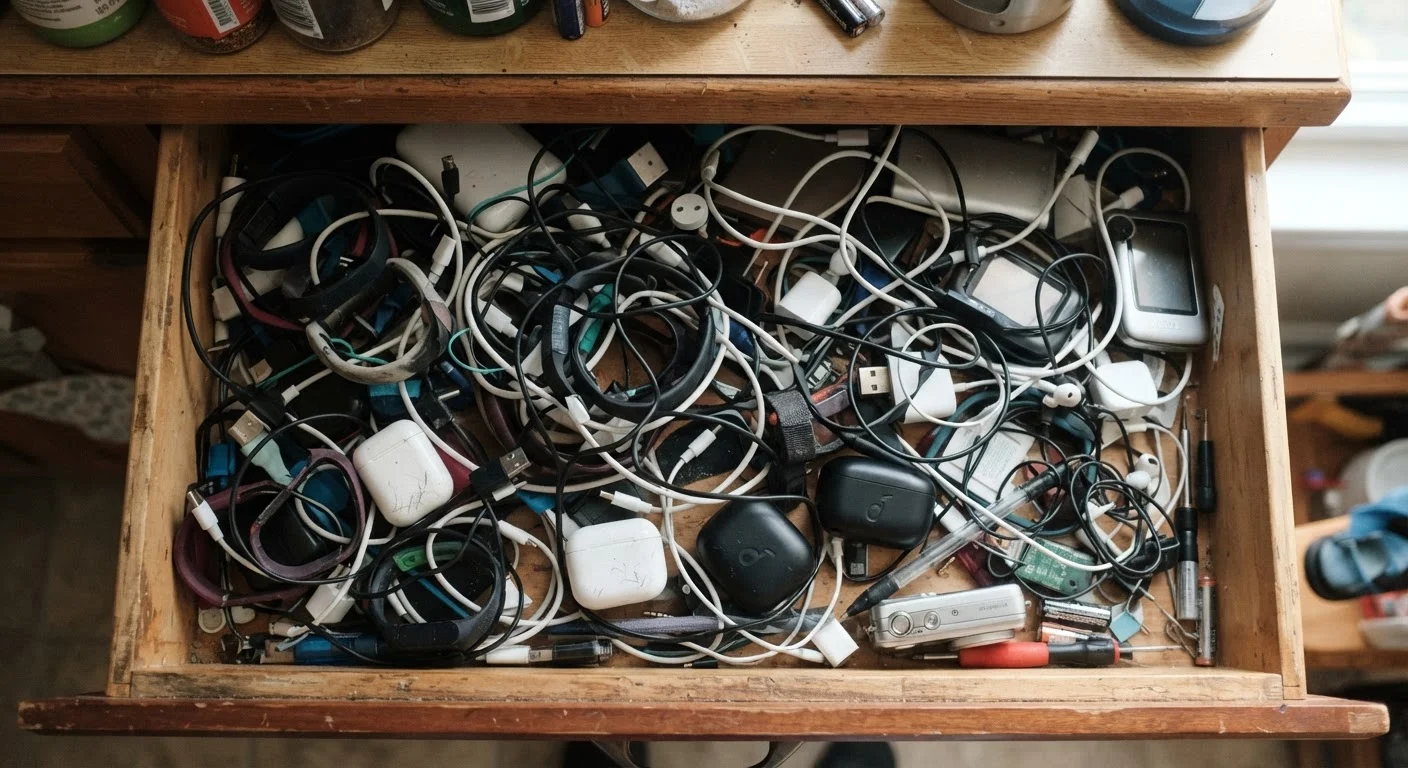
Why the Drawer Exists at All
Open almost any household's junk drawer, spare closet, or garage shelf and you'll find them: a wireless speaker that never got paired, a fitness tracker still in its box, a smart plug with no assigned outlet. These aren't broken items. They're abandoned ones.
The gadget drawer isn't a sign of carelessness. It's the predictable output of a purchasing environment designed to generate excitement. Consumer electronics marketing is exceptionally good at creating a felt need — a sense that a device will meaningfully change daily life. The experience of buying often delivers on that promise emotionally. The experience of using, over weeks and months, frequently does not.
Understanding why this happens is useful not as a source of guilt, but as a diagnostic. The pattern reveals something specific about how purchase decisions get made — and how they can be made differently. For a structured way to pressure-test future purchases, the pre-purchase thinking checklist is a practical starting point.
53.6M
Metric tons of e-waste generated globally in one year
The UN Environment Programme's Global E-waste Monitor documented this figure, describing e-waste as the world's fastest-growing solid waste stream.
17.4%
Share of e-waste formally collected and recycled
According to the same UN report, the vast majority of discarded electronics — including unused consumer gadgets — are not processed through certified recycling channels.
The Gap Between Imagined and Actual Use
The core mechanism behind gadget abandonment is what might be called the aspiration-to-habit gap. When evaluating a purchase, most people imagine an idealized version of themselves using it — exercising consistently, cooking elaborate meals, tracking sleep meticulously. That imagined person is real enough to feel compelling in the moment of decision.
The actual person who comes home after a long day is different. They have existing routines, limited attention, and a finite tolerance for friction. If a gadget requires new behavior rather than slotting into existing behavior, the odds of sustained use drop sharply.
Friction is a particularly underappreciated factor. Devices that require app setup, account creation, firmware updates, or daily charging before they're useful face compounding adoption barriers. Each step that delays the payoff is a point where the habit can fail to form.
What Gadget Accumulation Actually Costs
The obvious cost is financial: a $60 air quality monitor that never leaves its box represents $60 spent without return. But the full ledger is wider than that.
There's an environmental dimension. Electronics manufacturing is resource-intensive, involving rare minerals, water, and significant energy. A device that is used for years amortizes that embedded cost. One that sits in a drawer does not — and when eventually discarded, it contributes to the e-waste stream, which is now the fastest-growing category of solid waste worldwide according to the UN Environment Programme.
There's also a cognitive cost. Accumulated unused items create low-grade decision fatigue and visual clutter. Each abandoned gadget is a small, persistent reminder of a purchase decision that didn't pan out. Over time, that background noise compounds.
Finally, there's a spatial cost that is easy to underestimate. Storage is finite. Devices that aren't used take up room that functional items could occupy.
E-Waste Recycling Options Vary by Location
Many municipalities offer curbside or drop-off e-waste collection events. Major electronics retailers often accept certain devices for recycling regardless of where they were purchased. Check your local government's website or the manufacturer's take-back program for options specific to your area.
How to Evaluate Whether a Gadget Will Actually Stick
The most reliable signal of whether a device will get used isn't how impressive its features are — it's whether it maps onto something you already do. A gadget that enhances an existing habit is far more likely to integrate than one that requires you to build an entirely new routine around it.
A few questions worth asking before purchasing:
- What specific friction does this remove from my current routine? If you can't name it concretely, the device may be solving a perceived problem rather than a real one.
- How many steps does it take to use it on an average day? Low-friction devices — ones that work immediately or integrate invisibly — have meaningfully higher adoption rates.
- Do I know someone who uses this regularly? Real-world evidence from people with similar lifestyles is more reliable than marketing copy or review scores.
It's also worth distinguishing between gadgets that genuinely solve everyday problems and those that have compelling marketing but limited practical utility. That distinction is explored in more depth in our piece on gadgets that genuinely solve everyday problems.
Try Before You Commit Long-Term
If a retailer offers a return window, treat the first two weeks of ownership as a real-world trial. Track whether you actually reach for the device daily. If usage trails off before the return window closes, that's meaningful data — not a willpower failure.
Dealing With What's Already in the Drawer
For gadgets already accumulating, a practical audit can help. Sort by three categories: devices you use regularly, devices you could realistically start using, and devices you have no credible plan to use.
The third category is the most actionable. Functional devices can be donated, resold, or passed to someone with an actual use case. Many municipalities and electronics retailers offer e-waste recycling for items that have no resale value. Putting electronics in general household waste is generally inadvisable — most contain materials regulated as hazardous in landfill contexts.
For devices in the middle category — ones you intend to use — the honest question is whether that intention is realistic or aspirational. If a device has sat unused for more than a few months, the conditions that would have made it useful probably aren't going to materialize on their own.
For the devices you do keep and use regularly, habits that extend their lifespan are worth cultivating. The way you charge, store, and update devices has a measurable impact on longevity — see our guide on keeping gadgets longer for specifics. More broadly, the smart shopping hub covers practical strategies for avoiding common consumer pitfalls across electronics and beyond.
Frequently Asked Questions
Marketing often frames gadgets as solutions to vague aspirations — being more productive, healthier, or organized. Buyers imagine an idealized version of their future behavior, then find the device doesn't fit their real routine. The purchase feels justified in the store but not in daily life.
Electronics contain materials that require energy-intensive mining and manufacturing. Devices that sit unused represent that embedded cost with zero return. When eventually discarded, they contribute to e-waste, which is the fastest-growing solid waste stream globally according to UN Environment Programme data.
Ask whether you already have a habit the gadget would slot into, or whether it requires you to build an entirely new one. Devices that enhance existing behavior tend to stick; those that demand new routines often don't. Consider also whether setup and daily use are genuinely low-friction.
Often, yes — particularly for devices that are well-integrated into your routine. A gadget you actually use daily is worth maintaining. For guidance on that decision, see our article on <a href="/tech-shopping/electronics-basics/electronics-youve-owned-for-years-understanding-when-repair-makes-sense">when repair makes sense</a>.
Options include donating to local organizations, participating in certified e-waste recycling programs, or passing devices to someone with a genuine use for them. Selling is also viable for functional devices. Avoid putting electronics in general household trash due to hazardous materials.
The content on this site is for informational purposes only and is not a substitute for professional advice. Always consult a qualified professional for guidance specific to your situation.