

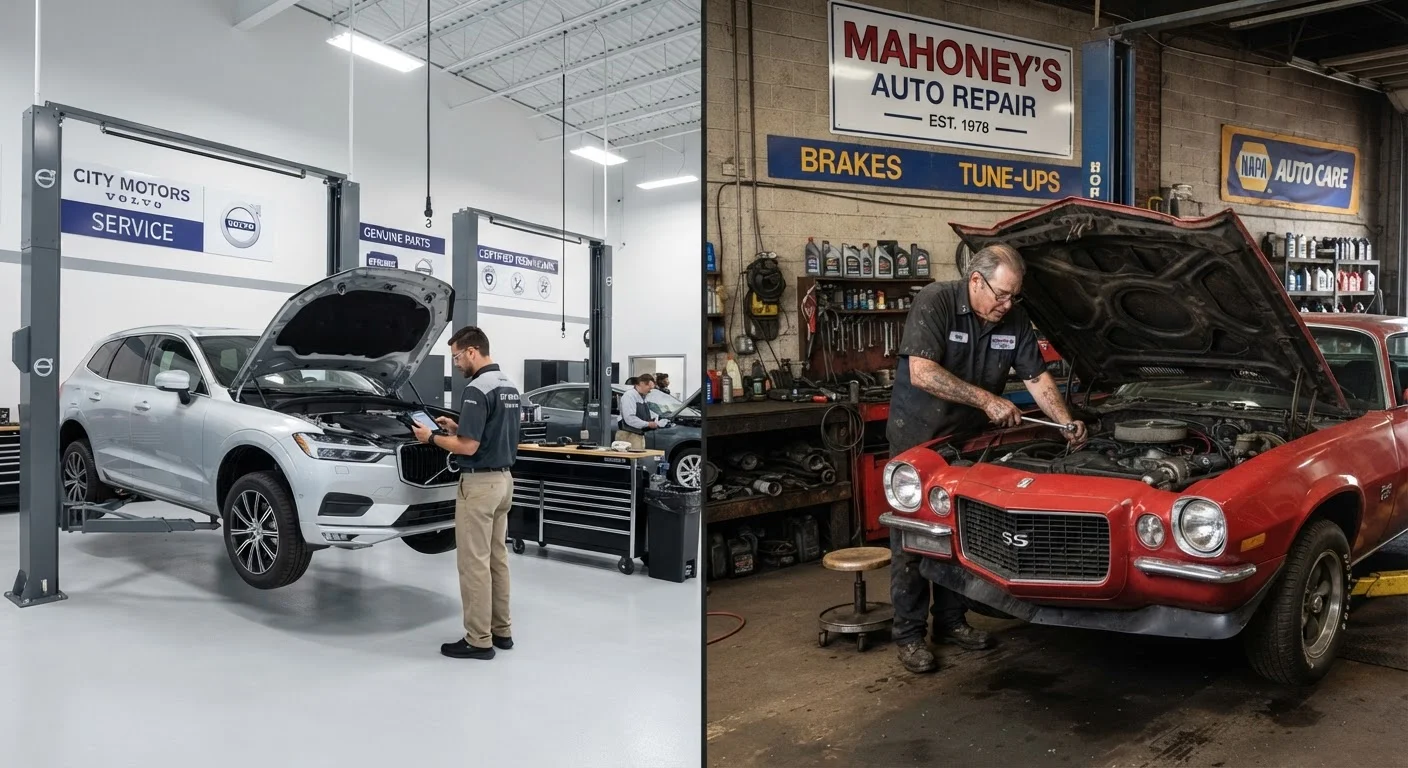
Option A
Dealership Service Center
The brand-aligned, warranty-backed option.
Best for: Owners of newer vehicles under manufacturer warranty or those needing brand-specific technical expertise and OEM parts.
Option B
Independent Mechanic
The flexible, often lower-cost community alternative.
Best for: Owners of older or out-of-warranty vehicles looking for personalized service and competitive pricing on routine and complex repairs.
What Sets These Two Service Options Apart
When your car needs maintenance or repairs, you essentially have two mainstream paths: return to a franchised dealership service center tied to your vehicle's brand, or visit an independent mechanic operating outside the manufacturer network. On the surface, both fix cars - but their structures, pricing models, and areas of expertise differ in ways that genuinely affect your decision.
Dealership service centers employ technicians who receive ongoing, brand-specific training directly from the manufacturer. They use original equipment manufacturer (OEM) parts - the same components your car shipped with - and have access to proprietary diagnostic tools and technical service bulletins. That infrastructure comes at a price: dealership labor rates are consistently higher than the independent shop average, and upsells on services you may not need are a documented consumer concern.
Independent mechanics run the spectrum from sole-operator garages to multi-bay shops with multiple certified technicians. Many hold ASE (Automotive Service Excellence) certifications and have decades of hands-on experience across multiple makes and models. They can source both OEM and aftermarket parts, often passing savings along to the customer. The trade-off is variability - the quality of independent shops varies far more than dealerships, making due diligence on your part essential.
| Criterion | Dealership Service Center | Independent Mechanic |
|---|---|---|
| Technician training | Brand-specific, manufacturer-certified | ASE-certified or trade-trained, multi-brand |
| Parts used | OEM parts standard | OEM or quality aftermarket, your choice |
| Labor cost | Generally higher | Generally lower |
| Diagnostic tools | Proprietary, brand-specific software | Universal tools; may lack some OEM-only features |
| Warranty claim processing | Yes - handles directly with manufacturer | No - cannot process manufacturer warranties |
| Recall repairs | Yes, at no cost to you | Not eligible to perform recall work |
| Accountability structure | Formal escalation via franchise/manufacturer | Reputation-based; varies by shop |
| Personalized service | Varies; often higher staff turnover | Often stronger; same technician over time |
The Warranty Question - What the Law Actually Says
One of the most persistent myths in auto maintenance is that servicing your vehicle outside the dealership voids the factory warranty. In the United States, the Magnuson-Moss Warranty Act generally prohibits manufacturers from voiding a warranty simply because you used an independent shop or non-OEM parts - unless the manufacturer can demonstrate that the independent service directly caused the problem in question.
Know Your Rights Under Federal Warranty Law
The Magnuson-Moss Warranty Act (15 U.S.C. § 2302) restricts manufacturers from conditioning warranty coverage on the use of specific service providers or branded parts - unless those parts or services are provided free of charge. This means taking your car to an independent shop for routine maintenance should not, by itself, void your factory warranty. That said, warranty terms for dealer-sold extended service contracts may differ from the original factory warranty, so always read those documents carefully.
This matters practically: routine oil changes, brake pad replacements, and tire rotations performed by a qualified independent mechanic should not jeopardize your powertrain or bumper-to-bumper coverage. However, it is worth reviewing your specific warranty documentation, since some extended warranties and service contracts - especially dealer-sold add-ons - may carry their own maintenance requirements. When in doubt, keep detailed records of every service performed, regardless of where you go. Receipts and service logs are your proof of compliance.
For recalls and technical service bulletins (TSBs), the dealership is generally the only place to have the work performed and documented at no cost to you. Independent shops cannot process recall repairs on the manufacturer's behalf.
Cost, Accountability, and Choosing Wisely
Labor rates at dealerships typically run higher than independent shops - often meaningfully so for the same job. Parts costs can also differ: OEM parts carry a premium, while quality aftermarket parts from reputable suppliers can perform equivalently for many repairs at a lower price point. If cost is a significant factor, an independent shop is often the more economical choice for out-of-warranty vehicles.
Accountability works differently in each setting. Dealerships operate within a franchise structure with formal service escalation paths, manufacturer oversight, and documented service histories tied to your VIN. If something goes wrong, there is a clear chain of responsibility. Independent mechanics, by contrast, build accountability through reputation - word of mouth, community trust, and online reviews carry significant weight. A long-established independent shop with consistent reviews is often just as accountable in practice, but you carry more responsibility for vetting them upfront.
Before choosing, consider asking any shop - dealership or independent - these questions: Are your technicians ASE-certified? Do you provide a written estimate before starting work? What warranty do you offer on parts and labor? Will you return replaced parts on request?
For more context on when professional service is essential versus when simpler tasks can be handled at home, see our guide on DIY car repair limits. And if you're in the market for a vehicle and weighing where to buy, our overview of private seller vs. dealership trade-offs covers that related decision in depth.
~33%
Average labor rate difference: dealership vs. independent
Industry surveys from organizations such as AAA have consistently found independent shops charge meaningfully less per labor hour than dealership service departments, though figures vary by region and vehicle type.
70%+
U.S. auto repair market served by independent shops
According to the Auto Care Association, independent repair facilities account for the majority of automotive service and repair business in the United States.
This article is for general informational purposes only and does not constitute professional automotive, legal, or financial advice. Warranty terms vary by manufacturer and contract - review your specific documentation and consult a qualified professional for guidance on your situation.
The content on this site is for informational purposes only and is not a substitute for professional advice. Always consult a qualified professional for guidance specific to your situation.