

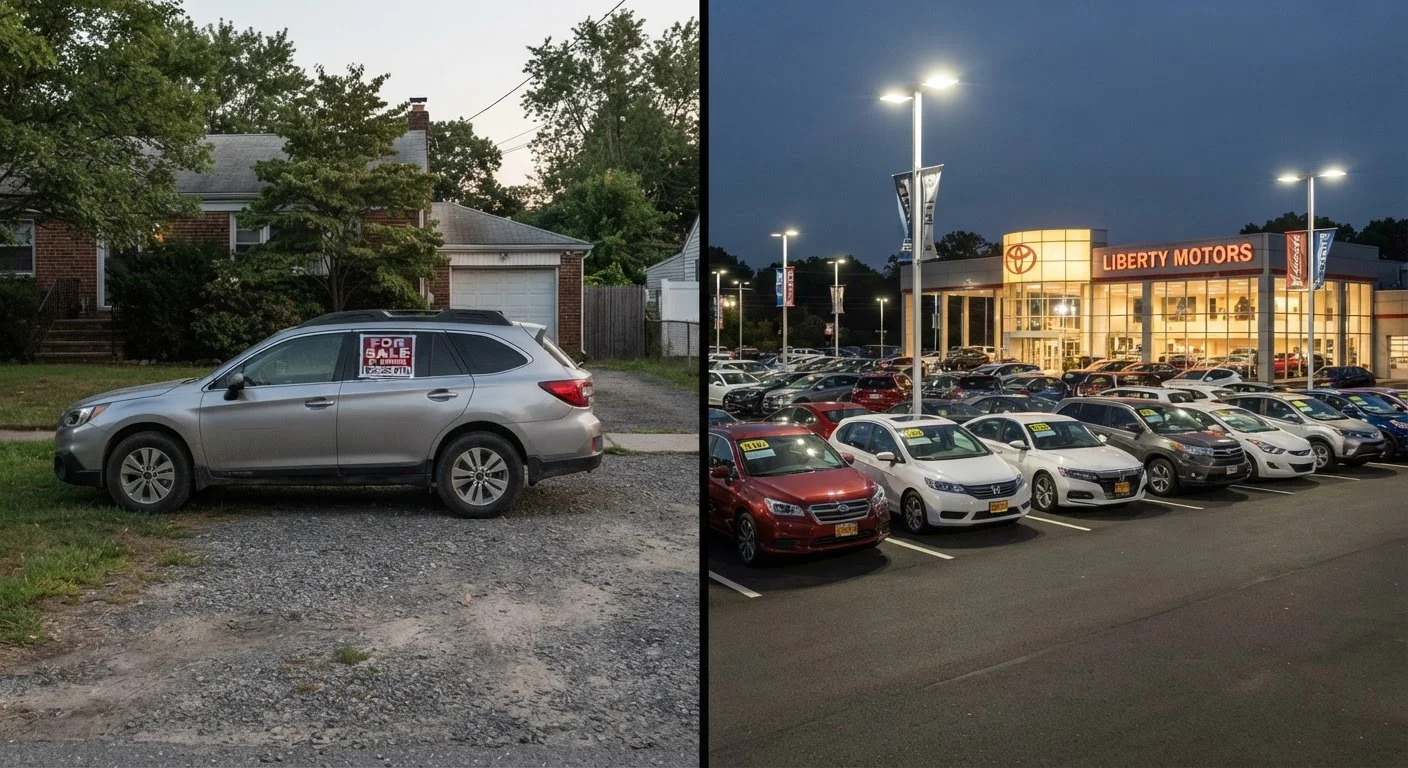
Option A
Private Seller
The lower-cost, higher-risk route.
Best for: Buyers who are comfortable doing their own due diligence, have mechanical knowledge or access to a trusted mechanic, and want to avoid markup.
Option B
Dealership
The structured, consumer-protected option.
Best for: Buyers who want financing convenience, title handling, and some layer of accountability built into the transaction.
What the Price Difference Actually Reflects
Private sellers usually price vehicles lower than dealerships for a straightforward reason: they carry none of the overhead. No sales staff, no reconditioning lot, no documentation department. That savings can be real - sometimes several thousand dollars on a comparable vehicle - but it comes without any of the services a dealer bundles in.
Dealerships price higher partly to cover costs and partly because they can offer things private sellers cannot: on-site financing, limited warranties, and administrative processing. The documentation fee (often called a "doc fee") alone can range from under $100 to over $800 depending on the state, and it's largely non-negotiable. Add lot fees, dealer prep, and optional add-ons, and the sticker price is rarely the final price.
Understanding what's in that markup helps buyers assess whether the convenience is worth the cost. For more on navigating the full buying process, see the full lifecycle of a car transaction.
| Criterion | Private Seller | Dealership |
|---|---|---|
| Typical price level | Generally lower, less overhead | Higher; includes markup and fees |
| Consumer protections | Minimal; usually sold as-is | State dealer laws apply; more recourse |
| Financing options | None; buyer arranges independently | On-site financing through lenders |
| Title and paperwork | Buyer manages transfer and DMV filing | Dealer handles title and registration |
| Vehicle history transparency | Buyer must verify independently | Reports often provided; still verify |
| Warranty coverage | None in most cases | Limited or certified pre-owned options may apply |
| Negotiation dynamic | One-on-one; flexible | Structured; fees often non-negotiable |
Consumer Protections: A Significant Gap
This is where the two routes diverge most sharply. Licensed dealerships operate under state dealer licensing laws, which impose disclosure requirements, title handling obligations, and in some states, implied warranties on used vehicles. If a dealer misrepresents a vehicle's condition or fails to disclose a known defect, there are legal avenues for recourse.
Private sellers operate under a fundamentally different standard. Most private sales are conducted "as-is," meaning the buyer accepts the vehicle in whatever condition it's in at the time of purchase. Unless the seller makes an explicit written representation that turns out to be false, the buyer has limited legal recourse after the sale closes.
Always Check the Title Before Buying Privately
Before any money changes hands in a private sale, confirm the seller's name matches the title and that no lien is listed. A lienholder has a legal claim to the vehicle until the debt is paid, and buying a car with an unresolved lien can create serious legal complications. Your state's DMV website typically offers a title status lookup by VIN.
This doesn't mean private sales are traps - most sellers are honest. But the burden of verification falls entirely on the buyer. A pre-purchase inspection by an independent mechanic is the single most important step a buyer can take. Running a vehicle history report (using the VIN) is also standard practice to flag prior accidents, title issues, or odometer discrepancies.
If you're also thinking about where to service the car after purchase, dealership service center vs. independent mechanic covers the ongoing trade-offs.
Financing, Title, and Paperwork
Dealerships handle the paperwork. Title transfer, registration, lien payoff on a trade-in, and financing documentation are all processed as part of the sale. For buyers who find that administrative side daunting, this bundling has genuine value.
Private sales require buyers to manage the title transfer themselves. That means verifying the seller holds a clean title (not salvage, rebuilt, or still carrying a lien), completing a bill of sale, and filing the appropriate transfer documents with your state's DMV. If the seller still owes money on the vehicle, the lien must be satisfied before a clean title can transfer - a process that requires coordination between the seller, the lienholder, and sometimes an escrow arrangement.
Financing is another major difference. Private sellers generally can't arrange financing; buyers need to arrive with cash or a pre-approved loan from a bank or credit union. Dealerships offer in-house financing, which is convenient but should be compared against outside offers. Understanding auto loan basics before stepping onto a lot gives buyers a clearer negotiating position. Similarly, financing through a dealer vs. arranging your own loan first is worth understanding before committing to either path.
~$400
Average dealer doc fee in the US
Documentation fees vary widely by state; some states cap them while others leave them unregulated, with fees occasionally exceeding $800.
1 in 5
Used vehicles with undisclosed prior damage
Vehicle history data providers have consistently found a significant share of used vehicles have accident or damage history not disclosed by sellers.
Making the Right Call for Your Situation
Neither route is objectively superior. The right choice depends on your financial preparedness, comfort with research, and risk tolerance. A buyer who researches pricing, orders a vehicle history report, schedules a pre-purchase inspection, and understands title procedures is well-positioned to buy privately and come out ahead financially. A buyer who needs financing, wants a cleaner paper trail, or is buying a higher-value vehicle may find the dealer's structure worth the cost.
It's also worth separating the buying decision from the selling side. If you're selling a current vehicle alongside buying a new one, trading in vs. selling privately involves its own distinct trade-offs on the seller's side of the equation.
Whatever route you take, go in with clear information - on the vehicle's market value, its history, and the full cost of the transaction including taxes, fees, and financing. That preparation, more than the channel itself, determines how well the deal goes.
This article is for general informational purposes only and does not constitute legal, financial, or professional advice. Consult a licensed professional for guidance specific to your situation.
The content on this site is for informational purposes only and is not a substitute for professional advice. Always consult a qualified professional for guidance specific to your situation.