

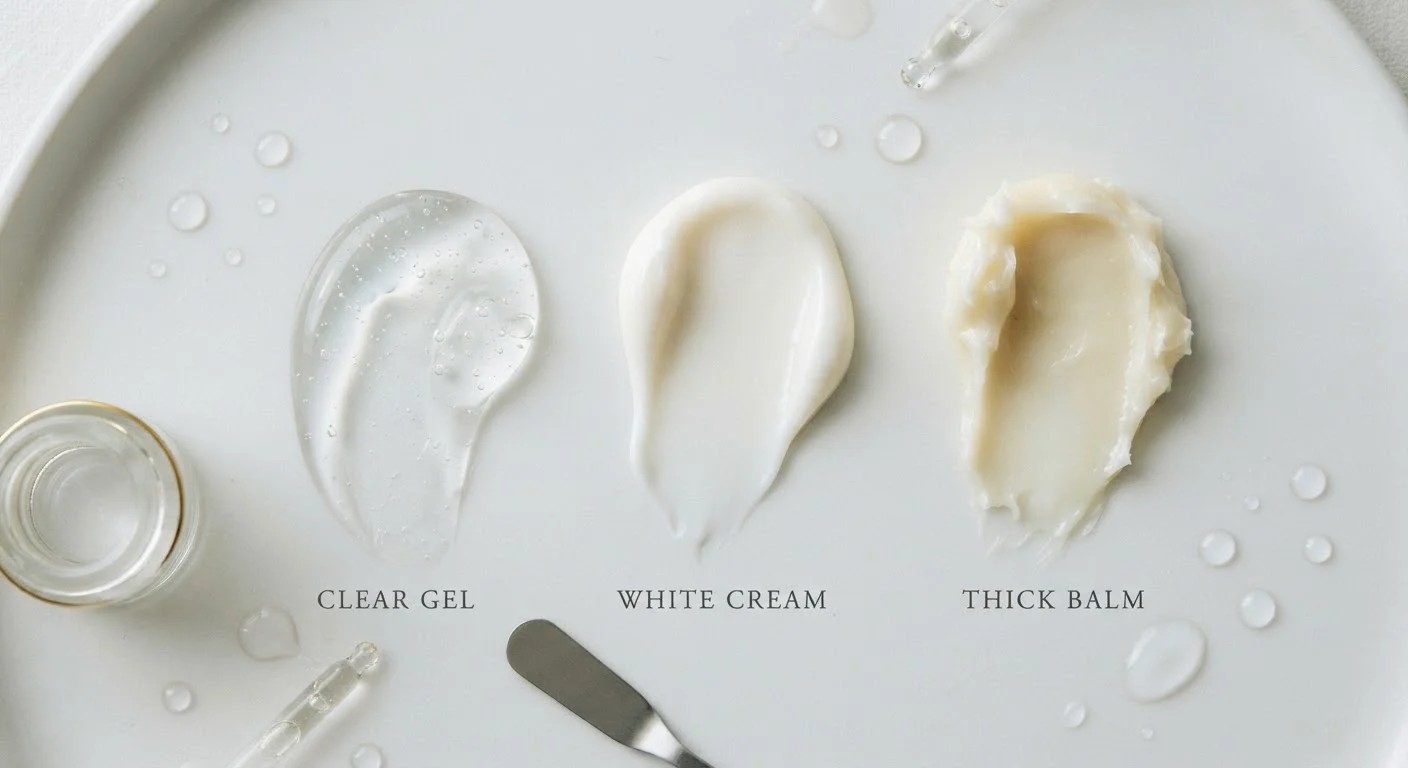
The Three-Part Framework Behind Every Moisturizer
Walk down any skincare aisle and the sheer number of moisturizer options can feel overwhelming. Lightweight gels, rich creams, overnight balms - they all promise hydration, but through very different means. Breaking down what's actually happening at the ingredient level makes those choices considerably clearer.
Dermatologists and cosmetic scientists organize moisturizing ingredients into three functional categories: humectants, emollients, and occlusives. Each addresses a different aspect of skin hydration, and understanding how they work lets you read labels with purpose rather than guesswork. This knowledge also informs how you layer your skincare products for the best results.
3
Core moisturizing ingredient categories
Cosmetic science classifies all moisturizing ingredients as humectants, emollients, or occlusives - most effective products combine two or more.
10-30%
Water content needed in the stratum corneum
Dermatological research identifies this range as the threshold for skin to remain flexible and maintain healthy barrier function.
98%
Of moisturizers contain glycerin
Glycerin is cited in cosmetic formulation literature as the most widely used humectant ingredient across all moisturizer categories.
Humectants: The Water Magnets
Humectants are ingredients that attract water and bind it to the skin. They work by forming hydrogen bonds with water molecules, pulling hydration either from the environment or from the deeper layers of the skin. The result is a measurable increase in the water content of the stratum corneum - the skin's outermost layer.
Common humectants include glycerin, hyaluronic acid, urea (at lower concentrations), aloe vera, and panthenol. Glycerin is one of the most researched and widely used; it has a strong safety and efficacy record across many skin types.
Apply Humectants to Slightly Damp Skin
To get the most out of humectant-rich products, apply them while your skin is still slightly damp after cleansing. This gives the humectant surface water to work with immediately, reducing any tendency to draw from deeper layers. Follow with an emollient or occlusive to lock in what you've just added.
One important nuance: in very dry, low-humidity environments, humectants may draw moisture upward from deeper skin layers if atmospheric water is scarce. This is why humectant-only formulas can occasionally leave skin feeling drier outdoors in winter. Pairing them with an emollient or occlusive mitigates this effect.
Emollients: The Texture Smoothers
Emollients work differently. Rather than adding water, they fill in the microscopic crevices between skin cells - particularly in the stratum corneum - creating a smoother, softer surface. Think of them as the ingredient category responsible for that immediate silky feel after applying a lotion.
Emollients include a wide range of ingredient types: plant oils (jojoba, squalane, rosehip), fatty acids, fatty alcohols (cetyl alcohol, stearyl alcohol), shea butter, and esters like isopropyl myristate. Their texture varies considerably - light esters feel dry and non-greasy, while plant butters are richer and more occlusive in their own right.
For readers building a body care routine, understanding emollients is just as relevant as skincare. Our guide to body care ingredients worth understanding covers how these same categories show up in lotions and washes.
Occlusives: The Sealants
Occlusives form a physical barrier on the skin's surface that slows transepidermal water loss (TEWL) - the passive evaporation of moisture through the skin. They don't add hydration on their own; they hold it in by creating a semi-permeable film.
Classic occlusives include petrolatum (one of the most effective available), beeswax, lanolin, dimethicone (a silicone), and mineral oil. Petrolatum in particular has a long history of use in dermatology as a barrier repair ingredient. Dimethicone is popular in lightweight formulas because it provides occlusion without a heavy feel.
“The skin barrier is not just a passive wall - it is an active, dynamic structure. Ingredients that support it work best when they address both hydration and sealing, because water in the skin without a barrier to retain it is quickly lost.”
— Dr. Albert Kligman, Dermatologist and pioneering skin barrier researcher
Occlusives are especially valuable for people with compromised skin barriers - conditions like eczema or very dry, cracked skin - because reducing water loss gives the barrier time to repair. They are best applied as the final step in a routine, layered over humectants and emollients to lock in the hydration those ingredients have delivered.
This article is for general informational purposes only and is not a substitute for professional dermatological advice. If you have a skin condition or persistent skin concerns, consult a qualified dermatologist.
Frequently Asked Questions
A humectant attracts and binds water molecules to the skin, boosting hydration levels. An emollient fills in the microscopic gaps between skin cells to create a smoother, softer surface. They work at different levels and are most effective when used together.
Yes, with care. Lighter occlusives like dimethicone are generally well-tolerated by oilier skin types. Heavy waxes and petrolatum may feel too occlusive for some people. It's worth patch-testing and observing how your skin responds rather than avoiding the category entirely.
Hyaluronic acid is a humectant. It is a naturally occurring polysaccharide that can hold a significant amount of water relative to its weight, making it a popular hydrating ingredient in serums and moisturizers.
Applying moisturizer to slightly damp skin is generally recommended because humectants are more effective when there is surface water available to bind. Pat skin mostly dry after cleansing and apply your moisturizer while a little moisture remains on the surface.
Not necessarily. A well-formulated moisturizer with humectants, emollients, and occlusives can be sufficient on its own. Serums are useful if you want a higher concentration of a specific active ingredient, but they are not required for basic, effective hydration.
Tightness after moisturizing can signal that your product is primarily a humectant without enough emollient or occlusive support, or that your skin barrier is compromised. In dry or cold climates, humectants may draw moisture from deeper skin layers rather than the air. Adding a richer cream or a thin occlusive on top may help.
The content on this site is for informational purposes only and is not a substitute for professional advice. Always consult a qualified professional for guidance specific to your situation.