

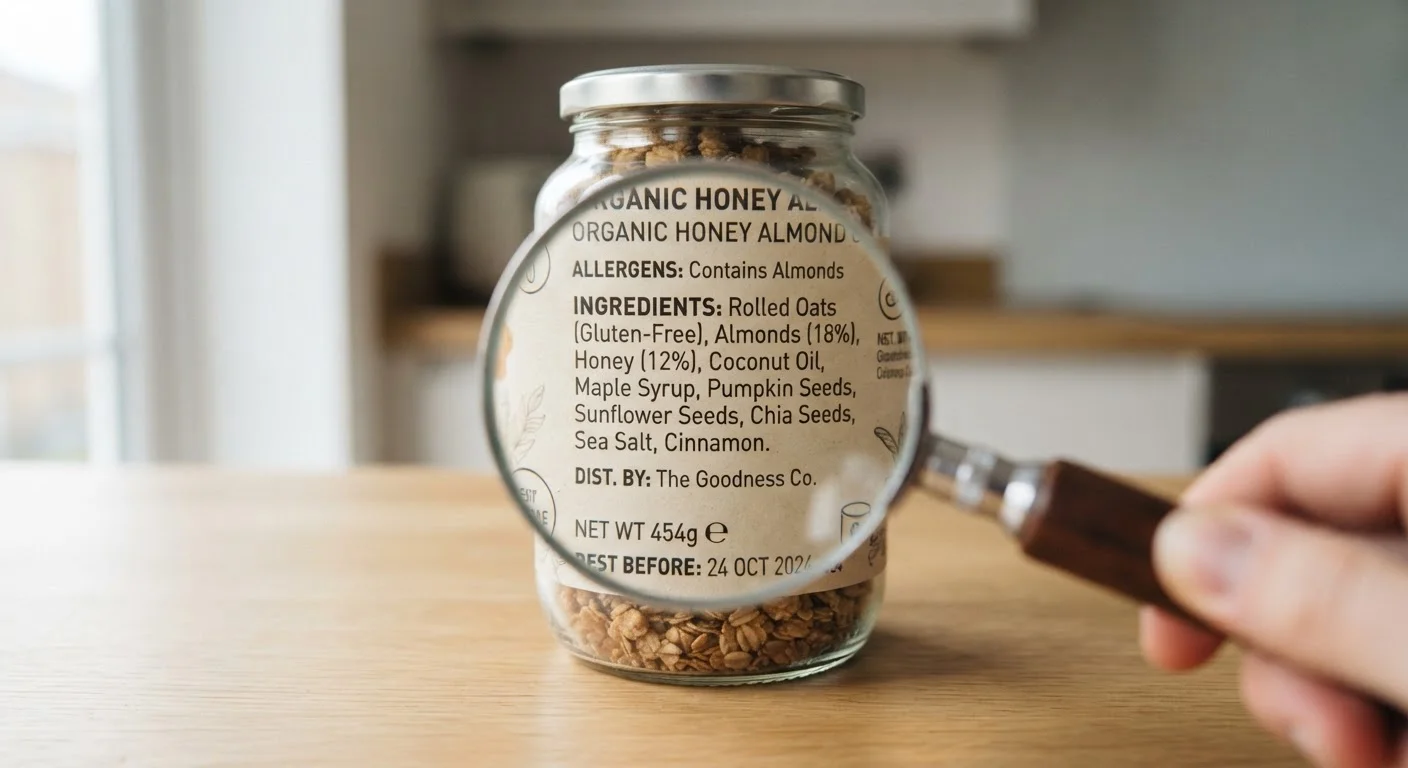
Why Added Sugar Is Hard to Spot
Food manufacturers use dozens of different sugar-derived ingredients to sweeten products, improve texture, extend shelf life, or enhance color. Because ingredient lists name each one separately, a product can contain several forms of added sugar that individually appear far down the list - even if sugar is effectively a primary ingredient by total weight.
The U.S. Food and Drug Administration (FDA) now requires a dedicated "Added Sugars" line on the Nutrition Facts panel, expressed in grams and as a percentage of the Daily Value. That number is your single most reliable tool. But understanding ingredient-list language helps you evaluate products at a glance, compare options quickly, and recognize patterns across different food categories. For a broader walkthrough of the Nutrition Facts panel, see our guide to reading a Nutrition Facts label.
The Nutrition Facts Label Is Your Primary Tool
The ingredient list tells you what sugars are present, but not their combined total weight. Always cross-reference with the "Added Sugars" line on the Nutrition Facts panel for an accurate gram count. Relying on ingredient placement alone can underestimate a product's total added sugar content when multiple aliases are used.
The Main Categories of Sugar Aliases
Added sugars generally fall into a few recognizable families. Learning these patterns is more practical than memorizing individual names.
The "-ose" Endings
Many sugars are named using chemical nomenclature ending in -ose: sucrose, fructose, dextrose, maltose, glucose, galactose, and lactose are common examples. When you see any word ending in -ose in an ingredient list, it is a sugar.
Syrups
High-fructose corn syrup, corn syrup, rice syrup, malt syrup, tapioca syrup, and agave syrup are all added sugars in liquid form. The word "syrup" is a reliable flag.
"Natural" and Whole-Food-Sounding Sugars
Honey, maple syrup, molasses, coconut sugar, date sugar, raw cane sugar, turbinado, and evaporated cane juice are metabolically similar to refined white sugar. They may carry trace minerals, but they are still counted as added sugars by the FDA.
Fruit and Juice Concentrates
Apple juice concentrate, grape juice concentrate, and similar ingredients are frequently used as sweeteners. When fruit concentrate is added beyond what was naturally present in the food, it qualifies as an added sugar.
A Useful Pattern: "Natural" Doesn't Mean Unlimited
Honey, coconut sugar, and maple syrup are often marketed as healthier alternatives to refined white sugar. While they differ slightly in their micronutrient profiles, the body processes the sugars they contain in broadly similar ways. The FDA counts all of them as added sugars. Factor them into your total just as you would granulated white sugar.
Step-by-Step: How to Evaluate a Product Label
Start with the Added Sugars line on the Nutrition Facts panel
Before reading the ingredient list, check the Added Sugars row under Total Carbohydrate on the Nutrition Facts label. The gram amount and % Daily Value give you an objective measure of how much added sugar one serving contains. The FDA's Daily Value reference is 50 grams of added sugar per day for a 2,000-calorie diet - a threshold derived from dietary guidelines, not a personal prescription.
Scan the ingredient list for "-ose" words
Read through the full ingredient list and mentally flag any word ending in -ose. Each is a sugar. Note how many appear and where they fall in the list - ingredients are ordered from highest to lowest weight. If multiple sugar aliases appear in the first five ingredients, sugar is likely a major component of the product.
Look for syrup and concentrate terms
Identify any ingredient containing the word syrup or concentrate. These are nearly always added sugars. Common examples: high-fructose corn syrup, brown rice syrup, agave syrup, apple juice concentrate. Note each occurrence separately.
Count how many distinct sugar ingredients appear
Tally the total number of sugar aliases in the ingredient list. A product with five or six different sugar-related ingredients spread throughout the list may contain more added sugar than the ingredient placement alone suggests. This practice - sometimes called sugar splitting - allows manufacturers to list each form lower on the list than a single consolidated sugar ingredient would appear.
Consider the product in context
A small amount of added sugar in a food that also delivers meaningful protein, fiber, vitamins, or minerals is nutritionally different from the same amount of sugar in a product with little other nutritional value. Use the full Nutrition Facts panel - not just the sugar line - to assess overall nutrient density before drawing conclusions about whether a food fits your eating pattern.
This article provides general nutrition information and education. It is not a substitute for personalized advice from a registered dietitian or qualified healthcare professional.
The content on this site is for informational purposes only and is not a substitute for professional advice. Always consult a qualified professional for guidance specific to your situation.