

Start here
What a Budget Actually Is (and Isn't)
Next
Step 1: Know Your Take-Home Income
Then
Step 2: List and Categorize Your Expenses
Apply it
Step 3: Choose a Simple Budgeting Method
Make it stick
Step 4: Track and Adjust Every Month
Level up
Where to Go From Here
What a Budget Actually Is (and Isn't)
A budget is simply a written plan for your money — a record of how much comes in and a decision about where it goes. That's it. It is not a strict punishment, a sign that you're struggling, or something only accountants can understand.
The biggest misconception beginners carry is that budgeting means never spending on anything enjoyable. In reality, a good budget includes spending on things you enjoy — it just makes sure those choices are intentional rather than accidental. Think of it as giving every dollar a job before the month begins.
Net Income
The amount of money you actually receive after taxes and deductions are taken out of your paycheck — your real spending power.
Fixed Expense
A bill that stays the same amount every month, like rent or a loan payment, making it easy to plan for in advance.
Variable Expense
A cost that changes from month to month depending on your choices or circumstances, such as groceries or utility bills.
Irregular Expense
A cost that does not appear every month but recurs periodically — like an annual car registration fee or holiday spending — that needs to be planned for ahead of time.
Discretionary Spending
Money spent on non-essential items — things you want but do not strictly need, such as dining out or streaming subscriptions.
Zero-Based Budget
A budgeting approach where you assign a purpose to every dollar of income so that income minus planned spending equals zero — nothing is left unaccounted for.
For a broader context on where budgeting fits in your overall financial life, the Practical Starter's Roadmap to Personal Finance lays out the full picture from budgeting through to tackling debt.
Step 1: Know Your Take-Home Income
Before you can plan spending, you need to know exactly how much money actually lands in your bank account each month. This is your net income — your pay after taxes, health insurance premiums, and any other deductions are removed. It is almost always lower than the salary figure on your job offer letter.
Add up all regular income sources: wages, freelance payments, side work, benefits, or any other consistent inflows. If your income varies, use a conservative estimate — typically the lower end of what you have earned over the past three to six months. This protects you from overspending in months when earnings dip.
Use Your Actual Pay Stub, Not Your Salary
Your gross salary and your net pay can differ by hundreds of dollars per month once taxes, benefits, and retirement contributions are factored in. Always base your budget on the number that hits your bank account — not the headline figure. If your pay varies, track three months of deposits to find a reliable average.
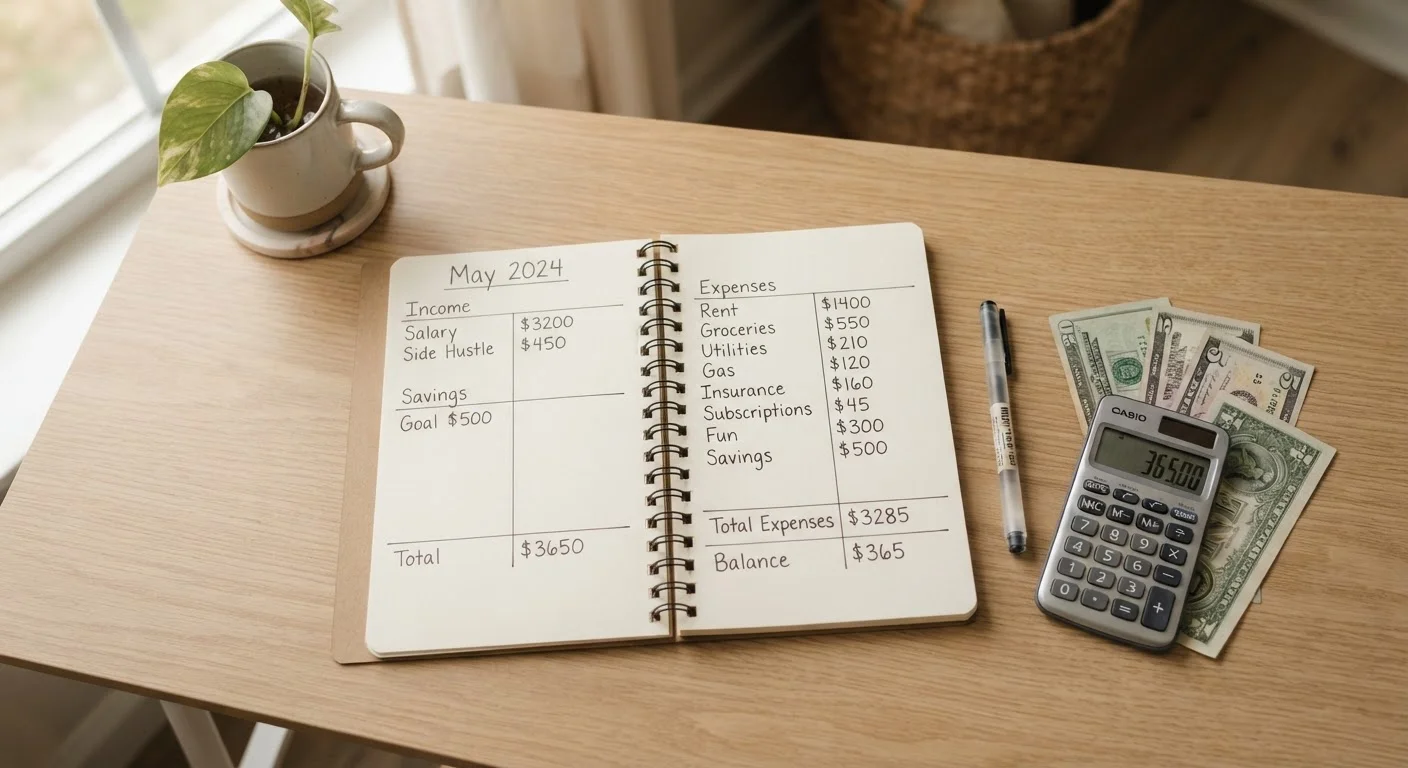
Once you have a reliable monthly income figure, write it at the top of a blank page or spreadsheet. Everything else in your budget flows from this single number.
Step 2: List and Categorize Your Expenses
Pull up two to three months of bank and credit card statements and write down every expense you see. Then sort those expenses into three groups:
- Fixed expenses — costs that are the same every month, such as rent or a car payment.
- Variable expenses — costs that change month to month, like groceries, gas, and dining out.
- Irregular expenses — costs that hit a few times a year, like car registration, annual subscriptions, or holiday gifts.
Irregular expenses are the category most beginners skip entirely — then wonder why their budget keeps falling apart. Divide those annual or semi-annual costs by 12 and set that amount aside each month so the bill never catches you off guard.
For a detailed walkthrough on building a tracker to capture all of this, see Setting Up a Monthly Spending Tracker From Scratch. And for a list of categories many first budgets miss entirely, check out Spending Categories Most Household Budgets Overlook.
Don't Skip Irregular Expenses
Car repairs, medical copays, annual insurance premiums, and holiday spending are predictably unpredictable — they will happen, even if not every month. Leaving them out of your budget is the single most common reason a budget that looks balanced on paper falls apart in practice. Set aside a small amount each month for these costs so they never arrive as a surprise.
Step 3: Choose a Simple Budgeting Method
With your income and expense categories in hand, you need a framework for deciding how to divide your money. Here are three approaches that work well for beginners:
- 50/30/20 Rule
- Allocate 50% of take-home income to needs (housing, utilities, groceries), 30% to wants (entertainment, dining out), and 20% to savings and debt repayment. It's flexible enough to adapt to most situations.
- Zero-Based Budgeting
- Assign every dollar a specific purpose until income minus expenses equals zero. This takes more effort but gives you precise control over every category.
- Pay Yourself First
- Move a set savings amount out of your account on payday before spending anything else, then budget the remainder. This method prioritizes savings without requiring willpower at month's end.
No method is universally superior. The one you will actually stick with is the right one. The Complete Household Budgeting Roadmap covers how these methods can evolve as your financial goals grow.
Step 4: Track and Adjust Every Month
Creating a budget once and never revisiting it is one of the most common beginner mistakes. Spending patterns shift, unexpected costs arise, and income can change. A monthly check-in — even 20 minutes reviewing what you spent versus what you planned — keeps the budget useful rather than decorative.
At the end of each month, compare your planned amounts to your actual spending in each category. If you consistently overspend in one area, you have two options: reduce spending there or reduce it somewhere else to compensate. Both are valid — what matters is that the adjustment is deliberate.
Your Budget Will Evolve — That's Normal
No first budget survives contact with real life perfectly intact. Life events — a raise, a move, a new expense — will require you to revisit your allocations. Treat each monthly review as a chance to refine rather than a test you can fail. A budget that gets adjusted regularly is working exactly as intended.
This article is general financial education and is not a substitute for personalized advice. For guidance tailored to your own financial situation, consider speaking with a licensed financial adviser or nonprofit credit counselor.
Where to Go From Here
A working monthly budget is a foundation, not a finish line. Once you have a few months of consistent tracking under your belt, the natural next step is building a financial cushion for unexpected expenses. The Building Your First Emergency Fund on a Tight Budget guide walks through realistic ways to start, even when money is tight.
From there, exploring the Saving & Debt hub will open up strategies for paying down debt and growing savings over time. And if any budgeting terminology felt unfamiliar along the way, the Plain-Language Glossary of Budgeting Terms is a quick-reference resource worth bookmarking.
The first budget you make will not be perfect. That is completely normal and completely fine. What matters is that you start — and that you come back to it next month.
This article is for general informational and educational purposes only and does not constitute personalized financial or investment advice. Consult a qualified financial professional before making decisions based on your individual circumstances.
Frequently Asked Questions
There is no minimum income threshold. A budget is useful at any income level because it helps you direct whatever money you have intentionally. In fact, lower incomes often benefit most from a clear spending plan.
The 50/30/20 rule is widely recommended for beginners because it only requires sorting spending into three broad buckets: needs, wants, and savings. It requires no complex spreadsheet and is easy to adjust as your situation changes.
Either works. The best tool is whichever one you will actually use consistently. Free spreadsheet templates and free budgeting apps both do the job well. Start with what feels least intimidating and switch later if needed.
Base your budget on a conservative estimate — typically your lowest recent monthly income. Cover essential fixed expenses first, then allocate what remains. In higher-earning months, direct the extra toward savings or irregular expenses.
Annual fees, irregular car maintenance, medical copays, subscriptions, and personal care costs are frequently overlooked. These can quietly derail a budget that looks balanced on paper. Our related guide covers these <a href="/money-finance/budgeting-basics/spending-categories-most-household-budgets-overlook">commonly overlooked spending categories</a> in detail.
Most people find their budget feels more natural after two to three months of consistent tracking. The first month is primarily about gathering accurate data on your real spending habits — don't judge the results too harshly.
The content on this site is for informational purposes only and is not a substitute for professional advice. Always consult a qualified professional for guidance specific to your situation.