

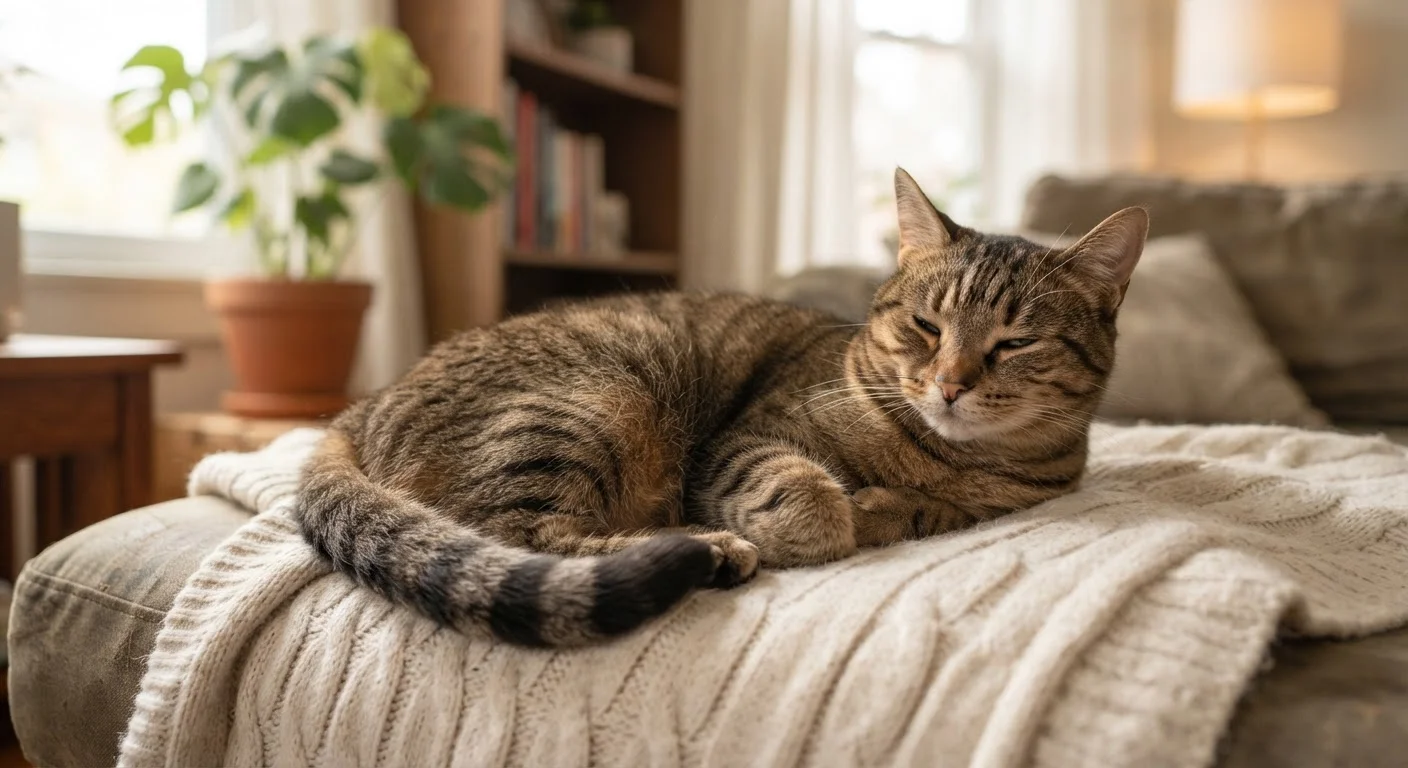
How to Read the Signals
Cats don't communicate the way people do — they rarely use a single signal in isolation. Instead, they layer cues: a tail position paired with ear angle and pupil size tells a far more accurate story than any one feature alone. This guide breaks those signals down body part by body part so you can cross-reference them in real time, wherever in the house the interaction is happening.
| Primary communication channels | Body posture, tail, ears, eyes, vocalizations, and scent |
| Slow blink meaning | Trust and relaxed contentment (Animal behavior research, University of Sussex, 2020) |
| Piloerection (puffed fur/tail) signals | Fear or agitation — cat is attempting to appear larger |
| Upright tail greeting | Friendly, confident approach — common with familiar people |
| Kneading behavior origin | Rooted in kittenhood nursing; signals comfort in adults |
| Tail lashing (rapid side-to-side) | Agitation or predatory focus — not a sign of happiness |
For a broader foundation in daily feline care, see our complete overview of everyday pet care. And if you've ever wondered whether unusual body language might signal discomfort, our article on signs your pet is in pain that are easy to miss is a useful companion read.
Eyes, Ears, and Tail: The Core Vocabulary
Three body regions carry the most expressive weight in feline communication. Learning to read them together — rather than individually — is the key to accurate interpretation.
Piloerection
The involuntary raising of fur along the back and tail, making the cat appear larger. It occurs in response to fear or intense agitation and is controlled by the autonomic nervous system.
Bunting
When a cat presses the top of its head against a person or object. It deposits scent from glands on the head and is a clear signal of affection and social bonding.
Slow blink
A deliberate, unhurried closing and reopening of the eyes directed at a person or another animal. It functions as a non-threatening social signal indicating trust and relaxation.
Kneading
A rhythmic, alternating paw-push motion against a soft surface. It originates in nursing behavior and persists into adulthood as a self-soothing comfort display.
Trilling
A short, high-pitched vocalization cats produce by passing air over a closed or partially open mouth. Commonly used as a greeting or to express anticipation.
Airplane ears
An informal term for ears that rotate outward and flatten sideways. It signals increasing discomfort, anxiety, or irritation and is an early warning before a defensive response.
Eyes
- Slow blink: A relaxed, deliberate closing and opening of the eyes. Often called a "cat kiss," it signals trust and comfort. Returning a slow blink to your cat is widely recognized by animal behaviorists as a way to reinforce a positive bond.
- Dilated pupils: Large, round pupils can indicate excitement, fear, or overstimulation — context determines which. A cat crouched low with dilated pupils is likely fearful; one mid-play session is probably just aroused.
- Constricted pupils (vertical slits): Associated with calm alertness or, in some situations, aggression. Paired with a stiff body and flattened ears, narrow pupils often signal threat.
Ears
- Forward and upright: Alert and interested. Your cat is engaged with something in the environment.
- Rotated sideways ("airplane ears"): Anxiety or mild irritation — a warning that the cat is becoming uncomfortable.
- Flat against the skull: Fear or defensive aggression. Back away and give the cat space.
Tail
- High and upright: Confidence and a friendly greeting — the feline equivalent of a wave.
- Question-mark curve at the tip: Playful and open to interaction.
- Puffed (piloerection): Fear or agitation — the cat is trying to appear larger.
- Low or tucked: Submission, anxiety, or pain. If this posture is persistent and unexplained, a veterinary check is worth scheduling.
- Rapid side-to-side lashing: Agitation or predatory focus. Not a wag — it typically means the cat wants space or is locked onto prey.
Room-by-Room Scenarios
Living Room
A cat who rolls onto their back and exposes their belly in the living room is expressing trust — but this is not necessarily an invitation to touch. Many cats will swat at a hand that reaches for the belly because the exposed posture is a vulnerability display, not a petting request. Observe the full picture: if the ears are forward and the tail is loose, brief contact may be welcome. If the tail is flicking, it isn't.
The Belly Trap: A Common Misread
A cat rolling belly-up is offering one of its most vulnerable postures — a clear sign of trust. However, many cats will react defensively if the belly is touched, because the exposed position activates protective instincts. Before reaching in, check the ears (forward is better than sideways) and the tail (still or loosely curved is better than lashing). When in doubt, let your cat initiate contact.
Kitchen
Cats who weave between your legs while you prepare food are communicating anticipation — but they also perform this same figure-eight greeting with people they haven't seen in a while. Head bunting (pressing the top of the head against you) and cheek rubbing deposit scent and are unambiguous affection signals. A cat sitting very still with a fixed stare at the counter is in predatory watch mode, regardless of whether there's actual prey nearby.
Bedroom at Night
Kneading — rhythmically pushing paws against a soft surface — is a comfort behavior rooted in kittenhood nursing. A cat who kneads your blanket before settling is displaying contentment and security. Chirping or trilling softly while watching out the window, however, indicates frustrated predatory drive: the cat sees prey it cannot reach. This is entirely normal and connects to the curiosity-driven behavior explored in our piece on why cats knock things off tables.
When Body Language Signals a Problem
Some postures cross from communication into potential health flags. A cat who consistently holds their tail low, moves with a hunched back, or sits in a loaf position with eyes half-closed and withdrawn may be experiencing discomfort rather than simply being tired. Chronic hiding, reduced grooming, or a sudden change in typical posture are all reasons to contact your veterinarian. Body language that seems out of character is often the earliest observable sign that something has changed internally.
If anxiety-related postures — repeated crouching, excessive hiding, flattened ears with no clear trigger — appear regularly, that pattern deserves professional evaluation. Our guide on anxiety in dogs and cats covers the behavioral signs and evidence-backed approaches vets use to help.
16+
Distinct ear positions cats can produce
Cats have 32 muscles controlling each ear, enabling highly precise directional and expressive movement.
~25%
Of cats show belly-up trust posture
Veterinary behaviorists note that exposing the ventral (belly) region is a significant vulnerability signal, not universally an invitation to touch.
This article is for general informational purposes only and is not a substitute for professional veterinary advice. If you have concerns about your cat's health or behavior, consult a licensed veterinarian.
The content on this site is for informational purposes only and is not a substitute for professional advice. Always consult a qualified professional for guidance specific to your situation.