

The Predatory Instinct at the Root of It
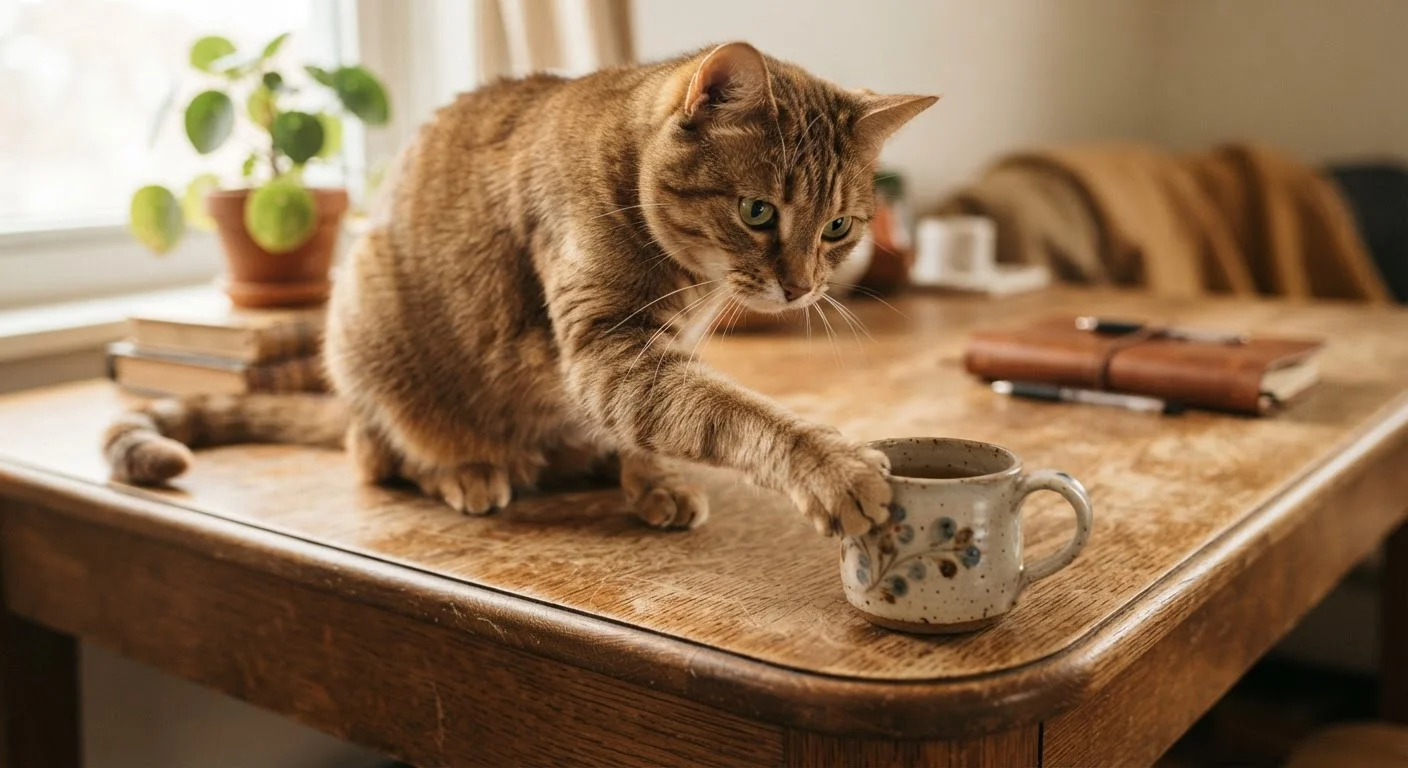
Before cats were domesticated, they were hunters. That legacy is embedded in their nervous systems. When a cat extends a paw and taps an unfamiliar object, they're performing the same action they'd use to test whether a small animal is alive — or safe to approach. A mouse that doesn't move might be dead; one that rolls away is worth chasing.
Falling objects mimic that escape movement perfectly. The moment something drops and skids across the floor, the cat's predatory attention is triggered. This explains why many cats seem more interested in what happens after the push than in the pushing itself. They're not destroying your belongings — they're running a simulation of a hunt.
This predatory basis also connects to how cats use their paws more broadly. Understanding cat body language reveals just how much information cats gather through physical contact with their environment.
~74%
U.S. households with cats reporting object-knocking behavior
Survey data from the American Pet Products Association and various feline behavior studies consistently show object displacement is among the most commonly reported cat behaviors by owners.
24+
Whisker-like vibrissae on a cat's body
Cats have vibrissae not only on their muzzle but also above the eyes and on the carpal region of their front legs, giving their paws significant tactile sensitivity during object exploration.
Sensory Exploration and the Role of Whiskers
A cat's whiskers — technically called vibrissae — are sophisticated sensory organs capable of detecting subtle changes in air currents and surface textures. They're not just on the face: cats also have carpal vibrissae on the backs of their front legs. This means that when a cat pats at an object with a paw, they're gathering rich tactile data that complements what their eyes and nose tell them.
Cats are naturally drawn to edges — physical boundaries where one surface ends and another begins. An object sitting near a table edge represents a kind of sensory invitation. The paw follows the edge, the object tips, and the sensory feedback loop is complete. This is exploratory behavior by design, not malice.
Give Your Cat a Safe Zone to Explore
Place a shallow tray or small basket on a low shelf filled with cat-safe lightweight objects — corks, crinkle balls, or small cardboard tubes. This gives your cat a sanctioned surface to investigate and push things around without involving your valuables. Refresh the items occasionally to maintain novelty.
The Attention-Seeking Layer
Here's where the science meets household reality: cats learn. If your cat has discovered that knocking your water glass off the counter reliably produces a dramatic reaction from you — movement, vocalizations, direct eye contact — they have successfully trained you. Animal behaviorists describe this as operant conditioning, where a behavior is reinforced because it reliably produces a result.
This is especially common in cats whose social or play needs aren't consistently met. A cat that doesn't have regular, structured interaction may escalate attention-seeking behaviors because intermittent reinforcement (sometimes you react, sometimes you don't) actually strengthens the behavior over time.
Building a predictable daily routine — including consistent play times — can reduce how often cats resort to environmental disruption to get your attention.
What You Can Do About It
Understanding the behavior makes managing it more effective. Because object displacement draws on instinct, you won't eliminate it entirely — and trying to do so through punishment is counterproductive. What you can do is redirect the drive toward appropriate outlets.
- Increase structured play: Two focused interactive play sessions daily (using wand toys or similar) address the predatory drive directly.
- Minimize reaction: When the behavior happens, resist the urge to scold or make a scene. Neutral non-reaction removes the attention reward.
- Offer sanctioned knock-off zones: Some cat owners place a small basket of lightweight toys at a table edge specifically for the cat — giving the behavior a harmless outlet.
- Use puzzle feeders: These engage the exploratory and hunting instincts in a controlled way that doesn't involve your belongings.
If you've noticed the behavior escalating or occurring in patterns that seem more compulsive than playful, it's worth reading about compulsive behaviors in pets to understand where the line between quirk and concern lies.
“Cats are not being naughty when they knock things over — they're being cats. The behavior makes complete sense when you understand that domestic cats retain virtually all of the sensory and motor drives of a small predator. We share our homes with hunters.”
— Mikel Delgado, Certified Cat Behavior Consultant and feline behavior researcher
Frequently Asked Questions
Cats use their paws to test objects for movement and safety, an extension of predatory investigation instinct. When something falls and bounces, it mimics prey behavior, which is inherently rewarding to a cat. They're not acting vindictively — they're following instinct.
It can be. Cats that lack sufficient mental and physical stimulation may increase exploratory behaviors like object displacement. Adding structured play sessions and puzzle feeders often reduces how frequently this happens.
Yes, in many cases this is a learned component. If a cat has discovered that batting an object off a shelf reliably brings you running, they'll repeat it. Avoiding big reactions and rewarding calmer attention-seeking helps break the cycle.
Punishment is not recommended by animal behaviorists and is generally ineffective with cats. It can damage trust and increase anxiety without changing the underlying drive. Redirection and enrichment are more productive approaches.
If the behavior is frequent, compulsive, and paired with other signs like repetitive movements or distress, it's worth a veterinary conversation. See our article on <a href="/pets-animals/pet-behavior/compulsive-behaviors-in-pets-when-habits-cross-into-something-more">compulsive behaviors in pets</a> for more guidance.
Store breakables in closed cabinets or display cases. Offer your cat designated surfaces with cat-safe objects to manipulate — textured toys, crinkle balls, or puzzle feeders placed at cat height give the same sensory payoff without the breakage risk.
The content on this site is for informational purposes only and is not a substitute for professional advice. Always consult a qualified professional for guidance specific to your situation.