

Our Verdict
There is no universal rule for how much social contact a pet needs — it depends entirely on the species' evolutionary wiring. Social animals need compatible companions and should rarely be housed alone, while solitary animals typically thrive with dedicated human interaction and enrichment rather than animal housemates. Matching your care routine to your pet's species-typical behavior is one of the highest-impact changes you can make as an owner.
| Best for | Recommended |
|---|---|
| Owners who are away from home for long hours | Social species kept in bonded pairs or groups |
| Owners with limited space or time for multiple animals | Solitary species with strong daily enrichment routines |
| Families wanting interactive, hands-on pets | Social species that bond with humans as well as conspecifics |
| Owners seeking low-conflict, simpler housing setups | Solitary species in well-enriched individual enclosures |
Why Social Wiring Matters in Pet Care
Every pet species has a behavioral baseline — a set of social needs, activity patterns, and communication styles shaped by millions of years of evolution. When captive environments match that baseline, animals are calmer, healthier, and easier to live with. When they don't, behavioral problems often follow: repetitive movements, aggression, lethargy, or constant vocalizing.
Understanding whether your pet is naturally social or solitary isn't just trivia. It directly informs housing decisions, daily schedules, and how you interpret your animal's behavior. See our complete overview of responsible pet ownership for how social needs fit into the broader picture of daily care.
| Guinea Pig | Rabbit | Dog | Syrian Hamster | Leopard Gecko | |
|---|---|---|---|---|---|
| Social category | Social (herd) | Social (pair/group) | Social (pack) | Solitary | Solitary |
| Ideal housing | Bonded pair or group | Bonded pair | Family/multi-dog OK | Single animal only | Single animal only |
| Risk of solo housing | High stress, depression | Moderate-high stress | Separation anxiety | Preferred; low risk | Preferred; low risk |
| Risk of group housing | Low if bonded | Low if bonded | Low if socialized | Fighting, injury | Competition, stress |
| Primary enrichment source | Companions + space | Companions + space | Humans + activity | Owner interaction | Habitat complexity |
Social Species: Animals That Need Company
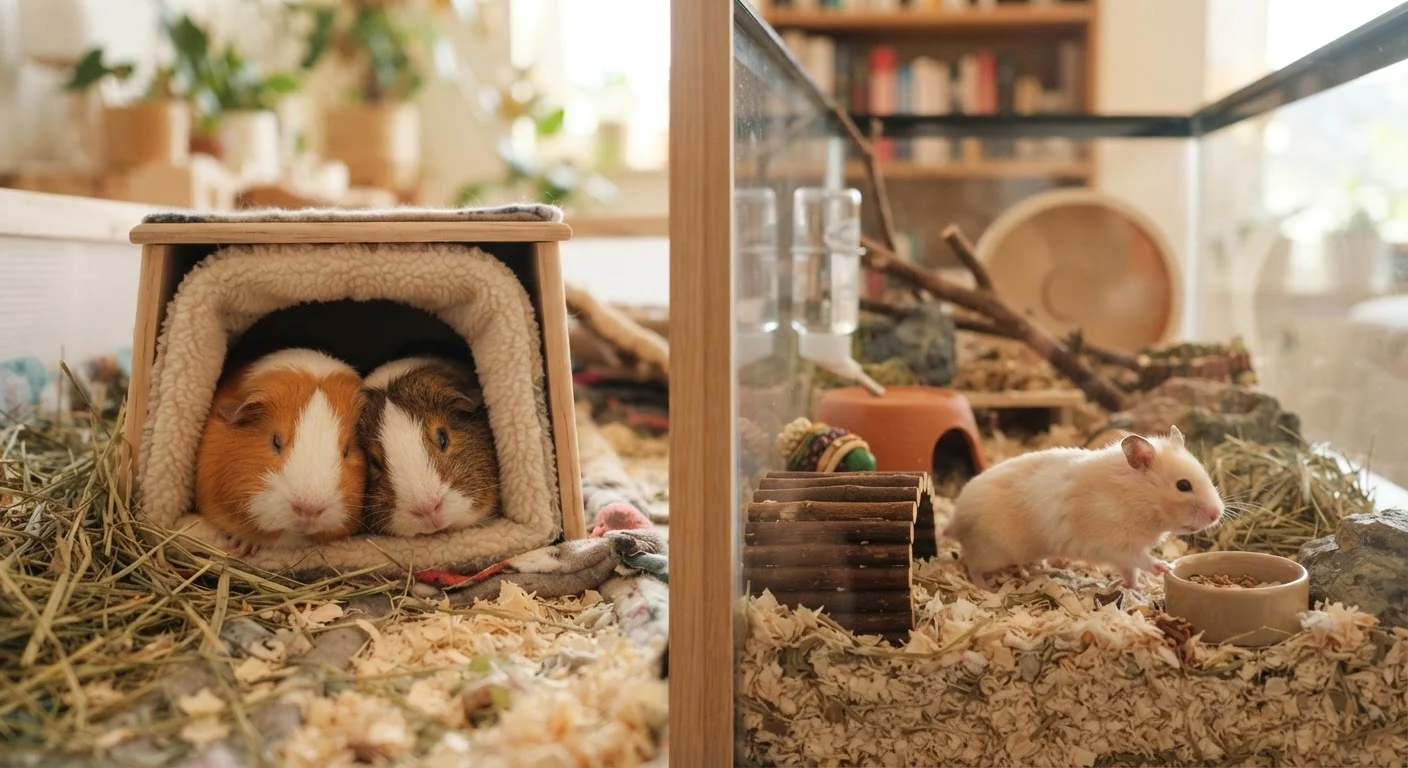
Guinea pigs are perhaps the clearest example of a social species among common small pets. In the wild, they live in herds. Alone, they can display chronic stress behaviors including teeth chattering, reluctance to eat, and reduced activity. Many European countries now legally require guinea pigs to be housed with at least one compatible companion — a reflection of how well-established this science is.
Rabbits are also social animals that benefit significantly from bonded companionship, though the bonding process requires careful introduction. Dogs are another obvious example: pack-oriented by nature, they rely on social bonds — whether with humans or other dogs — to feel secure. Extended isolation is a well-documented trigger for separation anxiety and destructive behavior in dogs.
Introducing a New Companion Animal
Never place a new animal directly into an established pet's space. Neutral territory introductions, gradual scent-swapping, and supervised initial meetings reduce territorial conflict significantly. For guinea pigs and rabbits especially, a quarantine period for the new animal is also advisable to protect the existing pet from any illness. Your vet can advise on species-appropriate introduction protocols.
For social species, the quality of companionship matters. A poorly matched pair can be more stressful than no companion at all. Same-sex pairs, spayed or neutered animals, and gradual introductions are generally advisable — your veterinarian or an animal behaviorist can guide species-specific pairing strategies.
Solitary Species: Animals That Prefer Their Own Space
Hamsters — especially Syrian hamsters — are naturally solitary and territorial. In the wild, adults maintain separate burrow systems and actively defend them. Housing two Syrian hamsters together, even with the best intentions, frequently results in serious fighting. This is not a personality flaw; it is the species' normal social organization.
Many reptiles share this profile. Leopard geckos, bearded dragons, and most tortoise species are generally better off housed individually. In mixed-species or overcrowded reptile enclosures, subtler forms of stress often go unrecognized — one animal out-competing another for basking spots or food, for example.
Don't House Solitary Species Together 'For Company'
It is a common but harmful mistake to house inherently solitary animals together out of a belief that they must be lonely. Syrian hamsters, in particular, can inflict serious injuries on one another very quickly. If you have a solitary species and are concerned about its well-being, the answer is enrichment and human interaction — not a cage mate.
Solitary does not mean emotionally simple. These animals still need environmental enrichment and mental stimulation to avoid boredom-related behaviors. They simply get that stimulation from habitat complexity and human interaction rather than from animal companions.
Applying This Knowledge to Daily Care
Once you know where your pet sits on the social spectrum, you can build a care routine around that reality. Social species often do better when they have a predictable companion presence — a bonded pair of guinea pigs left together while you're at work is far less stressed than a singleton. For dogs, a structured daily routine that includes consistent social contact from family members reduces anxiety measurably.
For solitary pets, the owner's role shifts: you become the primary source of novel stimulation. Regular, calm handling sessions, varied foraging opportunities, and enclosure rearrangements can all substitute meaningfully for the social complexity a group-living animal would seek from peers. Behavioral changes over time — whether your pet is becoming more withdrawn or more reactive — are worth discussing with a veterinarian, as they can also reflect health changes. See our guide on how behavior shifts across a pet's life to put those signals in context.
~65%
Dogs showing signs of separation anxiety
Research published in veterinary behavioral journals estimates a significant proportion of dogs display some anxiety-related behavior when left alone, underscoring the species' social dependency.
2+
Guinea pigs legally required per enclosure
Several European countries, including Switzerland and Austria, mandate that guinea pigs be housed with at least one compatible companion, reflecting scientific consensus on their social needs.
This article is for general informational purposes only and does not constitute veterinary advice. Consult a licensed veterinarian or certified animal behaviorist for guidance specific to your pet's species, age, and health status.
The content on this site is for informational purposes only and is not a substitute for professional advice. Always consult a qualified professional for guidance specific to your situation.