

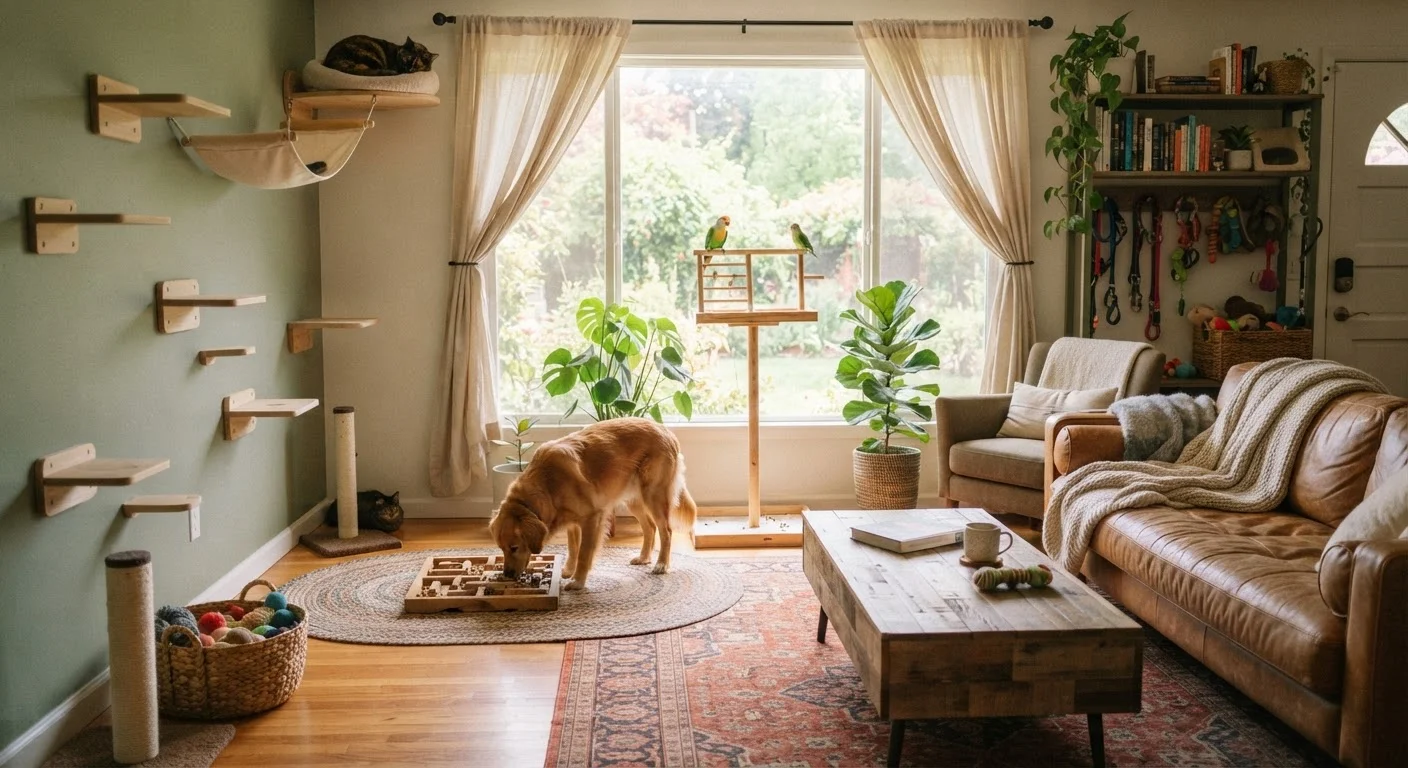
Why Indoor Pets Develop Problem Behaviors
When a dog chews furniture, a cat knocks objects off shelves repeatedly, or a parrot feather-plucks, owners often interpret these as personality flaws or discipline failures. In most cases, they're signals of an under-stimulated nervous system. Indoor pets live in environments that are safe but stripped of the sensory complexity their brains evolved to process.
Wild counterparts of domestic animals spend the majority of their waking hours foraging, hunting, exploring, or navigating social dynamics. Indoor pets often have all their needs met in seconds — food appears in a bowl, threats are absent, and the environment never changes. The behavioral fallout can look like aggression, anxiety, compulsive repetition, or destructive chewing. Understanding this context is the starting point for building a better space. For a deeper look at how to tell stress-driven destruction apart from boredom, see our article on separation anxiety versus boredom in dogs.
Best Practices for Environmental Enrichment
Effective enrichment isn't about buying more toys — it's about creating conditions that let your pet engage in natural, instinct-driven behaviors safely and consistently.
Use feeding as an enrichment opportunity, not just a meal
Pets that eat from puzzle feeders, snuffle mats, or scattered kibble engage foraging instincts that a standard bowl eliminates entirely. This mental effort produces genuine fatigue and reduces restless, demand-driven behaviors. It also slows eating, which benefits digestion.
Create vertical and horizontal territory that is actually usable
Cats and small parrots in particular need three-dimensional space — not just floor area. Placing shelves, cat trees, or perches at varying heights gives animals control over their proximity to stimuli and other household members, which reduces stress-driven aggression and hiding.
Rotate enrichment items on a regular schedule
Novelty is a core component of enrichment. Once a pet habituates to an object, it stops providing cognitive engagement. Putting items away for a week and reintroducing them restores their value without purchasing anything new.
Incorporate species-appropriate scent work into daily life
Smell is a dominant sense for dogs, rabbits, and many rodents. Scent-based activities — hiding small food portions around a room, offering novel safe scents on cotton pads, or using herb bundles — engage the brain in ways that visual enrichment alone cannot.
Provide appropriate chewing and manipulating outlets
Chewing, digging, and object manipulation are instinctive motor behaviors. Pets that lack appropriate outlets redirect these behaviors onto furniture, cables, or themselves. Matching the outlet to the intensity of the pet's drive prevents destructive displacement.
Allow controlled exposure to outdoor sensory input
Even strictly indoor pets benefit from controlled windows to the outside world. Open screened windows, bird feeders placed where pets can observe them, or leashed outdoor time gives animals access to changing stimuli that a static indoor environment can't replicate.
Species-Specific Enrichment Considerations
No single enrichment strategy fits all pets. A border collie needs very different stimulation than a corn snake, and a rabbit has different spatial needs than a cockatiel. The foundation for getting this right is understanding where your pet's species falls on the behavioral spectrum — see our guide on social versus solitary pets for background that directly shapes how you should structure their space.
Enrichment Needs Change With Age
A puppy or kitten needs high-stimulation, varied enrichment to support healthy cognitive development. Senior pets often benefit from gentler, scent-based, or low-impact activities as mobility and sensory acuity change. Revisit your enrichment setup as your pet moves through life stages, and check in with your veterinarian if you're unsure what intensity is appropriate.
For cats specifically, the indoor environment requires extra attention. Cats denied outdoor access need vertical territory, scent variety, and hunting-sequence outlets. Our companion article on indoor versus outdoor cat environments covers how living arrangements shape health risks beyond behavior alone.
85%
Of behavior complaints linked to insufficient enrichment
Veterinary behaviorists frequently report that the majority of common behavior referrals — including destructive chewing, excessive vocalization, and compulsive behaviors — involve environments that fail to meet species-typical needs.
20–30 min
Puzzle feeding time vs. 30 seconds from a bowl
Studies comparing food enrichment delivery methods show dogs given puzzle feeders spend significantly longer eating and exhibit calmer post-meal behavior than those fed from standard bowls.
Quick Wins You Can Implement Today
Meaningful enrichment doesn't require a large budget or a home renovation. Many of the highest-impact changes cost nothing and take minutes to set up. Pairing enrichment with a reliable daily routine amplifies the benefits — consistent timing helps pets anticipate and settle, as explored in our guide to building a daily routine your pet can rely on.
Start Small and Observe Closely
Introduce one enrichment change at a time and watch how your pet responds over several days. Some animals — particularly anxious ones — can find rapid environmental changes stressful rather than stimulating. Gradual introduction lets you identify what genuinely engages your individual pet and what overwhelms them.
This article is for general informational and educational purposes only. If your pet is showing sudden or severe behavioral changes, consult a licensed veterinarian or a certified animal behaviorist, as these can sometimes signal underlying medical conditions.
The content on this site is for informational purposes only and is not a substitute for professional advice. Always consult a qualified professional for guidance specific to your situation.