

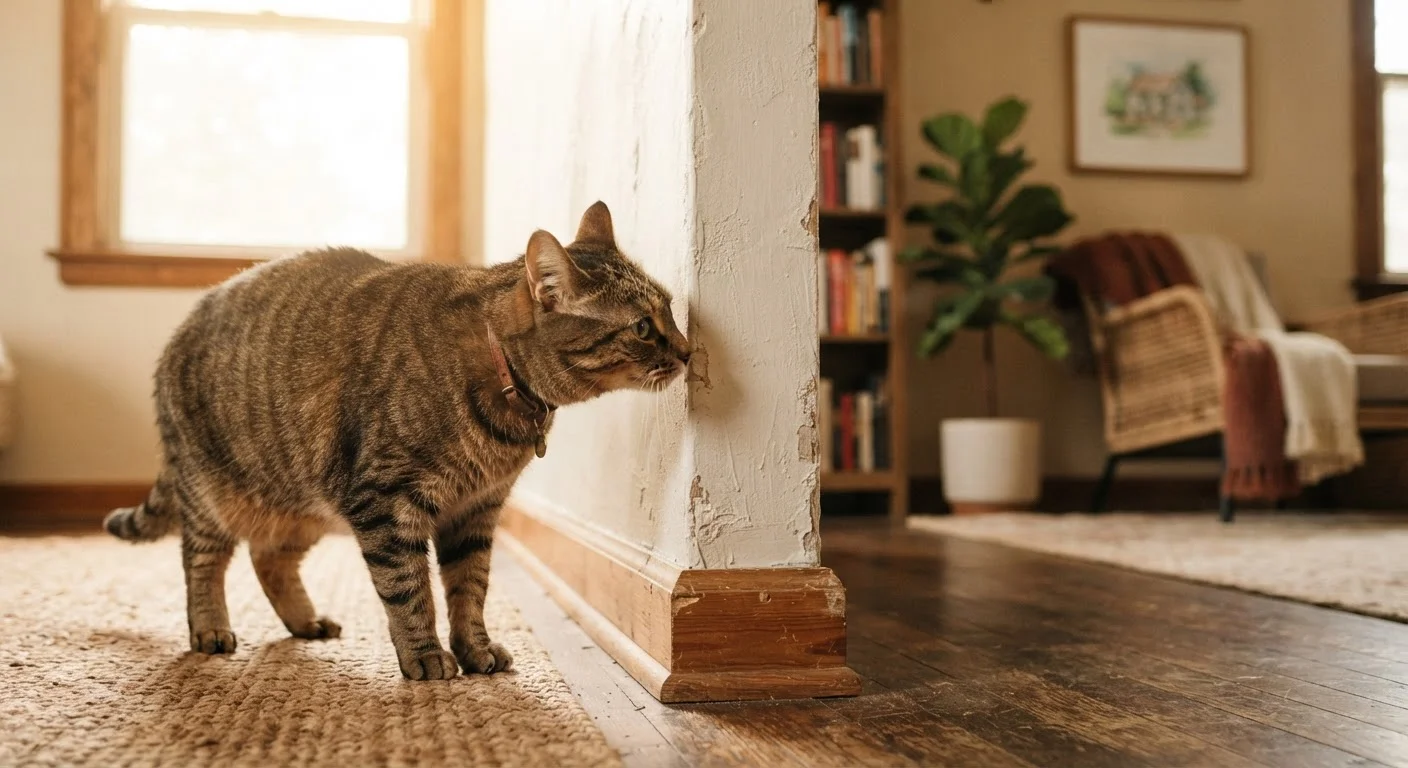
What Territorial Marking Actually Is
Territorial marking is a form of chemical communication. Cats and dogs deposit scent — through urine, glands in their paws, or facial rubbing — to convey information to other animals. Indoors, this behavior can feel frustrating or bewildering, but it's rooted in biology, not bad manners.
In cats, urine spraying is the most recognized form of marking. A cat typically backs up to a vertical surface, raises its tail, and releases a small amount of urine. This is distinct from normal elimination, which happens in a litter box in a squatting position. Dogs mark by depositing small amounts of urine on vertical objects — walls, furniture legs, doorframes — and may also scratch the ground with their hind paws to leave visual and scent signals simultaneously.
Understanding this distinction matters because the solution for a litter box avoidance problem differs significantly from the approach needed for true marking behavior. Misidentifying the issue can lead to months of ineffective responses.
Marking vs. Inappropriate Elimination
It's important to distinguish territorial marking from a litter box avoidance problem. Marking typically involves small amounts of urine on vertical surfaces and occurs alongside normal litter box use. Inappropriate elimination usually involves larger volumes deposited on horizontal surfaces and may indicate a litter box issue — such as an unclean box, wrong substrate, or poor placement — rather than a territorial drive. If you're unsure which behavior you're seeing, a veterinarian or certified animal behaviorist can help you differentiate.
Common Triggers Behind Indoor Marking
Several well-documented factors can prompt or escalate marking indoors:
- Intact reproductive status: Unneutered males — both cats and dogs — are the most frequent markers. Hormones directly drive the urge to broadcast territorial claims. Female cats in heat also spray more often.
- New animals in the home: Introducing a new pet destabilizes an established hierarchy. Resident animals may intensify marking to reassert familiarity and ownership of spaces.
- Outdoor animal sightings: A cat spotting a stray through a window can trigger stress-marking even if the intruder never enters the home.
- Household changes: Moving furniture, new people, renovation noise, or changes in owner schedules can generate enough anxiety to prompt marking, particularly in cats.
- Conflict between housemates: Multi-pet homes where animals compete for resources — food, sleeping spots, attention — often see higher rates of marking.
Knowing your specific trigger is key to choosing an effective response. For deeper context on how stress behaviors manifest in felines, see our article on redirecting aggression in cats.
Best Practices for Managing Marking Behavior
The following approaches represent the most evidence-supported strategies for reducing indoor marking. No single method works in isolation — combining several tends to produce the best outcomes.
Schedule a veterinary exam before assuming the cause is purely behavioral.
Urinary tract infections, bladder stones, kidney disease, and other medical conditions can cause or worsen inappropriate urination that resembles marking. Treating the wrong problem wastes time and can allow a health issue to progress. A clean bill of health from a vet makes behavioral interventions far more focused.
Spay or neuter your pet if they are not already altered.
Reproductive hormones are one of the strongest biological drivers of marking. Neutering eliminates the hormonal basis for much of this behavior, with studies suggesting it reduces urine marking in a significant majority of cats. The earlier the procedure, the more pronounced the effect tends to be, though older animals often benefit too.
Clean marked areas with an enzymatic cleaner, not standard household products.
Standard cleaners may remove visible stains but leave behind odor compounds that signal to your pet that this is an acceptable marking site. Enzymatic cleaners break down urine proteins at a molecular level, eliminating the scent cue that encourages repeat marking. Using the wrong cleaner can inadvertently train a pet to return to the same spot.
Reduce access to visual triggers that provoke stress marking.
Cats and dogs that mark in response to seeing outdoor animals are reacting to a perceived territorial threat they cannot resolve. Blocking sight lines removes the stimulus before the stress response can escalate into marking. This is especially useful in homes with ground-level windows.
Increase predictability and resource availability in multi-pet households.
Competition for food, resting spots, litter boxes, and attention creates chronic low-level stress that expresses itself as marking. Following the general guideline of one litter box per cat plus one extra, and ensuring feeding stations are separated, lowers the social tension that drives territorial behavior.
Use synthetic pheromone products as a supportive tool during high-stress periods.
Synthetic versions of naturally occurring feline and canine calming pheromones — available as plug-in diffusers or sprays — can help reduce anxiety-driven marking during transitions such as moving, introducing a new pet, or household disruption. These are not substitutes for behavioral intervention but can lower baseline stress while other changes take effect.
For a broader look at how your pet's living setup affects behavior, the principles covered in environmental enrichment for indoor pets apply directly here.
Quick Actions to Start Today
While some solutions — like spaying or behavior modification — take time, there are immediate steps that can reduce marking right away.
Consistency is critical. Partial measures applied inconsistently often prolong the problem rather than resolve it. If your efforts aren't producing change within a few weeks, revisiting with your veterinarian or a certified animal behaviorist is a reasonable next step.
This article is for general informational purposes only and does not constitute veterinary or medical advice. Always consult a licensed veterinarian regarding your individual pet's health and behavior.
The content on this site is for informational purposes only and is not a substitute for professional advice. Always consult a qualified professional for guidance specific to your situation.