

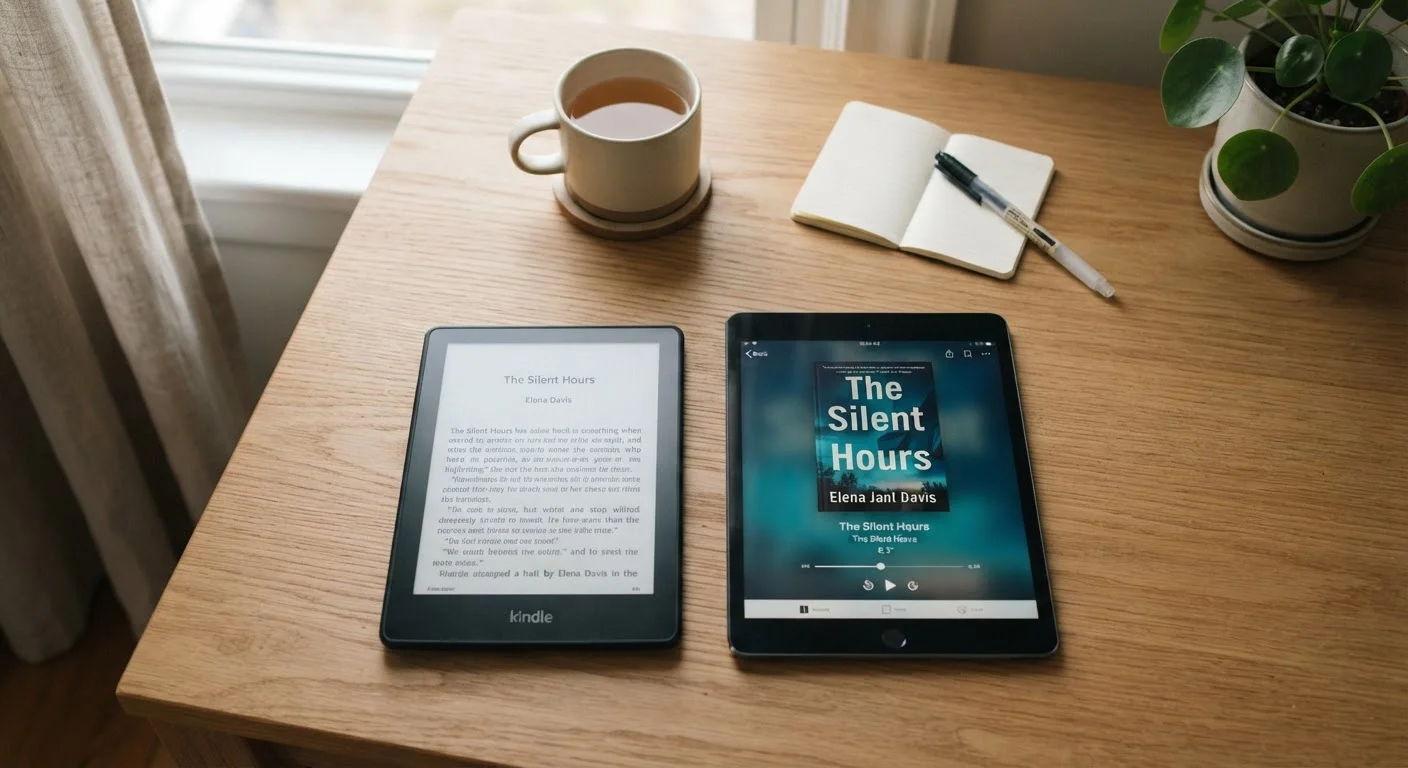
Option A
E-Reader
The purpose-built reading companion.
Best for: Dedicated readers who want long battery life, eye-friendly display, and a distraction-free experience.
Option B
Tablet
The versatile, do-everything screen.
Best for: People who want one device for reading, streaming, browsing, apps, and light productivity.
Why the Comparison Is Worth Making
At a glance, e-readers and tablets look nearly identical: a flat, rectangular screen in a thin frame. But the engineering decisions behind each device reflect very different priorities, and buying the wrong one is a common and avoidable mistake.
The confusion is understandable. Several tablet manufacturers also make e-readers, and many reading apps are available on tablets. But availability isn't the same as suitability. Understanding what each device is actually optimized for — and where it makes trade-offs — is the more useful lens. This fits into a broader pattern worth recognizing: as explained in our look at problem-solving tech, the best device is the one designed around your actual use case, not the one with the longest feature list.
The Display Difference Is the Core Difference
The most consequential distinction between these devices is the screen technology. E-readers use E Ink (electronic ink) displays, which work by rearranging physical microcapsules of pigment to form text. This process doesn't emit light the way a standard screen does — instead, it reflects ambient light like a printed page. The result is significantly less eye strain during extended reading, even in bright sunlight where a tablet screen can wash out.
Tablets use LCD or OLED panels that emit light directly toward your eyes. These screens refresh dozens of times per second, which is essential for video and animation but creates more visual load during long reading sessions. Color reproduction is rich, and response time is fast — advantages that matter enormously for streaming, games, or any visual content.
| Criterion | E-Reader | Tablet |
|---|---|---|
| Display type | E Ink (reflective) | LCD or OLED (emissive) |
| Eye strain during reading | Lower — mimics printed page | Higher — emits direct light |
| Battery life | Weeks per charge | Hours per charge |
| Color display | Grayscale (mostly) | Full color |
| App ecosystem | Limited — reading-focused | Broad — general purpose |
| Video streaming | Not supported | Fully supported |
| Outdoor readability | Excellent in sunlight | Can wash out in bright light |
| Weight | Typically under 7 oz | Typically 1–1.5 lbs |
E-readers also have a meaningful edge when it comes to outdoor use. Their reflective displays perform well in direct sunlight, a scenario where tablet screens typically become difficult to read without significant brightness adjustment — which drains battery rapidly.
Battery Life and Performance Trade-Offs
Battery life is one of the most practically significant differences between these devices. E-readers consume power only when the screen content changes — when you turn a page. While the display is static, almost no power is drawn. This is why e-readers typically last several weeks on a single charge under normal reading conditions.
Tablets, by contrast, are running active displays, processors, and often background app processes continuously. Battery life is measured in hours, not weeks — typically ranging from six to twelve hours depending on usage and brightness settings. That's still useful for a day of travel, but it means charging is a daily or near-daily habit.
~4–6 weeks
Typical e-reader battery life per charge
Most major e-reader models advertise battery life measured in weeks based on roughly 30 minutes of daily reading with wireless off.
6–12 hours
Typical tablet screen-on battery life
General-purpose tablet battery life varies widely depending on screen brightness, active apps, and processor load during use.
For readers curious about how underlying hardware affects these differences, our breakdown of storage, RAM, and processing power explains how these components interact in everyday device use.
What Each Device Can't Do
E-readers have deliberate limitations. Most cannot stream video, run mainstream apps, or handle multitasking. Their processors are optimized for text rendering — not general computing. Color E Ink technology exists but remains expensive and relatively rare; the majority of e-readers display only in grayscale, which makes illustrated content like comics or magazines a poor fit.
Tablets are limited by a different set of constraints. They do almost everything, but that generality can undermine the specific experience of reading. Notifications arrive, apps call for attention, and the lit screen contributes to what researchers have described as increased cognitive stimulation before sleep — a consideration for evening readers. For guidance on evaluating what product descriptions actually tell you about a device's capabilities, see our guide to reading product descriptions critically.
The decision ultimately comes down to specificity. A device built for one thing often does that thing better than a device built to do everything. For readers who want to protect their investment over time, practices covered in our article on extending device life apply to both categories.
E-Readers Can Still Access Reading Apps
Some e-readers support a limited selection of third-party apps, including library borrowing services and note-taking tools. However, these ecosystems are deliberately constrained compared to a tablet's full app store. If access to a broad app library matters to you, that constraint is worth factoring into your decision before purchasing.
The content on this site is for informational purposes only and is not a substitute for professional advice. Always consult a qualified professional for guidance specific to your situation.