

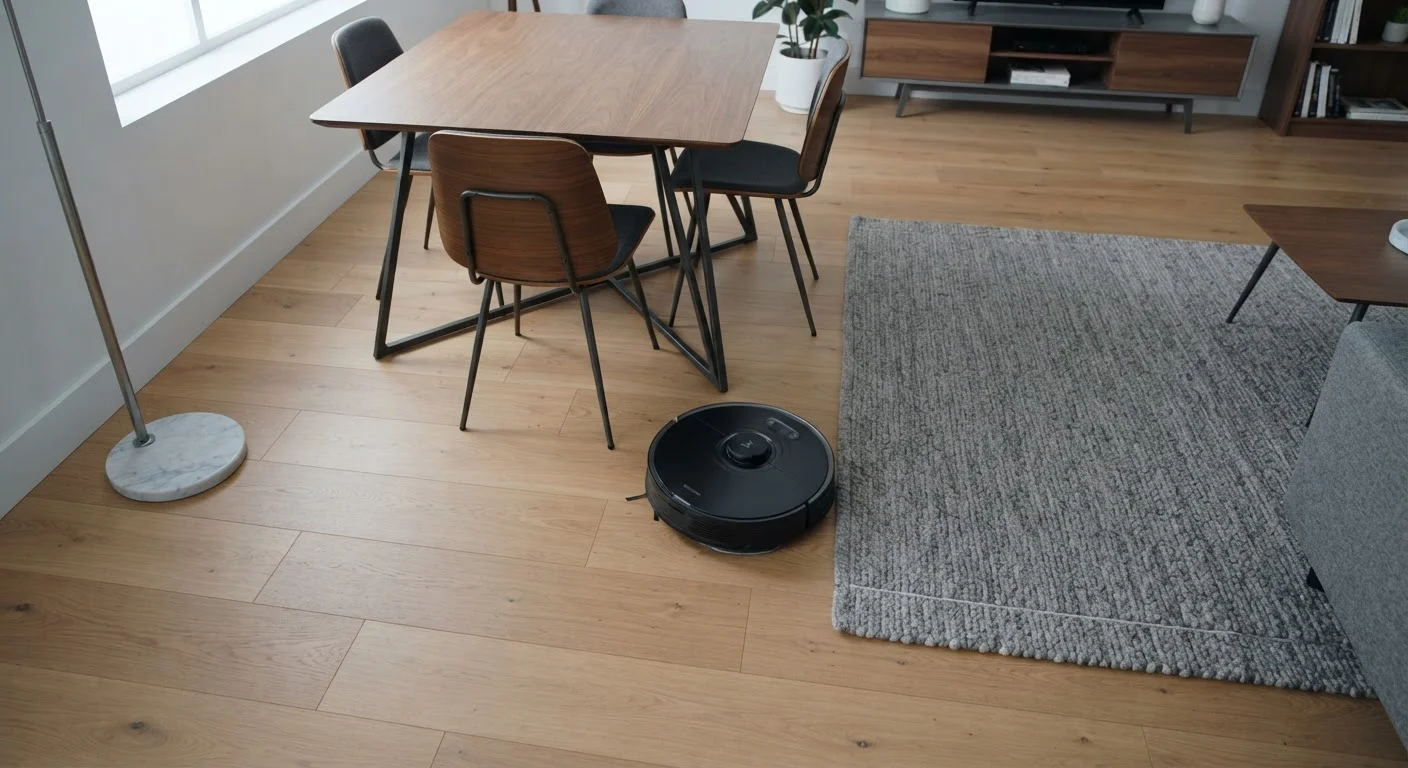
Suction Power: When More Pascals Actually Matter
Suction is measured in pascals (Pa) and is one of the most prominently advertised robot vacuum specs. Entry-level models typically fall in the 1,500–2,500 Pa range; higher-tier models advertise 5,000 Pa or above. What the spec doesn't tell you: real pickup performance depends equally on brush roll design and how efficiently the airflow is channeled through the dustbin.
For low-pile carpet and hard floors, a mid-range suction figure is generally sufficient for everyday debris — crumbs, dust, light pet hair. The spec becomes more meaningful when your home has thick rugs or heavy pet shedding, where stronger suction genuinely helps lift embedded hair from carpet fiber.
~20%
Performance gain from suction above practical threshold
Engineering analyses suggest suction gains beyond a household-adequate threshold deliver diminishing real-world pickup improvements on typical floor types.
3x
Frequency difference: random vs. mapped navigation
Independent testing has found mapped-navigation robots typically cover a floor plan in roughly one-third the passes of random-bump models on similar-sized rooms.
If your floors are predominantly hard surface with area rugs, obsessing over maximum Pa figures is unlikely to improve your actual cleaning results. Focus instead on brush design — a rubber brush roll tends to tangle less with pet hair than a bristle brush, regardless of suction rating.
Navigation and Mapping: The Spec That Changes Daily Usability the Most
How a robot vacuum finds its way around your home has a larger effect on day-to-day satisfaction than suction power for most households. Navigation approaches fall into a rough hierarchy:
- Random bump navigation: The robot moves until it hits something and redirects. Coverage is eventual but inefficient and inconsistent.
- Gyroscope or camera-based navigation: Straighter paths and some spatial awareness, but maps are often not stored between sessions.
- LiDAR-based mapping with SLAM: Builds and retains a precise floor plan, enabling room-by-room scheduling, no-go zones, and methodical row-by-row cleaning.
Pascal (Pa)
The unit used to measure suction pressure in robot vacuums. Higher numbers indicate stronger suction, though real-world performance also depends on brush design and airflow path.
LiDAR mapping
A laser-based navigation system that scans a room to build a precise floor plan. Enables methodical, grid-like cleaning paths and persistent room memory between sessions.
SLAM
Simultaneous Localization and Mapping — a software process that allows a robot to build a map of its environment while tracking its own position within it in real time.
Dustbin capacity
The volume of the onboard bin that collects debris during a cleaning run. Measured in milliliters; smaller bins fill faster and need more frequent emptying.
Auto-empty base
A docking station that suctions debris from the robot's onboard bin into a larger sealed bag after each run, reducing how often a user needs to intervene manually.
Obstacle avoidance
Hardware and software that detects objects — cords, shoes, pet waste — and navigates around them instead of bumping into or running over them.
For apartments and smaller homes, lower-tier navigation may be adequate — the robot will cover the space eventually. For multi-room homes, homes with complex furniture arrangements, or households with pets (where you want the robot to avoid specific areas), persistent mapping pays meaningful dividends. It also allows app-based scheduling by room, which is a convenience feature many users find they rely on quickly. For context on how smart home devices handle real-world use vs. marketing promises, see how smart speakers compare in terms of realistic vs. advertised capability.
Dustbin Size, Auto-Empty Bases, and Practical Maintenance
A dustbin rated at 300 ml will fill noticeably faster than one at 600 ml — relevant if you have shedding pets or run the robot daily. In practice, a small bin in a pet household may need emptying after every single run, which defeats much of the automation benefit.
Specs Are Measured in Labs, Not Homes
Suction figures, runtime estimates, and coverage area claims are generated under controlled test conditions that rarely mirror a real home — with furniture, rugs, corners, and pet hair. Use specs as a relative comparison tool, not as a guarantee of performance. Reading how specs are framed in product listings can help too; see our guide on decoding product descriptions online.
Auto-empty bases address this by suctioning the robot's bin contents into a larger sealed bag after each run. The tradeoff: the base itself takes up more floor space, makes noise during the transfer process (typically 10–15 seconds), and requires periodic bag replacement. If hands-off maintenance is your primary goal — especially relevant for pet owners managing shedding — this feature has genuine utility. For a broader look at pet-related home management, everyday pet care basics covers how grooming and routine upkeep reduce how much ends up on your floor in the first place.
Mopping attachments are now common on many models. Most use a damp pad rather than active scrubbing, which is adequate for light surface maintenance on hard floors but is not a substitute for manual mopping on sticky or heavily soiled areas.
Understanding which specs represent real-world performance versus lab conditions is a skill that applies across all electronics categories. This framework for evaluating practical gadgets helps clarify whether a device's feature list translates to genuine daily value — the same logic applies directly to robot vacuums.
The content on this site is for informational purposes only and is not a substitute for professional advice. Always consult a qualified professional for guidance specific to your situation.