

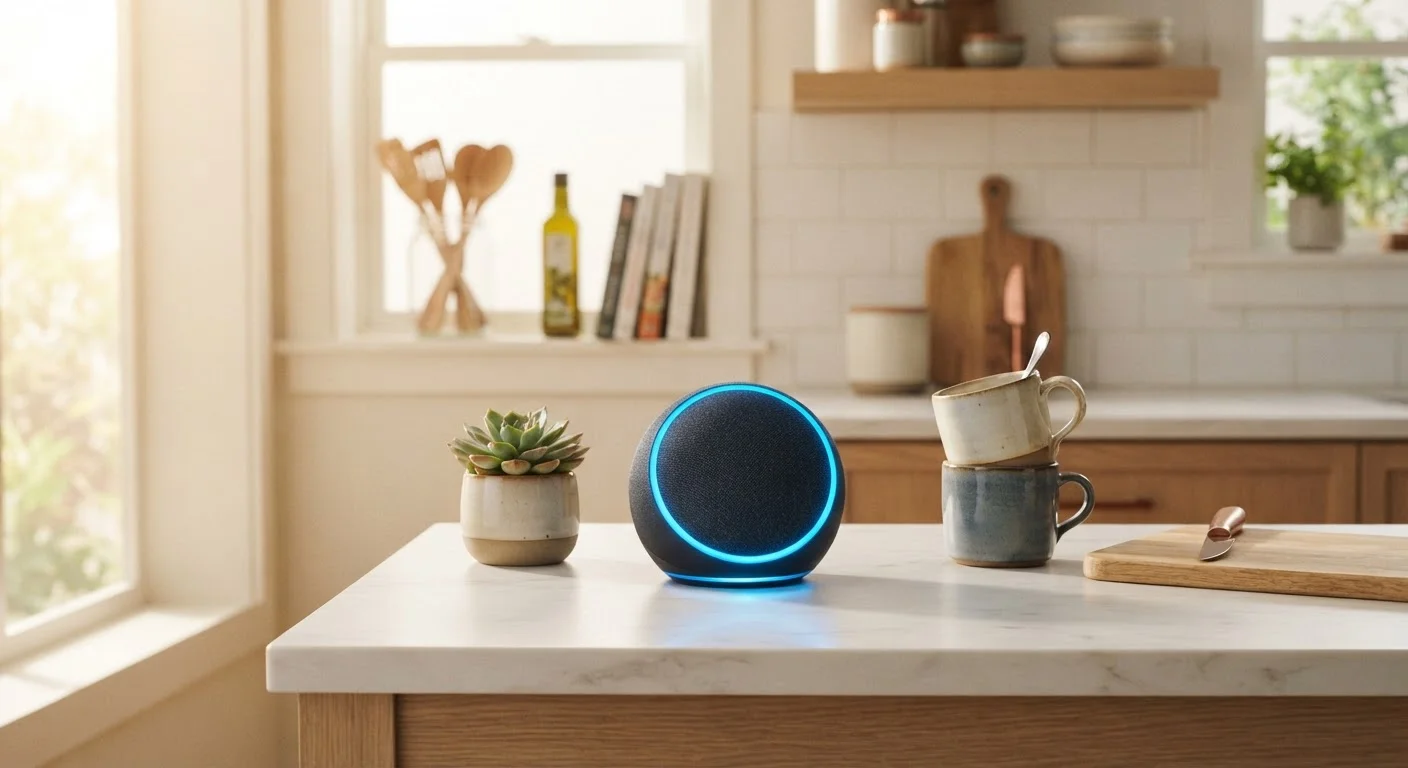
Our Verdict
Smart speakers genuinely earn their place for hands-free convenience, ambient music, and simple smart home control — especially for people already invested in a compatible ecosystem. However, they are frequently oversold as all-purpose assistants, and their limitations in accuracy, privacy, and complex reasoning are real. Understanding what they actually do prevents disappointment and helps you decide whether they fit your household's specific habits.
Best for households that want quick, voice-accessible shortcuts for everyday tasks and already use compatible smart home devices or streaming services.
What Smart Speakers Actually Are
A smart speaker combines a wireless audio speaker with a voice-activated digital assistant. You speak a wake word — a short phrase that activates the microphone — and the device captures your request, sends it to cloud servers for processing, and returns a spoken response or triggers an action.
The key detail here is that most of the intelligence lives in the cloud, not the device itself. The speaker is largely a microphone, a speaker, and a Wi-Fi radio. This architecture shapes nearly everything about what smart speakers can and cannot do. A stable internet connection isn't optional — it's fundamental to how these devices function.
For a broader look at how hardware components relate to device capability, see our explainer on storage, RAM, and processing power.
What Smart Speakers Do Well
Hands-free convenience for everyday quick tasks
Timers, reminders, unit conversions, and weather checks take seconds by voice — useful when cooking, exercising, or occupied with other tasks.
Instant music and audio playback by voice
Integrated streaming service support lets users play music, podcasts, or radio stations in any room without touching a device.
Basic smart home control without a separate app
Compatible smart lights, plugs, and thermostats can be adjusted by voice command, reducing friction for common adjustments.
Low learning curve for most users
Natural language commands mean most people can start using a smart speaker productively within minutes of setup.
Accessible interface for users with mobility limitations
Voice-first interaction can meaningfully reduce barriers for people who find touchscreens or keyboards difficult to use.
The tasks where smart speakers genuinely shine share a common trait: they are well-defined, low-stakes, and benefit from being hands-free. Setting a cooking timer while your hands are covered in flour, playing music in a room without a screen, checking the weather before you leave the house — these are cases where voice interaction offers a real convenience gain over reaching for a phone.
Smart speakers also work reasonably well as a lightweight interface for compatible smart home devices. If you use smart bulbs, plugs, or thermostats, a voice command is often the fastest way to adjust them — though as we cover below, reliability varies. For a deeper look at how smart home control layers work, our guide to smart home hubs explains when a hub adds more capability than a speaker alone.
Where Smart Speakers Fall Short
Unreliable with complex or multi-step requests
Requests involving nuance, context, or multiple steps frequently produce incomplete or inaccurate responses — cloud-based AI assistants are not designed for deep reasoning tasks.
Always-on microphone raises privacy concerns
The device continuously listens for its wake word, and accidental activations have been documented, meaning unintended audio can occasionally be processed.
Requires strong, consistent internet connection
All core functionality routes through cloud servers, so a slow or dropped connection renders most features unusable.
Ecosystem lock-in limits device compatibility
Smart speakers are typically optimized for one platform's services and devices; mixing ecosystems can result in partial or unreliable integration.
Not a reliable source for factual accuracy
Smart assistants have well-documented accuracy limitations, including outdated information and calculation errors — users should verify anything consequential.
Limited utility without complementary services or devices
Much of a smart speaker's value comes from integration with streaming services, smart home gadgets, and calendars — users without these get significantly less benefit.
The limitations of smart speakers are closely tied to the same architecture that enables them. Cloud processing means any complex, nuanced, or multi-step request tends to produce unreliable results. Asking a smart speaker to summarize a document, help you draft an email, or walk you through a decision involving your specific situation will typically yield a generic or unhelpful response.
Smart speakers are also a poor substitute for a dedicated device when precision matters. Math errors, misheard commands, and outdated information are documented, recurring issues across all major platforms. They are not designed for tasks that require verification, critical thinking, or personalized judgment.
Ecosystem Compatibility Matters More Than Specs
Smart speakers are not standalone devices in practice — their usefulness scales with how well they integrate with the services and hardware you already use. A device marketed as a smart home controller may offer very limited control over devices from a different ecosystem. Before assuming compatibility, check the manufacturer's official supported device list rather than relying on product description language, which can be imprecise.
Smart speaker utility is also ecosystem-dependent. A device tuned for one platform's services may work poorly — or not at all — with services from a different provider. Before assuming a smart speaker will integrate with your existing devices, verify compatibility directly with manufacturers. See our guide to problem-solving gadgets for a framework to evaluate whether any device fits your actual needs.
Privacy: What You Should Know
Smart speakers listen for their wake word continuously. While manufacturers state that audio is only transmitted to servers after the wake word is detected, independent researchers have documented cases of accidental activations triggered by similar-sounding words or ambient speech.
35%+
U.S. adults owning a smart speaker
According to Pew Research Center survey data, more than one in three American adults reported owning a smart speaker, reflecting mainstream adoption of the technology.
~30%
Voice commands misunderstood or mishandled
Academic and industry research has estimated that roughly a quarter to a third of voice queries result in an unhelpful or incorrect response, depending on request complexity.
Audio snippets from accidental activations have, in documented cases, been reviewed by human contractors as part of quality improvement programs — a practice that several major platforms have acknowledged and modified after public reporting. Reviewing privacy settings and opting out of human review programs, where available, is a reasonable step for users with privacy concerns.
For households with children or those who discuss sensitive personal, financial, or health information at home, this is not a trivial consideration. These devices are always-on microphones connected to the internet, and that design involves trade-offs regardless of brand.
Setting Realistic Expectations
Smart speakers are useful tools for a specific range of tasks — not universal assistants. The gap between marketing language and real-world capability is something worth scrutinizing carefully, as our guide to reading product descriptions explores in detail.
Think of a smart speaker as a voice-accessible shortcut layer, not a replacement for other devices. A phone handles complex tasks better. A dedicated smart home hub handles device integration more reliably. A smart speaker sits between those use cases — convenient for simple, repeated actions, but limited elsewhere. Whether that value proposition fits your household depends on your routines, your existing tech setup, and how often you'd genuinely reach for it.
The content on this site is for informational purposes only and is not a substitute for professional advice. Always consult a qualified professional for guidance specific to your situation.