

The Core Mechanism: What Price Trackers Actually Do
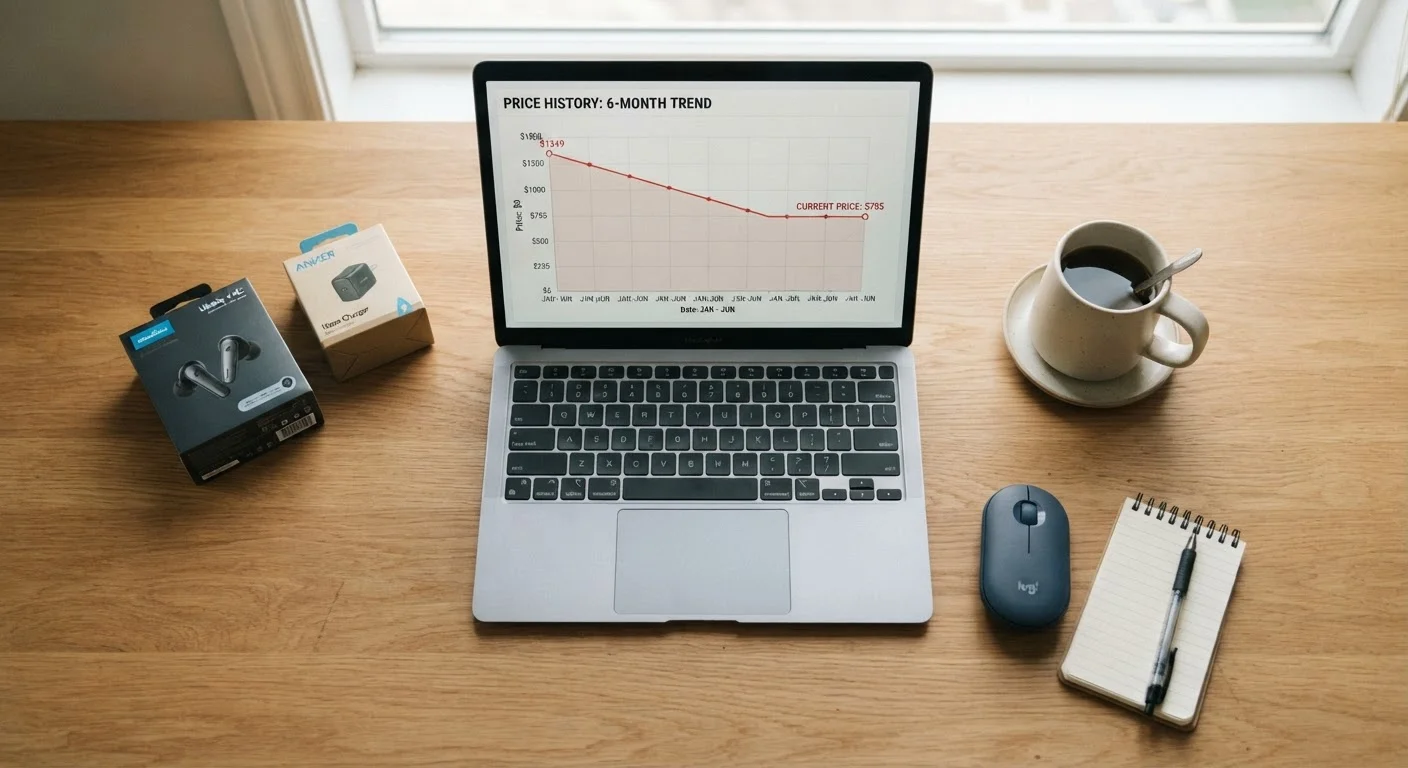
At its simplest, a price tracker is a logging system. It visits a product's page on a retailer's website at regular intervals — often every few hours — records the price it finds, and stores that data point in a database. Do this hundreds of times over months and you build a price history: a timeline showing exactly what that item has cost at different points in time.
When you set an alert for a target price, the tracker checks each new data point against your threshold. The moment the listed price falls at or below your number, it notifies you — typically by email or push notification. The underlying logic is straightforward; the value comes entirely from the accumulated historical record.
~30%
Products with inflated "original" prices
Research into online retail pricing has found a significant share of items are listed with reference prices that were rarely or never the actual selling price, making historical tracking data especially useful for verification.
1–24 hrs
Typical price check interval for tracking tools
Most consumer-grade price trackers poll product pages somewhere between once per hour and once per day, meaning very short flash sales can fall entirely outside the recorded data.
It's worth understanding what trackers are not doing: they aren't negotiating prices, accessing private retailer data, or predicting the future. They observe publicly visible prices and report them faithfully. That distinction matters because it sets honest expectations about what the tool can and cannot tell you.
Why Historical Price Data Changes the Picture
Retailers routinely inflate a product's "original" price before marking it down, creating the appearance of a discount that may not represent genuine savings. A price tracker cuts through this by showing you what the item actually sold for over the past year — not just what the product page claims it used to cost.
If a laptop is listed at $1,299 with a crossed-out $1,599 "original" price, but the tracker's history shows it has sold at $1,299 or lower for most of the past six months, the discount framing tells a different story. This connects directly to a broader pattern of manufactured reference pricing — something worth understanding alongside price tracker data. Learn how reference pricing works to sharpen your instincts further.
“The most dangerous number in retail is the original price. Without knowing what something actually sold for over time, you have no way to evaluate whether the current number represents real value.”
— Consumer pricing researcher, Academic researcher in behavioral economics and retail pricing
Historical data also reveals seasonal patterns. Many product categories show predictable price cycles tied to product release schedules or major retail events. Recognising those cycles in a price graph helps you time a planned purchase more deliberately.
Real Limitations You Should Know Before Relying on One
Price trackers have meaningful gaps that can mislead a shopper who treats them as a complete source of truth.
- Flash sales and short-duration promotions may not be captured if they expire before the tracker's next check cycle. A 4-hour sale that starts and ends between two polling intervals simply won't appear in the history.
- Third-party sellers on marketplace platforms often list the same product at very different prices. Some trackers blend these prices together; others track only the primary retailer. The difference matters.
- In-store pricing is almost never reflected. If a physical store runs a local promotion, it typically won't show up in any tracker's data.
- Product variations — different colors, storage capacities, or bundle configurations — are sometimes tracked separately and sometimes conflated, which can produce misleading history.
Set Your Target Price Before You Shop
Before adding a product to a tracker, decide what price would make the purchase feel clearly worthwhile to you — independent of any "sale" framing. Setting your own target number first prevents the tracker's data from simply anchoring you to whatever the current price happens to be.
Pairing price history with an understanding of common retail pricing tactics gives you a more complete analytical toolkit. Anchoring, decoys, and bundle pricing are strategies designed to steer your perception of value — knowing them helps you interpret price history more critically.
When Price Tracking Is Actually Worth the Effort
Price tracking delivers the most value in a specific kind of purchase situation: a planned, non-urgent buy for a higher-cost item that has a reasonably stable product identity over time. Electronics, appliances, and home goods fit this profile well. Impulse purchases, perishables, and items with high model turnover fit it poorly.
The practical approach is to add an item to a tracker when you first consider buying it — not after you've already decided. Watching the price for several weeks before committing gives you a realistic baseline for what "normal" actually looks like for that product. If you're already in the habit of tracking your monthly spending, this kind of deliberate pause before purchase fits naturally into that mindset. Building a monthly spending tracker can complement price tracking by showing you exactly how much room you have for a planned purchase.
Price trackers are a useful tool — not a guarantee of savings. Used with clear expectations and a basic understanding of their limitations, they give everyday shoppers one more data point for making more informed purchasing decisions.
This article is for informational and educational purposes only. It does not constitute financial advice. Readers should evaluate their own circumstances when making purchasing decisions.
Frequently Asked Questions
Most popular price tracking tools offer a free tier that covers basic price history and email alerts. Some offer premium tiers with faster alert frequency or additional features. The free versions are sufficient for most everyday shoppers.
Accuracy depends on how often the tool checks prices and whether it captures all seller types. Most tools poll prices every few hours to once daily, so very short-lived flash sales may not appear in the record. Data from third-party marketplace sellers can also introduce gaps.
Coverage varies by tool. Many focus heavily on major e-commerce platforms, with limited or no visibility into smaller retailers, in-store pricing, or regional promotions. Always check which retailers a given tracker supports before relying on it.
Most price trackers are designed for durable goods like electronics and appliances rather than groceries. Grocery pricing is highly regional and changes faster than most trackers can follow, making them less practical for perishables.
A tracker shows you historical lows and trends, which can inform your decision — but it cannot predict future prices with certainty. Seasonal patterns (like late-November retail events) are observable in historical data, but there are no guarantees.
Browser extensions request permissions to read page content, which carries some privacy considerations. Review the permissions an extension requests and check whether the developer has a published privacy policy before installing.
The content on this site is for informational purposes only and is not a substitute for professional advice. Always consult a qualified professional for guidance specific to your situation.