

Why Prices Are Never Just Numbers
When you see a price, you don't evaluate it in isolation. You compare it — to other prices nearby, to what you paid before, to what you expected to pay. Retailers know this, and they engineer the context around a price just as carefully as the price itself.
This isn't fringe manipulation. It's mainstream retail strategy grounded in decades of behavioral research. Three tactics account for the vast majority of what you'll encounter: anchoring, decoy pricing, and bundling. Understanding how each one works is the first step toward evaluating prices on your own terms rather than the seller's.
For a broader look at how these habits compound over time, see shopping habits that quietly drain your budget.
~90%
Consumers affected by anchoring bias
Behavioral economics research consistently finds that anchoring influences the vast majority of numerical judgments, including price evaluations, regardless of the observer's sophistication.
3-tier
Most common decoy pricing structure
The three-option pricing structure — with a mid-tier decoy — is documented across restaurant menus, subscription services, and consumer electronics as one of the most widely deployed pricing formats.
40%+
Bundle items consumers report not using
Consumer surveys in multiple product categories suggest a significant share of bundled items go unused, indicating that perceived bundle value frequently exceeds actual realized value.
Anchoring: The First Number Wins
Anchoring works by presenting a high reference price before the actual selling price. Once a number is in your head, it distorts everything you evaluate afterward. A $400 item marked down to $280 feels like a deal — even if the item was never meaningfully sold at $400.
Anchors appear in several forms: a crossed-out 'original' price on a tag, a manufacturer's suggested retail price displayed next to a sale price, or a premium product shown first in a product lineup. In each case, the anchor's job is to establish a ceiling against which the target price looks favorable.
The effect is powerful enough that even obviously arbitrary anchors influence judgments. In classic experiments, people asked to estimate the value of an item after seeing an unrelated high number gave systematically higher estimates than those who saw a low number first.
When evaluating a price, ask: What would I think this was worth if I hadn't seen that reference price? For verifiable price history, tools that track historical pricing data are more reliable than in-store framing — our guide to how price tracking tools work explains the mechanics. And for a deeper look at strikethrough prices specifically, see sale prices and manufactured discounts.
Decoy Pricing: The Option That's There to Lose
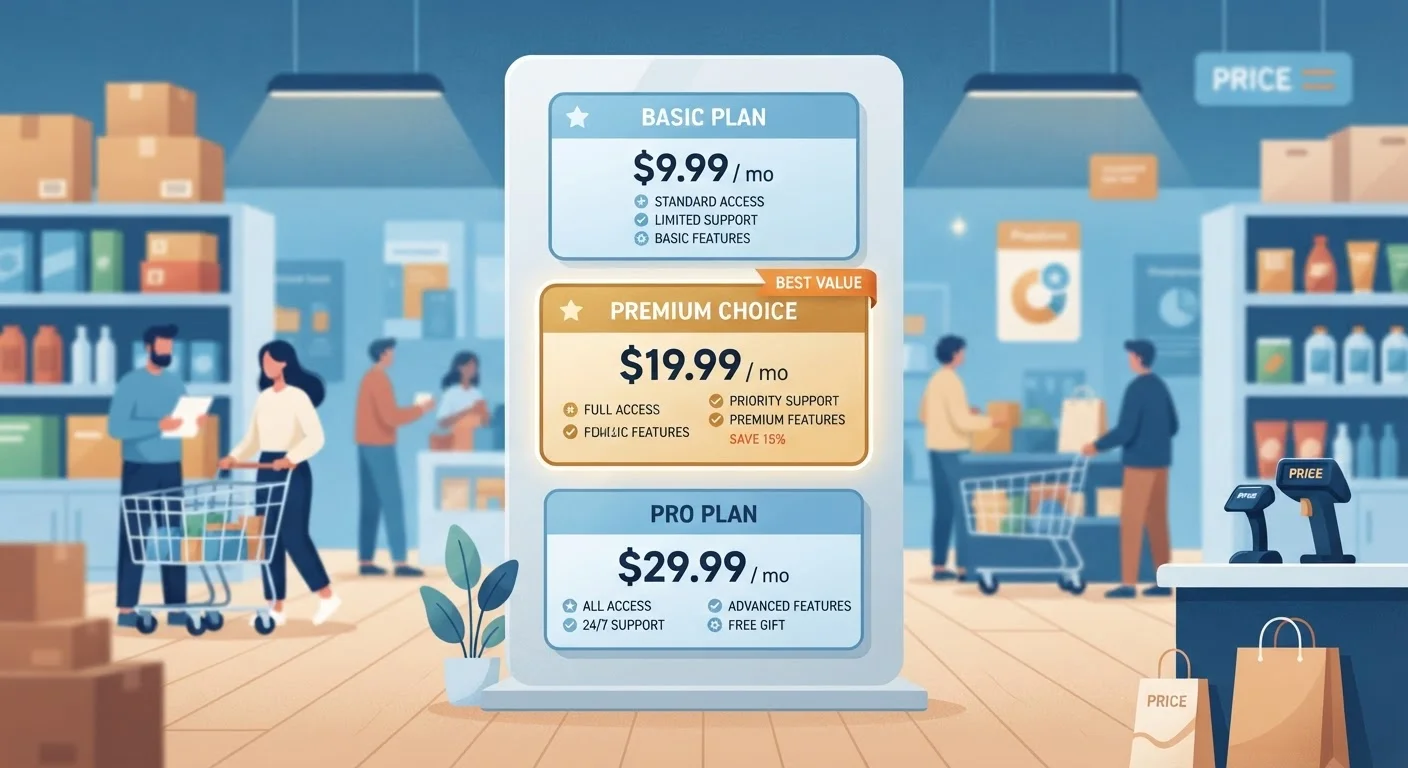
A decoy is an option designed not to be chosen — its purpose is to make another option look better by comparison. The classic setup involves three tiers: a basic option, a mid-tier option, and a premium option. The decoy is typically the mid-tier, priced close to the premium but offering substantially less, making the premium appear to be good value.
Streaming services, software subscriptions, and coffee shop menus use this structure constantly. The small popcorn exists so the large popcorn looks like an obvious upgrade. The middle subscription tier exists so the premium tier's marginal cost over it seems small.
The tell is when an option seems to exist mainly to make you feel better about a pricier choice rather than to serve a genuine use case. If you find yourself thinking 'well, for just a bit more I get so much more,' pause and ask whether you actually need the more expensive version — or whether the decoy manufactured that reasoning.
Bundling: Value You Didn't Ask For
Bundles package multiple items together at a combined price that appears lower than buying them separately. They can represent genuine savings — but only when you'd have bought each component anyway. The problem is that bundles regularly include items of low value to you, padded in to inflate the perceived savings.
The tactic is especially common in electronics retail (accessories added to a device purchase), cable and internet services, and software suites. A bundle that adds $60 in apparent value may include items worth $0 to you personally.
Evaluate any bundle by mentally removing the items you wouldn't buy on their own and recalculating whether the remaining items are still priced competitively. Unit price math offers a useful parallel framework for grocery bundles and multi-packs specifically.
Price the Bundle's Components Separately First
Before accepting a bundle's stated savings, look up each component's standalone price from an independent source. Remove any item you wouldn't buy on its own, then recalculate. If the remaining value still beats the bundle price, it may be worth it — if not, you're paying for items you don't need.
If you're thinking about bulk purchases — which share some structural similarities with bundles — buying in bulk explains when the math actually works in your favor.
Building a Defense That Actually Works
Awareness of these tactics is useful but not sufficient. The more durable protection is building decision habits that don't rely on the seller's framing at all.
A few practical approaches: Decide in advance what a product is worth to you before you see the pricing. Compare against external references — independent reviews, historical pricing data, or product descriptions read critically — rather than against other items on the same shelf. And for any multi-option purchase, ask whether you'd choose the same option if the others weren't shown.
These tactics persist because they work — even on people who know about them. The goal isn't to outsmart every retail display; it's to consistently make decisions you'd still endorse after the fact. For a systematic approach to shopping more deliberately, building a smarter shopping mindset walks through the broader framework.
“The price of a product is not just a number — it's a story told in context. Change the context, and you change what the number means to the person reading it.”
— Richard Thaler, Nobel Prize-winning behavioral economist and co-author of 'Nudge'
Frequently Asked Questions
Price anchoring is when a retailer displays a high initial price before revealing a lower one, making the lower price feel like a bargain by comparison. The anchor doesn't have to be a price you'd ever pay — it just sets the mental reference point. Research consistently shows that even arbitrary numbers can shift what people consider a reasonable price.
A decoy is an option priced to make a specific alternative look more attractive. Typically, the decoy is priced close to the premium option but offers noticeably less value, nudging buyers toward the pricier choice. Subscription services and cinema concession stands use this structure routinely.
Sometimes — but the key question is whether the bundle contains items you'd genuinely use. If a bundle includes products you wouldn't buy separately, the apparent savings are misleading. Evaluate bundles by pricing each component individually before assuming value.
Most pricing tactics are legal, though some jurisdictions regulate deceptive reference pricing — such as displaying a 'was' price that was never genuinely charged. The Federal Trade Commission has guidance on deceptive pricing, but enforcement is limited and context-dependent. Reading our article on <a href="/tech-shopping/smart-shopping/sale-prices-strikethroughs-and-manufactured-discounts-separating-real-deals-from-theater">manufactured discounts</a> covers this in more detail.
Research suggests awareness helps, but doesn't fully neutralize the effects — the psychological mechanisms operate partly outside conscious reasoning. The more practical protection is building decision habits that evaluate price against your own reference points rather than the retailer's framing.
They're most visible in subscription tiers, electronics retail, fast-casual dining, grocery packaging, and auto dealerships. Anywhere a seller presents multiple options at once, some version of anchoring, decoy pricing, or bundling is likely at work.
The content on this site is for informational purposes only and is not a substitute for professional advice. Always consult a qualified professional for guidance specific to your situation.