

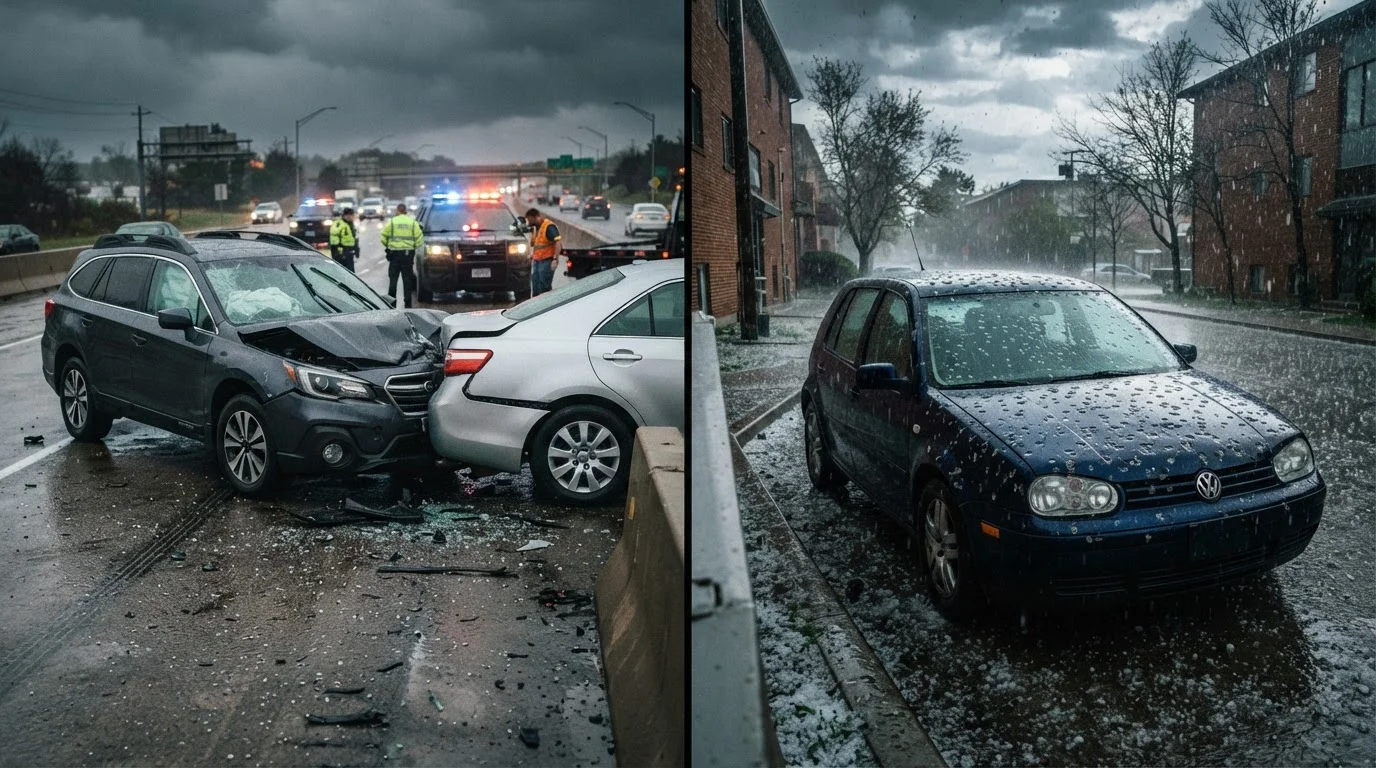
Option A
Collision Coverage
The coverage that steps in after your car hits something.
Best for: Drivers who want protection for crash-related vehicle damage, regardless of who is at fault.
Option B
Comprehensive Coverage
The coverage for everything the road didn't cause.
Best for: Drivers who want protection from theft, weather events, and other non-collision incidents.
How Each Coverage Is Defined
Auto insurance can feel like a wall of jargon, but collision and comprehensive coverage each have a precise, well-established definition - and the distinction between them comes down to a single question: what caused the damage?
Collision coverage pays to repair or replace your vehicle when it makes physical contact with another vehicle or a stationary object - a guardrail, a telephone pole, another car in a parking lot. It also applies if your vehicle rolls over. The at-fault determination doesn't matter for your own claim; if you rear-end someone or someone rear-ends you, collision coverage handles your vehicle's damage either way.
Comprehensive coverage handles physical damage that isn't caused by a collision. Insurers sometimes call this "other than collision" coverage, which is actually a more precise name. It covers events like vehicle theft, vandalism, hailstorm or windstorm damage, flooding, fire, falling objects (think tree branches or debris), and animal strikes - including the very common scenario of hitting a deer. If something damages your car and it wasn't a crash, comprehensive is almost certainly the relevant coverage.
For a broader view of how these coverages fit within a full policy, see The Auto Insurance Landscape, Start to Finish.
| Criterion | Collision Coverage | Comprehensive Coverage |
|---|---|---|
| What triggers a claim | Impact with vehicle or object; rollover | Theft, weather, fire, animals, vandalism |
| At-fault requirement | Not required - covers regardless of fault | Not applicable - non-collision events |
| State-mandated | No - optional under law | No - optional under law |
| Lender/lessor requirement | Typically required for financed/leased vehicles | Typically required for financed/leased vehicles |
| Deductible applies | Yes | Yes (windshield may be $0 in some states) |
| Maximum payout | Actual cash value of vehicle | Actual cash value of vehicle |
| Relative premium cost | Generally higher | Generally lower (varies by region) |
Deductibles, Premiums, and the Cost Equation
Both collision and comprehensive are subject to a deductible - the amount you pay out of pocket before your insurer covers the rest of a covered claim. Common deductible amounts range from $250 to $1,500. Choosing a higher deductible lowers your premium; choosing a lower deductible raises it.
In general, collision coverage tends to cost more than comprehensive because crashes are statistically more frequent and more expensive to repair than most non-collision events. However, in regions with high rates of vehicle theft or severe weather, comprehensive premiums can be substantial.
~6M
Estimated U.S. vehicle crashes per year
The National Highway Traffic Safety Administration (NHTSA) reports approximately 6 million police-reported crashes annually in the United States, underscoring the frequency of collision-eligible events.
~1M
Vehicles stolen annually in the U.S.
According to the FBI's Uniform Crime Reporting data, motor vehicle theft has remained in the range of approximately one million incidents per year, a core comprehensive coverage risk.
$4,700+
Average collision claim cost (industry estimates)
Industry data from sources including the Insurance Research Council suggests the average collision claim payout has risen significantly over recent years, driven by parts costs and labor rates.
Your insurer will never pay more than the vehicle's actual cash value (ACV) - the depreciated market value of your car at the time of the loss - minus your deductible. This is why many financial advisers suggest periodically reassessing whether the combined premium for both coverages still makes sense relative to your vehicle's current ACV. If your car's value has dropped to the point where a payout would be minimal after the deductible, you may decide to drop one or both coverages.
Keep in mind that dropping coverage on a financed or leased vehicle is typically not an option - your lender holds a lien on the vehicle and will require both coverages in your loan or lease agreement. Letting them lapse can trigger force-placed insurance, which is generally far more expensive and covers only the lender's interest, not yours.
Common Scenarios and Which Coverage Applies
Understanding these coverages in theory is one thing; seeing them applied to real situations clarifies the line quickly.
- You back into a concrete pillar in a parking garage: Collision - you struck a stationary object.
- A hailstorm dents your hood and roof while parked overnight: Comprehensive - weather damage unrelated to driving.
- Your car is stolen from your driveway: Comprehensive - theft is a non-collision event.
- You swerve to avoid a deer and hit a tree: Collision - the tree impact is what caused the damage, not the animal. (Had the deer actually struck the car, that would typically fall under comprehensive.)
- Flood water damages your engine: Comprehensive - flooding is explicitly listed as a covered peril under most comprehensive policies.
- A driver runs a red light and hits your car: Collision applies to your own vehicle damage. You may also pursue the at-fault driver's liability coverage, but your collision coverage provides a faster path to a repair.
Unexpected gaps can still appear even when you carry both coverages. Coverage Gaps That Catch Drivers Off Guard explores scenarios - like rideshare activity and rental reimbursement - where standard physical damage coverage may not be enough.
Deer Strikes: The Collision vs. Comprehensive Grey Area
Many drivers assume hitting a deer always falls under comprehensive. In practice, insurers generally distinguish based on what was damaged by what: if your vehicle strikes a deer directly, that's typically a comprehensive claim. If you swerve to avoid a deer and collide with a guardrail or another vehicle, that contact is usually a collision claim. When in doubt, contact your insurer before filing to confirm how the specific circumstances will be categorized under your policy.
Making the Right Call for Your Situation
There is no universal answer to whether you should carry one, both, or neither of these coverages. The right decision depends on your vehicle's value, your financial cushion, your driving patterns, and where you live.
A practical starting point: look up your vehicle's current market value using a reputable valuation source. Then compare that figure against the combined annual premium for both coverages plus your deductible. If a total-loss payout would barely exceed what you'd spend over a few years in premiums plus your deductible, the math may favor dropping one or both on an older, owned-outright vehicle.
Conversely, if your vehicle still carries significant value - or you couldn't absorb a large out-of-pocket repair bill without financial strain - maintaining both coverages is a reasonable safeguard. Liability vs. Full Coverage: Understanding the Real Difference also helps frame where these coverages sit within the broader structure of a complete auto policy.
Insurance decisions are personal and depend heavily on individual circumstances. Consulting a licensed insurance agent or broker can help you evaluate the specific trade-offs for your vehicle, location, and budget before making changes to your policy.
This article is for general informational purposes only and does not constitute personalized insurance or financial advice. Coverage terms, exclusions, and availability vary by insurer and state. Always review your actual policy documents and consult a licensed insurance professional for guidance specific to your situation.
The content on this site is for informational purposes only and is not a substitute for professional advice. Always consult a qualified professional for guidance specific to your situation.