

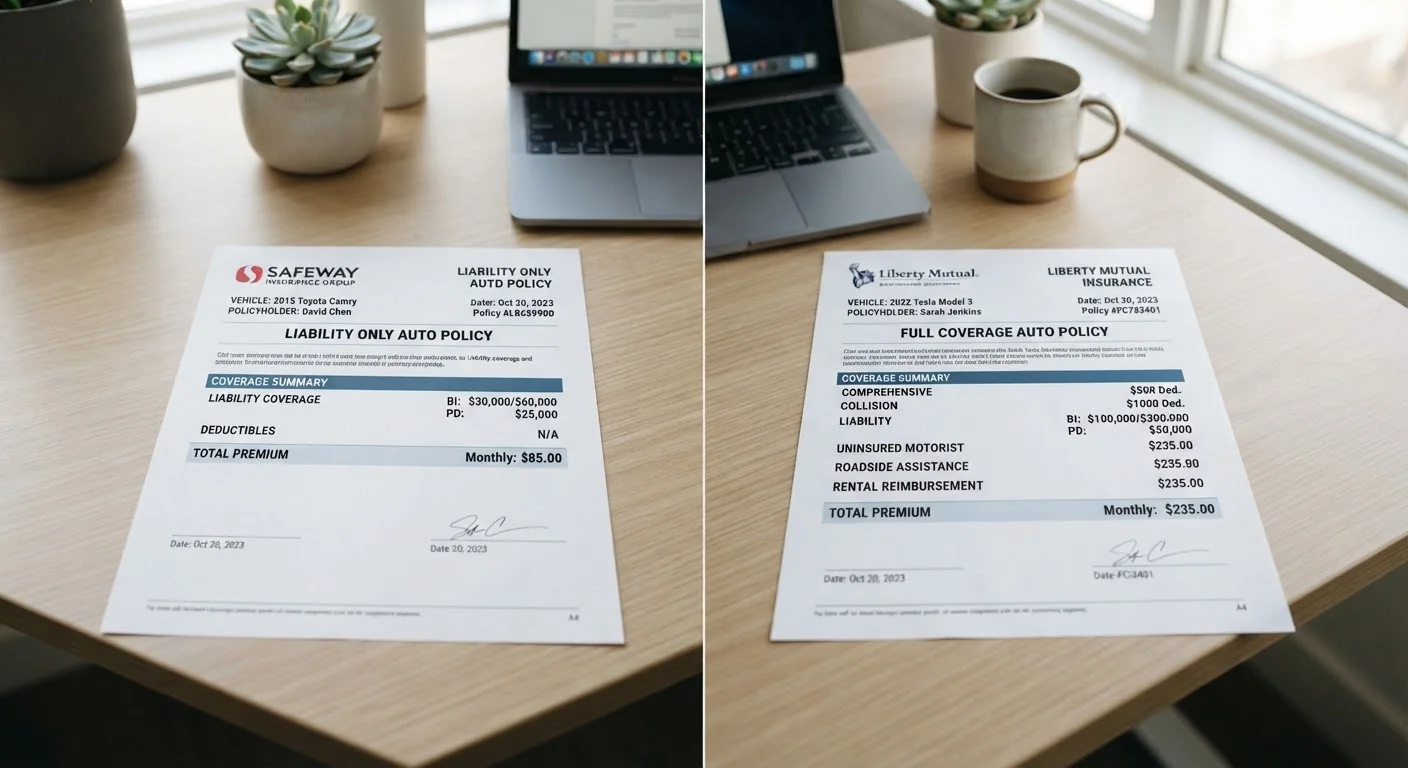
Option A
Liability-Only Coverage
The legally required minimum that protects others, not you.
Best for: Drivers of older, lower-value vehicles who can absorb the cost of repairing or replacing their own car out of pocket.
Option B
Full Coverage
Broader protection that includes damage to your own vehicle.
Best for: Drivers with newer or financed vehicles who need protection against both liability claims and damage to their own car.
What Each Term Actually Means
"Full coverage" isn't a defined industry term - no insurer sells a policy by that name. In practice, it refers to a policy that combines liability coverage with both collision and comprehensive coverage. Liability-only, by contrast, is exactly what it sounds like: coverage that pays for harm you cause to other people or their property.
Liability has two components. Bodily injury liability covers medical costs and related damages for people you injure in a crash you cause. Property damage liability covers repairs to the other driver's vehicle or any property you damage. What liability does not cover - at all - is your own vehicle or your own medical expenses.
Collision coverage pays to repair or replace your car after a crash, regardless of fault. Comprehensive covers non-collision events: theft, fire, flooding, hail, falling objects, and animal strikes. Together, these two fill the gap liability leaves. For a deeper breakdown of each coverage type, see Auto Insurance Decoded.
| Criterion | Liability-Only | Full Coverage |
|---|---|---|
| Covers damage to others | Yes | Yes |
| Covers your own vehicle damage | No | Yes (collision + comprehensive) |
| Covers theft or weather damage | No | Yes (comprehensive) |
| Required by lenders | No | Yes, for financed/leased vehicles |
| Typical premium cost | Lower | Higher |
| Deductible applies | No | Yes (collision and comprehensive) |
| State minimum compliance | Yes, in most states | Yes (exceeds minimum) |
The Financial Risk Each Leaves Uncovered
Carrying only liability means that if you cause an accident, the other driver is protected - but you absorb the entire cost of your own vehicle's damage. If your car is totaled, you walk away with nothing from your insurer. That's a straightforward trade-off when a vehicle has minimal value, but a serious financial exposure when it doesn't.
Full coverage doesn't eliminate all risk either. Both collision and comprehensive come with a deductible - the amount you pay before your insurer covers the rest. Choosing a higher deductible reduces your premium but raises your cost after a claim. Understanding that deductible trade-off is an important part of structuring any policy effectively.
It's also worth knowing that full coverage still leaves gaps - rental reimbursement, gap insurance for underwater loans, and rideshare activity are commonly overlooked. Coverage gaps that catch drivers off guard are worth reviewing once you've settled on a base policy.
~80%
Drivers carrying more than liability-only
According to the Insurance Research Council, roughly 80% of insured drivers in the U.S. carry some form of physical damage coverage beyond liability.
$4,500+
Average collision claim payout
Industry data from the Insurance Information Institute indicates the average collision claim has historically exceeded several thousand dollars, underscoring the exposure of going without it.
How to Think Through Your Own Decision
A widely used rule of thumb: if your annual collision and comprehensive premium exceeds 10% of your vehicle's current market value, carrying those coverages may not be cost-effective. That's a starting point, not a formula - your actual financial cushion matters just as much.
If your car is financed or leased, the choice is already made for you. Lenders require full coverage to protect their collateral. Dropping to liability-only on a financed vehicle typically violates the loan agreement and may trigger lender-placed insurance, which is usually more expensive and less favorable.
Drivers meeting only their state's legal minimum should understand what that actually means in practice. State minimum vs. adequate coverage is a distinction worth making - legal minimums are often lower than what's needed to avoid out-of-pocket liability after a serious at-fault accident.
For more context on how collision and comprehensive work individually, collision vs. comprehensive coverage explains the specific risks each one addresses.
This article provides general information about auto insurance coverage types and is not a substitute for personalised advice from a licensed insurance professional. Coverage terms, exclusions, and availability vary by insurer and state. Always review your actual policy documents and consult a licensed agent for guidance specific to your situation.
The content on this site is for informational purposes only and is not a substitute for professional advice. Always consult a qualified professional for guidance specific to your situation.