

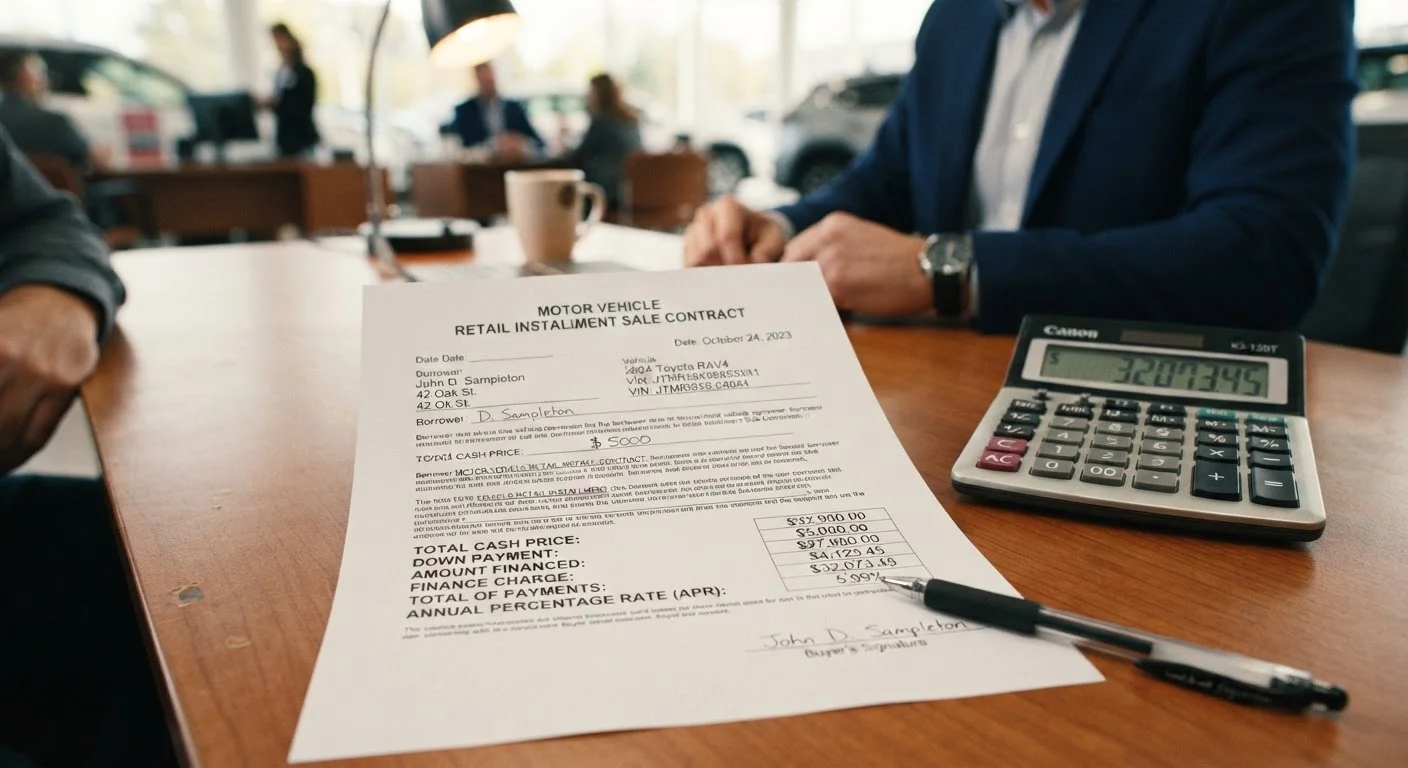
Why the Sticker Price Is Just the Starting Point
Walk into any dealership and you'll encounter a cascade of numbers: MSRP, sale price, advertised price, monthly payment. None of these tell the complete story. The only figure that matters when buying a car is the out-the-door price - the total, final cost you hand over to drive away.
MSRP (Manufacturer's Suggested Retail Price) is the baseline the automaker prints on the window sticker. It covers the vehicle and factory options - nothing else. Advertised prices are often even more misleading, sometimes deducting manufacturer rebates that not every buyer qualifies for. As explained in our piece on common retail pricing tactics, headline numbers are frequently engineered to anchor your expectations low before additional costs are layered on.
The gap between MSRP and your actual payment can run anywhere from a few hundred dollars to several thousand, depending on your state's tax rate and the dealer's fee structure.
What the Out-the-Door Price Actually Includes
A legitimate out-the-door price is an itemized total. Here's what it typically contains:
- Negotiated sale price: The agreed-upon price of the vehicle itself, which may be above or below MSRP depending on market demand and negotiation.
- Sales tax: Calculated as a percentage of the sale price and set by your state and sometimes county or municipality. This is non-negotiable.
- Title fee: The government charge to transfer legal ownership of the vehicle to you.
- Registration fee: The state fee to register the vehicle and issue license plates. Amounts vary significantly by state.
- Documentation fee ("doc fee"): A dealer charge for processing paperwork. This varies widely - from under $100 in some states to several hundred dollars in others. Some states cap it; some don't.
- Dealer add-ons: Items like nitrogen-filled tires, paint sealant, or window tinting that dealers sometimes pre-install and fold into the price. These are often negotiable or removable.
$300-$800
Typical dealer documentation fee range
Documentation fees vary widely by state; some states cap the amount dealers may charge, while others impose no limit.
5%-10%
Common gap between MSRP and out-the-door price
Taxes and fees typically add 5-10% above the negotiated vehicle price, depending on the state and the dealer's fee schedule.
50+
States with unique registration fee structures
Every U.S. state sets its own registration and title fees, meaning out-the-door costs for the same vehicle can differ by hundreds of dollars depending on where you buy.
Understanding each line item protects you from paying for services or products you didn't agree to. Always request a full itemized breakdown - not just a bottom-line total.
Monthly Payments Are Not a Substitute
One of the most common ways buyers lose track of the out-the-door price is by focusing on monthly payments instead. A salesperson who shifts the conversation to "what can you afford per month?" has effectively moved you away from evaluating the actual cost of the vehicle.
Monthly payments can be stretched across longer loan terms to appear smaller while the total amount paid - including interest - grows substantially. Before you consider financing at all, know your out-the-door price. That number is the foundation your loan is built on. Our auto loan basics guide walks through how interest rates and loan terms affect what you ultimately pay over time.
Get the Out-the-Door Price in Writing
Before you discuss financing, trade-ins, or monthly payments, ask for the out-the-door price itemized on paper or via email. This creates a reference point that prevents fees from quietly increasing by the time you reach the finance office. A dealer unwilling to provide this in writing is a signal worth heeding.
Remember: the purchase price is just the beginning of vehicle costs. Ongoing expenses - fuel, insurance, maintenance, and depreciation - add up considerably. See our full breakdown in the true annual cost of owning a car.
How to Use the Out-the-Door Price When Negotiating
The out-the-door price is most powerful when you make it the centerpiece of every conversation with a dealer. Here's a practical approach:
- Ask for it upfront: Before test drives or trade-in discussions, request an itemized out-the-door price quote in writing. Some dealers will push back; that's informative in itself.
- Compare across dealers: With an out-the-door figure from multiple dealers, you're comparing identical measures. Advertised prices are not comparable apples-to-apples.
- Scrutinize every fee: Question any line item you don't recognize. Documentation fees and add-on packages are the most common sources of inflated costs.
- Separate the trade-in: Negotiate the vehicle purchase and your trade-in independently. Bundling them makes it harder to evaluate whether either deal is fair.
If you're considering buying from a private seller rather than a dealership, note that the fee structure changes significantly - there's no doc fee, and some states allow private-sale tax exemptions. Our guide to private seller vs. dealership trade-offs covers what to weigh in that comparison.
State Fees Vary Significantly
Sales tax rates, registration fees, and documentation fee caps differ by state - sometimes by county. A vehicle purchased in one state but registered in another may be subject to the registration state's fee structure. Confirm your state's specific rules before finalizing a budget.
Frequently Asked Questions
The out-the-door price includes the negotiated vehicle sale price, state and local sales tax, title and registration fees, and any dealer documentation fees. Some dealers also include add-ons or dealer-installed accessories, which is why it's important to review a full itemized breakdown.
The vehicle sale price is generally negotiable, and some dealer fees - like documentation fees - may have room for adjustment depending on the dealer. Government fees like taxes, title, and registration are set by the state and are not negotiable.
MSRP, or Manufacturer's Suggested Retail Price, is the base sticker price the automaker recommends - it excludes taxes, fees, and dealer charges. The out-the-door price is always higher than MSRP because it accounts for all the costs required to legally complete the sale and register the vehicle.
Once agreed upon and documented in writing, the out-the-door price should not change at signing. If new charges appear on the final contract, you have the right to ask for an explanation and to walk away if the terms have materially changed.
Not automatically. Trade-in value is typically applied as a credit that reduces the amount you owe, but it's a separate negotiation. Ask the dealer to show you both figures - the out-the-door price of the new vehicle and the trade-in credit - clearly separated so you can evaluate each on its own merits.
The content on this site is for informational purposes only and is not a substitute for professional advice. Always consult a qualified professional for guidance specific to your situation.