

What Tire Pressure Actually Controls
Most drivers associate tire pressure with fuel economy, and that connection is real - underinflated tires create more rolling resistance, which means your engine works harder per mile. But tire pressure does much more than influence your MPG number.
Proper inflation determines how much of the tire's tread actually contacts the road. An underinflated tire bows outward at the sidewalls, shifting contact to the outer edges and wearing those edges faster. An overinflated tire sits too tall, concentrating contact in the center strip and creating a similar uneven wear pattern. Either condition shortens the life of a tire that should otherwise last tens of thousands of miles.
Pressure also shapes the tire's ability to respond to steering inputs. A correctly inflated tire transmits force predictably; a soft or overpressurized tire introduces lag or unpredictability, especially during cornering or sudden lane changes. These differences are subtle at low speeds but become meaningful at highway speeds or in emergency maneuvers.
For a broader look at the habits that accelerate vehicle wear over time, see things that quietly shorten a car's lifespan.
The Safety Risks Most Drivers Underestimate
Tire blowouts are disproportionately caused by underinflation. When a tire runs low on air, the sidewall flexes repeatedly with each rotation. That repeated flexing generates heat, and sustained heat degrades the rubber compounds and internal structure that hold the tire together. At highway speeds, a blowout from a structurally weakened tire can cause rapid loss of vehicle control.
Stopping distance is another underappreciated factor. Research from the National Highway Traffic Safety Administration (NHTSA) has linked tire condition - including pressure - to a meaningful share of tire-related crash involvement. While the contact patch of an underinflated tire is larger, it isn't uniformly engaged, and emergency braking performance can suffer as a result.
1 PSI
Monthly natural tire pressure loss
Tires lose approximately 1 PSI per month through normal permeation, independent of leaks or temperature changes.
~25%
TPMS light activation threshold below target
Most TPMS systems are federally required to warn when a tire reaches 25% below the vehicle's recommended cold inflation pressure.
1 PSI per 10°F
Pressure drop per temperature decrease
The Tire Industry Association notes that tire pressure drops roughly 1 PSI for every 10-degree Fahrenheit drop in ambient temperature.
Overinflation carries its own risks. A tire inflated significantly above the recommended PSI is stiffer and bounces over surface irregularities rather than conforming to them. On wet roads, this reduces hydroplaning resistance and makes the vehicle harder to steer precisely. Neither extreme - too soft nor too firm - is a safe operating condition.
Your dashboard's TPMS light is worth understanding, but don't rely on it exclusively. What your car's warning lights are actually telling you explains when that light activates and what it actually signals - the threshold is often well below where problems start.
How to Check and Adjust Tire Pressure Yourself
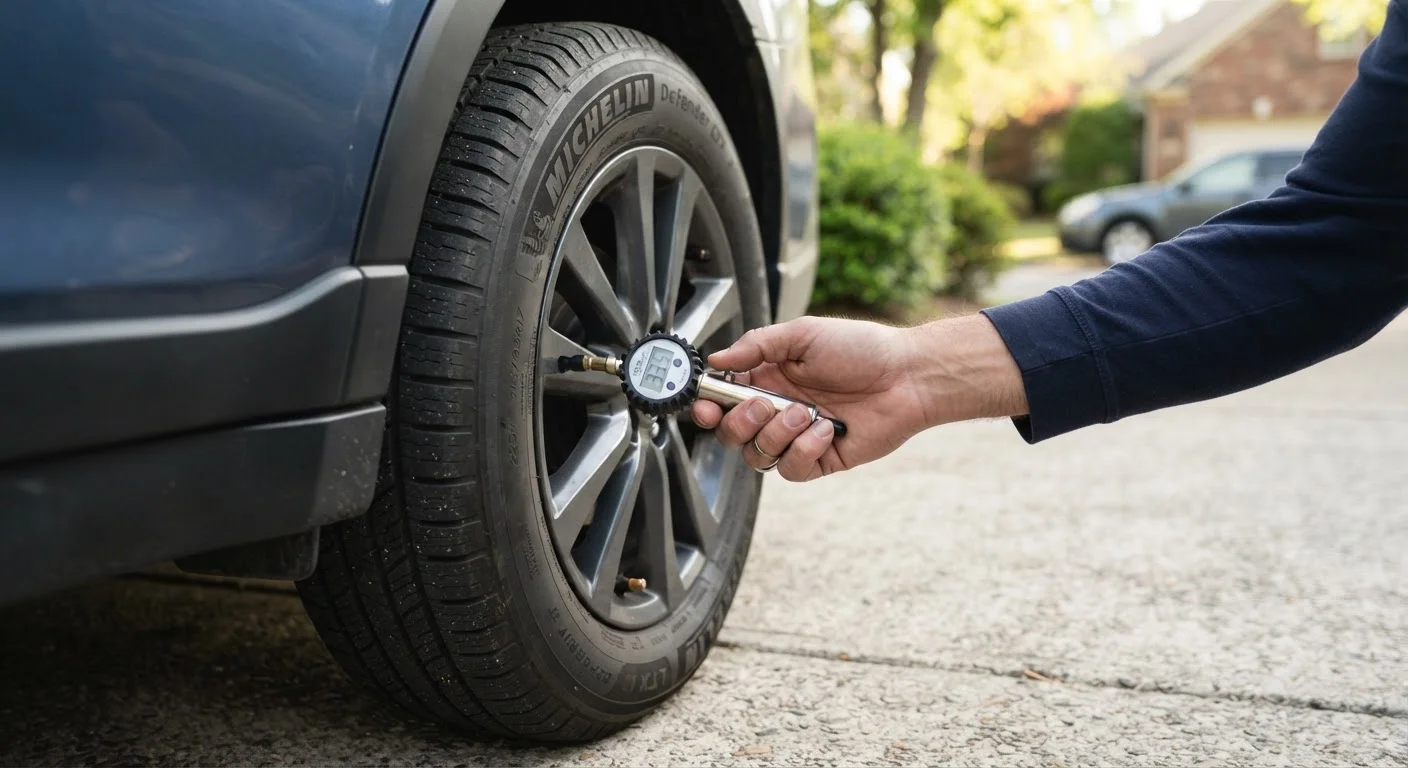
Checking tire pressure is one of the simplest vehicle maintenance tasks, and it requires only a basic gauge - either dial-type or digital. Check pressure when the tires are cold, before the vehicle has been driven more than a mile or two, since driving warms the air inside and raises the reading temporarily.
- Find your target PSI. Check the sticker on the inside edge of the driver's door. The number on the tire sidewall is the maximum the tire can hold structurally - not the pressure your vehicle is designed to run on. These are often different numbers.
- Remove the valve cap on the tire stem and press the gauge firmly onto the valve. A hiss of air means you haven't seated it squarely - reposition and try again.
- Read the pressure and compare it to your door sticker target. Note whether the front and rear axles call for different pressures, which is common on some vehicles.
- Add or release air as needed. Most gas stations have air compressors. To release air, use the small pin inside the valve stem or a tool designed for it. Recheck pressure after each adjustment.
Keep a Gauge in the Glove Box
Station air compressors often have built-in gauges, but their accuracy varies. Keeping a small digital gauge in your glove compartment means you can check pressure anywhere, anytime - at home, before a road trip, or when something feels off. They're inexpensive and last for years.
Temperature matters year-round. Tires drop roughly 1 PSI for every 10°F decrease in ambient temperature. A tire that was correctly inflated in September may be meaningfully low by December. A monthly check takes under two minutes and keeps you ahead of slow leaks and seasonal drops alike.
Pairing tire pressure checks with a quick fluid check makes good sense - fluid checks every driver should know how to do walks through the other under-hood basics that are easy to handle yourself.
Frequently Asked Questions
Once a month is a practical minimum for most drivers. You should also check before long road trips and whenever the outside temperature changes significantly - cold weather in particular causes pressure to drop quickly.
Look for a sticker on the inside edge of the driver's door or door jamb. Your owner's manual also lists the recommended PSI. Ignore the maximum pressure printed on the tire sidewall - that's the tire's structural limit, not what your vehicle needs.
Not reliably. The visual squeeze test is inaccurate at low PSI differences and can't detect a tire that's 5-8 PSI low, which is enough to affect safety. A basic digital gauge costs a few dollars and gives accurate readings in seconds.
Yes. Underinflated tires flex more but don't necessarily grip better in emergency stops - the contact patch deforms unevenly, which can extend stopping distances. The effect is more pronounced on wet or uneven pavement.
The Tire Pressure Monitoring System (TPMS) light signals that at least one tire has dropped significantly below the recommended PSI - typically 25% or more below target. It's a late warning, not an early one, so regular manual checks remain important.
The content on this site is for informational purposes only and is not a substitute for professional advice. Always consult a qualified professional for guidance specific to your situation.