

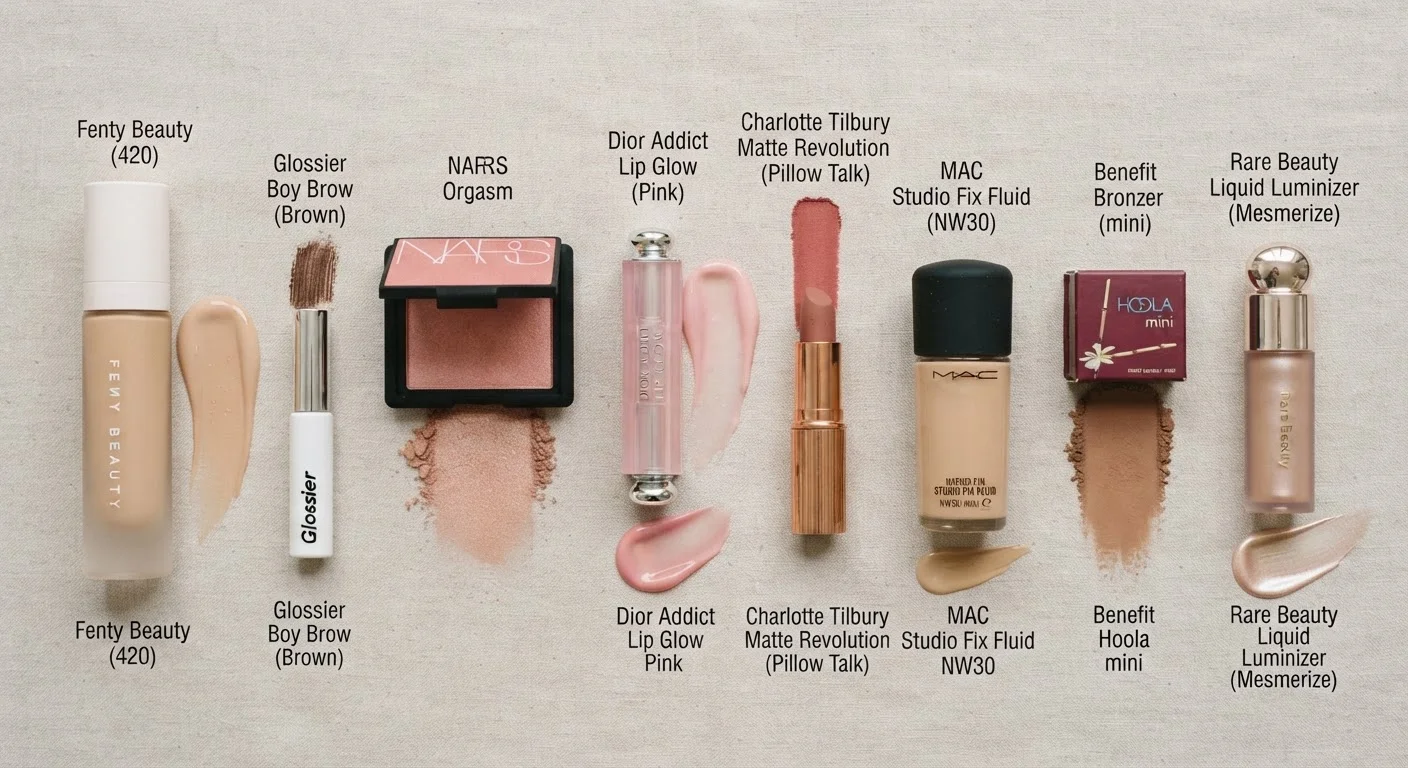
Finish Terminology: What the Glow (or Lack of It) Actually Means
Finish describes how a product looks on the skin after application - specifically how it interacts with light. Most makeup packaging falls into three broad finish categories, with several variations layered on top.
Matte finishes absorb light and produce no visible shine. They tend to read as flat or velvety on the skin and are often associated with oil control. Dewy finishes reflect light and mimic the appearance of well-hydrated skin - sometimes described as 'glowing' or 'luminous.' Satin sits between the two: slightly reflective but not shiny, often the closest to natural skin texture. Labels may also use 'radiant,' 'lit-from-within,' or 'natural' - these typically land in the dewy-to-satin range.
Finish preference is personal, but it can also be practical. If your skin produces excess oil, a dewy foundation may amplify shine by midday. Understanding finish lets you pick what works for your skin rather than relying on marketing imagery. For a deeper look at why formula and finish affect how long makeup stays put, see why your makeup never lasts the full day.
| Matte finish | No shine; absorbs light |
| Dewy finish | Reflects light; looks moisturized |
| Sheer coverage | Evens tone; skin still visible |
| Full coverage | Masks most discoloration and texture |
| "Clean" label claim | Not standardized; defined by each brand |
| Non-comedogenic | Self-regulated; no independent certification |
| Long-wear | Typically implies 8+ hours wear time |
| Buildable formula | Can be layered for more or less intensity |
Coverage Claims: From Sheer to Full and Everything Between
Coverage tells you how much of the skin's surface a product conceals. Most labels use four tiers: sheer, light, medium, and full. Sheer products even out skin tone slightly while letting your natural complexion and texture remain visible. Full-coverage products mask most discoloration, redness, and unevenness under an opaque layer.
The word buildable is especially useful: it signals that the product can be layered. A sheer-to-buildable foundation, for example, can be applied lightly for an everyday look or sheered-in layers for more coverage - giving you flexibility without needing two separate products. The makeup starter kit guide explains how coverage needs often shift as you get more familiar with your own routine.
Coverage and finish are independent variables. You can have a full-coverage matte product or a sheer dewy one - they describe different qualities. Reading both descriptors together gives a much more accurate picture of what you're actually purchasing.
Finish
The visual effect a makeup product leaves on the skin once applied - such as matte, satin, or luminous. Finish is distinct from coverage and describes how light interacts with the product on your face.
Coverage
How much of the skin's surface a product conceals. Sheer coverage lets most of the skin show through; full coverage masks most imperfections and unevenness.
Buildable
A product described as buildable can be layered to increase coverage or intensity without looking cakey or patchy. Starting sheer and adding more gives you control over the final look.
Transfer-resistant
A formula less likely to rub off onto clothing, masks, or surfaces after it has set on the skin. It does not necessarily mean waterproof.
Satin finish
A middle-ground finish between matte and dewy - soft, skin-like, and slightly luminous without visible shine. Often described as the most universally flattering option.
Long-wear
A descriptor indicating the formula is designed to stay in place for an extended period, typically eight hours or more. The claim is general and may not hold under all conditions.
Fragrance-free
No added fragrance ingredients are used in the formulation. This is different from 'unscented,' which may still contain masking fragrance to neutralize odor.
Non-comedogenic
The product is formulated without ingredients known to clog pores. The term is self-regulated and not formally certified, so individual responses can still vary.
Formula Descriptors and What They Signal
Beyond finish and coverage, formula claims describe how a product behaves - on your skin, over time, and in different conditions.
- Long-wear typically implies the formula is designed to stay in place for eight hours or more. This is a general, brand-set claim with no regulatory definition. Environmental conditions, skin type, and prep all affect real-world performance.
- Transfer-resistant means the formula is less likely to rub off after setting. It is not the same as waterproof.
- Waterproof indicates resistance to water, sweat, or humidity - often used for mascara, eyeliner, and lip products. Waterproof formulas typically require an oil-based or dedicated remover.
- Non-comedogenic signals the formula was developed without ingredients known to block pores. The term is self-regulated in the U.S., meaning no independent body certifies it.
- Fragrance-free means no added fragrance was used - distinct from 'unscented,' which may still include masking agents.
Marketing Language vs. Regulated Claims
Terms like 'clean,' 'natural,' 'gentle,' and 'dermatologist-tested' are not regulated by the FDA in the same way drug claims are. They reflect the brand's own standards, which vary widely. When evaluating these claims, look at the ingredient list alongside the label descriptor for a clearer picture. For a parallel look at how ingredient language works in skincare, see our skincare labels guide.
For a side-by-side look at how liquid and powder formulas behave on different skin types, the article powder vs. liquid makeup formulas is a practical companion to this reference. And if you want to go deeper on terminology you'll encounter in tutorials as well as on packaging, our plain-English makeup glossary covers a wider range of terms.
This article is for general informational and educational purposes only. Individual skin responses to cosmetic products vary; consult a dermatologist if you have specific skin concerns or sensitivities.
The content on this site is for informational purposes only and is not a substitute for professional advice. Always consult a qualified professional for guidance specific to your situation.