

Start here
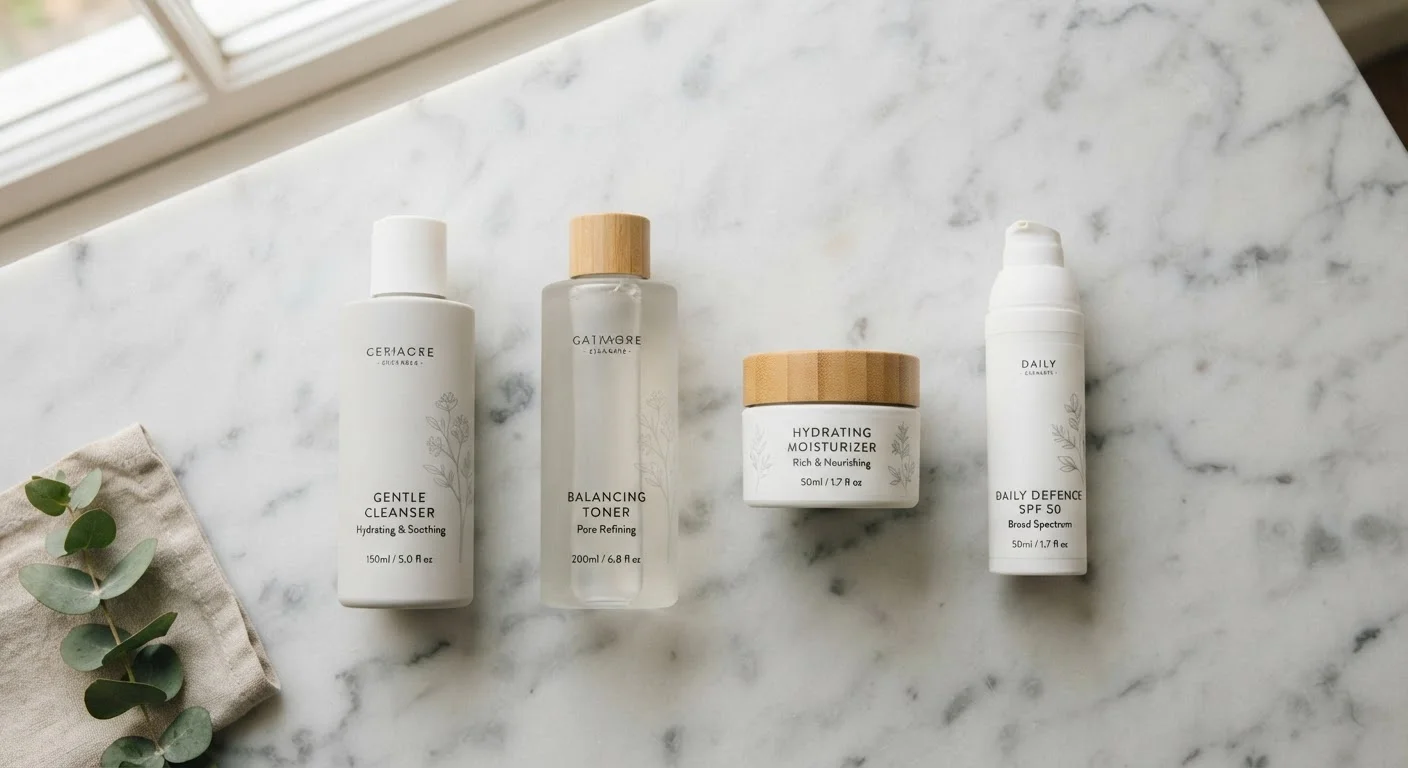
Why Four Steps Are Enough to Start
Build your base
Step 1: Cleanser - Reset Your Skin
Go deeper
Step 2: Toner - Prep and Balance
Seal it in
Step 3: Moisturizer - Lock in Hydration
Protect daily
Step 4: SPF - Your Non-Negotiable Daytime Shield
Apply it
Putting It All Together
Why Four Steps Are Enough to Start
Skincare aisles can feel overwhelming - serums, essences, ampoules, mists - but the science of what healthy skin actually needs each day is far simpler. A four-step routine addresses your skin's most fundamental requirements: removing impurities, restoring balance, maintaining the moisture barrier, and defending against UV damage. Everything beyond that is supplemental.
Complexity is not a proxy for effectiveness. Dermatologists and skin researchers consistently point out that a short, consistent routine performed daily produces better outcomes than an elaborate one used inconsistently. Before layering in active ingredients like retinoids or exfoliating acids, it pays to have these four steps working reliably. See our guide to skincare layering for the logic behind how products interact when you're ready to expand.
pH balance
A measure of acidity or alkalinity on a scale of 0-14. Healthy skin sits around pH 4.5-5.5 (slightly acidic), and maintaining this range helps protect the skin barrier.
Skin barrier
The outermost layer of skin that retains moisture and keeps out irritants. A healthy barrier feels comfortable and resilient; a damaged one may feel tight, flaky, or reactive.
Humectant
An ingredient that draws water into the skin from the environment or deeper skin layers. Glycerin and hyaluronic acid are common examples found in toners and moisturizers.
Broad-spectrum SPF
A sunscreen that protects against both UVA rays (linked to aging and deeper skin damage) and UVB rays (the primary cause of sunburn). Look for 'broad-spectrum' on the label.
Non-comedogenic
A product formulated to avoid clogging pores. Often recommended for oily or acne-prone skin, though no universal standard for this claim exists - individual responses vary.
Step 1: Cleanser - Reset Your Skin
Cleansing removes accumulated sebum, environmental pollutants, sweat, and residual products that sit on the skin's surface. If you skip this step, subsequent products have to work through a layer of debris rather than reaching skin directly.
The goal is to clean without stripping. The skin's outermost layer - the stratum corneum - contains natural lipids that act as a protective barrier. Harsh cleansers disrupt this barrier, leaving skin tight, reactive, or more prone to breakouts. A gentle, pH-balanced formula (typically around pH 4.5-5.5, close to the skin's natural range) does the job without causing that stripped feeling.
- Oily or acne-prone skin: Gel or foaming formulas tend to remove excess oil effectively.
- Dry or sensitive skin: Cream or lotion cleansers are less likely to disturb the moisture barrier.
- Combination skin: A mild gel or micellar water often works well across the T-zone and cheeks.
Cleanse once in the morning and once at night. If you wear sunscreen or makeup, a double cleanse in the evening - an oil-based cleanser first, then a water-based one - helps ensure complete removal.
Step 2: Toner - Prep and Balance
Toner is the most misunderstood step in a basic routine. Historically, toners were astringent formulas designed to remove soap residue - which made sense when bar soaps were common and left an alkaline film on the skin. Modern toners serve a different purpose: they help restore the skin's pH after cleansing, deliver a quick burst of hydration, and prime skin to absorb the moisturizer that follows.
Not everyone needs a toner, and that's fine. If your skin feels balanced after cleansing, skipping toner won't compromise your routine. But if your skin feels tight, dull, or reactive post-cleanse, a simple hydrating toner (look for ingredients like glycerin or hyaluronic acid) may help.
Apply Toner While Skin Is Still Slightly Damp
For best results, apply toner immediately after cleansing - within 30 to 60 seconds - before your skin fully dries. This helps lock in surface moisture and makes the active ingredients in toner more effective. Gently pat it in rather than rubbing to avoid unnecessary irritation.
What to avoid: alcohol-heavy toners that list denatured alcohol high on the ingredient list. These can dry out and irritate skin, particularly if it's already compromised. A well-formulated toner should feel soothing, not stinging.
Step 3: Moisturizer - Lock in Hydration
Moisturizer works through two primary mechanisms. Humectants (such as glycerin and hyaluronic acid) draw water into the skin. Occlusives (such as petrolatum and dimethicone) form a film that slows water loss from the skin's surface. Most well-rounded moisturizers combine both, along with emollients that smooth and soften the skin's texture.
Every skin type benefits from moisturizer - including oily skin. When the moisture barrier is compromised, skin can overcompensate by producing more oil. A lightweight, non-comedogenic gel moisturizer gives oily skin the hydration it needs without adding heaviness. Dry skin generally does better with richer cream formulas.
Don't Skip Moisturizer If You Have Oily Skin
Oily skin still needs hydration. Skipping moisturizer can signal to skin that it needs to produce more sebum to compensate for dryness, potentially worsening oiliness. Choose a lightweight, non-comedogenic gel formula rather than eliminating this step entirely.
Apply moisturizer while your skin is still slightly damp from toner or rinsing - this helps seal in surface moisture. Use it morning and night; your nighttime moisturizer doesn't need to differ from your daytime one unless you choose to add a separate night treatment later.
Step 4: SPF - Your Non-Negotiable Daytime Shield
If you do only one thing from this article, make it SPF. Ultraviolet radiation is the leading environmental cause of skin aging, uneven pigmentation, and - most critically - skin cancer. It affects all skin tones and is present year-round, even through overcast skies and windows.
Sunscreens work in two ways. Chemical (organic) filters absorb UV energy and convert it to heat. Mineral filters (zinc oxide, titanium dioxide) reflect UV rays away from the skin. Both are effective; the choice often comes down to skin sensitivity and texture preference. Mineral formulas are generally better tolerated by reactive skin, while chemical formulas tend to feel lighter under makeup.
Apply SPF as your last step in the morning, after moisturizer. Use enough - about a quarter teaspoon for the face alone - and reapply every two hours if you're spending extended time outdoors. SPF in foundation or tinted moisturizer is not a reliable substitute for a dedicated sunscreen layer; the amount applied is typically too thin to reach the labeled SPF value.
Once your SPF habit is solid, you'll have a complete, functional daytime routine. When you're ready to build beyond it, our retinoids overview is a good next read for understanding one of skincare's most studied active ingredients.
Putting It All Together
The full daytime sequence is: cleanser → toner → moisturizer → SPF. At night, drop the SPF and follow cleanser → toner → moisturizer. The logic behind this order is straightforward - you move from lightest to heaviest, and from cleansing to protecting. Applying in the wrong order can block absorption or reduce a product's effectiveness. Our skincare layering article covers this reasoning in full detail.
Give any new routine at least four to six weeks before evaluating it. Skin cell turnover operates on roughly that timeline, and results - whether improved hydration, fewer breakouts, or more even tone - take time to appear. If you experience persistent irritation, redness, or breakouts after introducing a new product, pause that product and consult a dermatologist.
When you're ready to explore beauty beyond skincare, our makeup starter kit guide applies the same philosophy - focus on essentials first, build from there.
Skincare Layering Guide
Learn the principles behind applying products in the correct order so each one absorbs and functions as intended. A natural next read after completing this routine.
Weekly Body Care Routine
Extend your skincare habits below the neck with a practical weekly checklist covering moisturizing, exfoliation, and other body care essentials.
This article is for general informational and educational purposes only. It does not constitute medical advice. If you have concerns about a skin condition, persistent irritation, or any symptoms, please consult a qualified healthcare professional or dermatologist.
Frequently Asked Questions
Cleansing, moisturizing, and SPF are the most essential daily steps. Toner can be used daily or skipped depending on your skin type and preference. Consistency matters more than perfection - even three reliable steps done every morning is a strong foundation.
Yes. Toner is the most optional step in this routine. If your skin is easily irritated, starting with just cleanser, moisturizer, and SPF is perfectly sound. Introduce a gentle, alcohol-free toner later only if your skin tolerates it well.
Dermatologists generally recommend daily SPF use regardless of weather, because UVA rays - linked to premature aging - penetrate clouds and windows. If you spend significant time near windows or outdoors, daily application is advisable.
Most dermatology organizations suggest a broad-spectrum SPF of at least 30 for everyday use. SPF 50 offers modestly more protection and may be preferable for higher sun exposure or lighter skin tones, but consistent application of any SPF 30+ is the priority.
At night, skip the SPF since it serves no purpose without UV exposure. You may also swap your morning cleanser for a gentler rinse if your skin is dry. Otherwise, a simplified version of the same four steps - cleanse, tone, moisturize - works well as a nighttime routine.
Skin cell turnover takes roughly four to six weeks, so most dermatologists suggest giving a new routine at least that long before judging its effect. Daily SPF and moisturizer benefits - like improved hydration - are often noticeable sooner.
The content on this site is for informational purposes only and is not a substitute for professional advice. Always consult a qualified professional for guidance specific to your situation.