

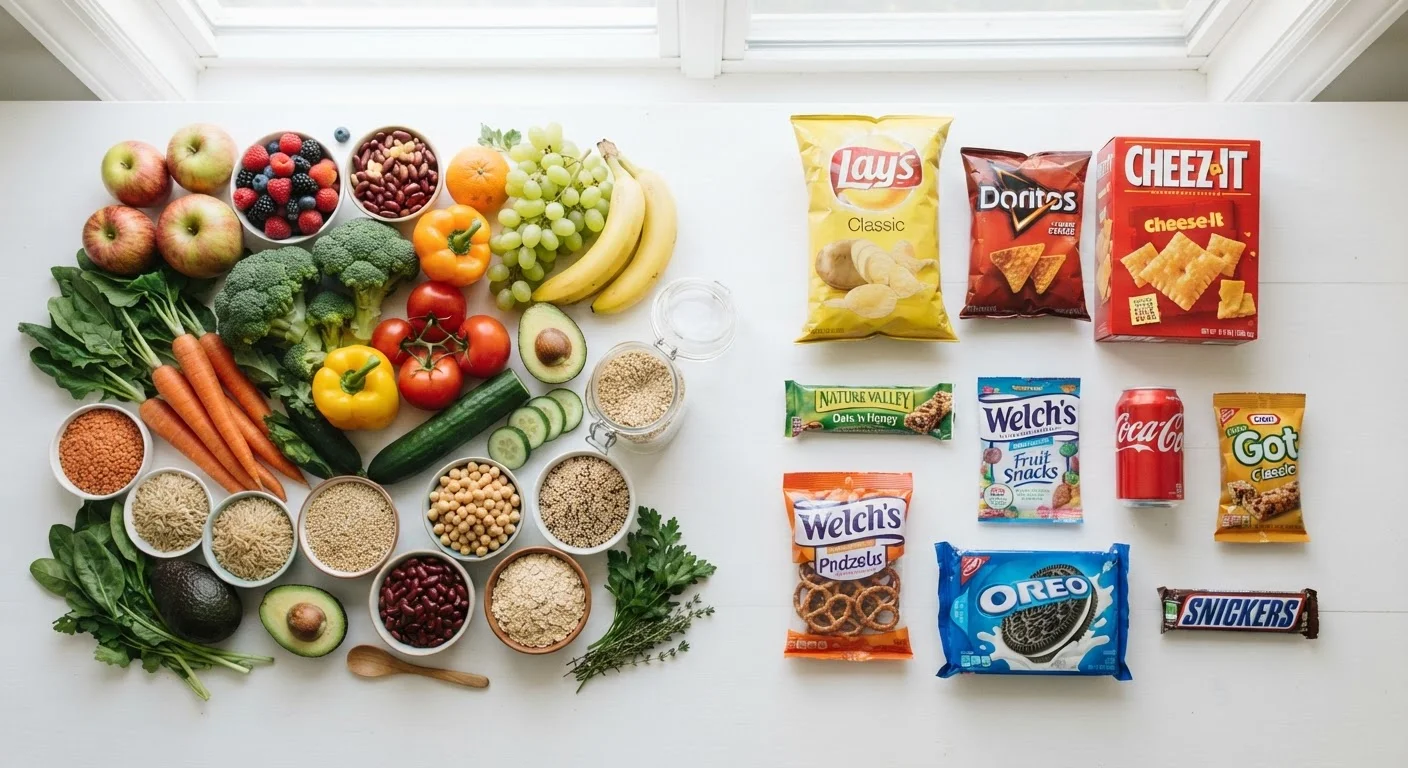
Option A
Whole Foods
Foods in or close to their natural, unaltered state.
Best for: People seeking nutrient density, fiber, and minimal additives as the foundation of their eating pattern.
Option B
Processed Foods
Foods that have been industrially altered from their original form.
Best for: Convenience and accessibility, though the degree of processing varies enormously and matters significantly for health.
Defining the Terms: What 'Whole' and 'Processed' Actually Mean
The word whole food refers to any food eaten in - or very close to - its natural state: a raw apple, a handful of walnuts, dried lentils, a piece of fresh fish, plain oats. Nothing significant has been added, removed, or chemically altered. The plant or animal structure, along with its full complement of fiber, micronutrients, and phytochemicals, remains largely intact.
Processed food is a broader and more contested term. The NOVA classification system, developed by researchers at the University of São Paulo and widely used in nutritional epidemiology, divides foods into four groups based on the extent and purpose of processing - from minimally processed (frozen peas, pasteurized milk) to ultra-processed (packaged snacks, reconstituted meat products, sugar-sweetened beverages with long additive lists). The distinction matters because lumping a can of plain chickpeas together with a shelf-stable snack cake misrepresents the actual nutritional landscape.
What researchers are most concerned about is the ultra-processed end of the spectrum - products manufactured predominantly from industrial ingredients such as refined starches, added sugars, hydrogenated oils, and synthetic flavor or color additives, with little or no whole food remaining in recognizable form.
What the Research Actually Shows
| Criterion | Whole Foods | Ultra-Processed Foods |
|---|---|---|
| Fiber content | Naturally high | Often removed or minimal |
| Added sugar | None or naturally occurring | Frequently high |
| Sodium | Low (naturally) | Often elevated |
| Micronutrient density | High and intact | Lower; some added back synthetically |
| Additives & preservatives | None | Multiple (colors, flavors, emulsifiers) |
| Convenience | Requires more preparation | Ready to eat or quick to prepare |
| Shelf life | Shorter | Extended |
| Satiety per calorie | Generally higher | Generally lower |
Large prospective studies, including analyses from the NutriNet-Santé cohort in France and research published in journals such as The BMJ and JAMA Internal Medicine, have found associations between high ultra-processed food consumption and elevated risks of cardiovascular disease, type 2 diabetes, obesity, and certain cancers. These studies are observational - they show correlation, not direct causation - so findings should be interpreted with appropriate caution.
Mechanically, several pathways are plausible: ultra-processed foods are often energy-dense but fiber-poor, which can impair satiety signaling and gut microbiome diversity. They frequently contain high levels of sodium and added sugar, both linked to cardiometabolic risk when consumed in excess. And some research suggests that the food matrix itself - the physical structure of a whole food - affects how nutrients are absorbed and metabolized, independent of nutrient content alone.
57%
Share of U.S. caloric intake from ultra-processed foods
A 2016 analysis published in BMJ Open estimated that ultra-processed foods account for more than half of calories consumed by American adults.
32%
Higher all-cause mortality risk associated with ultra-processed diets
A large prospective cohort study published in JAMA Internal Medicine found higher all-cause mortality rates among those with the greatest ultra-processed food consumption.
10g+
Daily fiber gap for most Americans
The Dietary Guidelines for Americans identify fiber as a 'nutrient of public health concern,' with most adults consuming well below the recommended 25-38 grams per day.
To understand what you're actually eating, learning to read a Nutrition Facts label is an essential skill. See Reading a Nutrition Facts Label Without the Confusion for a practical walkthrough.
Practical Implications: Moving Toward Whole Foods Without All-or-Nothing Thinking
Dietary patterns - not individual foods - determine long-term health outcomes. A single processed meal does not undermine an otherwise whole-food-anchored diet, and a diet built almost entirely on ultra-processed products is not balanced by occasional salads. The goal for most people is a realistic shift in the ratio, not perfection.
Some minimally processed foods are genuinely convenient and nutritious: frozen vegetables, canned fish, plain yogurt, and whole grain bread (check ingredient lists for whole grain as the first ingredient) fit comfortably into a health-supporting pattern. The line to watch is between minimally processed and ultra-processed - roughly, if a product has more than five ingredients including items you wouldn't find in a home kitchen, it's worth eating less frequently.
The 'Minimally Processed' Middle Ground
Foods like pasteurized milk, plain frozen vegetables, canned tomatoes, and rolled oats are technically processed but retain most of their original nutritional profile. Nutritionists and public health researchers generally do not place these in the same category as ultra-processed products. If your goal is improved diet quality, emphasizing whole foods while allowing minimally processed staples is both nutritionally sound and practical for everyday life.
For those interested in how cooking itself affects nutritional content - since whole foods are often prepared before eating - What Happens to Nutrients When You Cook Food offers useful context. And if you're exploring broader eating patterns, Plant-Based Eating vs. Omnivore Diets examines how food source choices interact with these same principles.
This article is for general informational and educational purposes only and does not constitute medical or dietary advice. Consult a qualified healthcare professional or registered dietitian for guidance tailored to your individual health needs.
The content on this site is for informational purposes only and is not a substitute for professional advice. Always consult a qualified professional for guidance specific to your situation.