

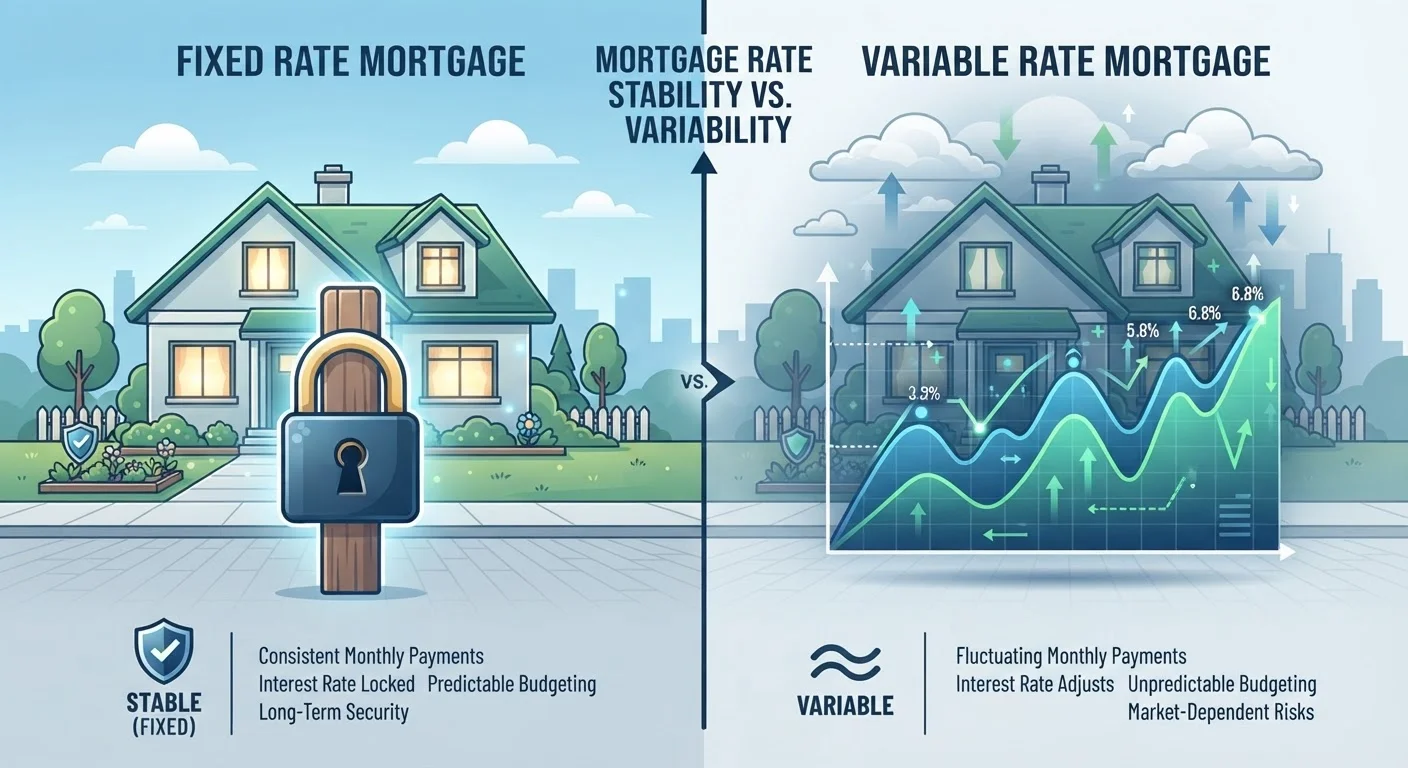
Option A
Fixed-Rate Mortgage
The predictable, stable long-term commitment.
Best for: Buyers who plan to stay in their home for many years and want consistent, budgetable monthly payments.
Option B
Adjustable-Rate Mortgage (ARM)
The flexible, lower-entry-cost alternative.
Best for: Buyers with shorter ownership horizons or those expecting income growth who can tolerate rate variability.
How Each Mortgage Structure Works
When you take out a mortgage, the interest rate structure determines how much you pay each month and how that figure may change over time. The two most common structures - fixed-rate and adjustable-rate - operate on fundamentally different principles.
A fixed-rate mortgage locks in a single interest rate for the full loan term, typically 15 or 30 years. Your principal-and-interest payment remains identical from month one to your final payment, regardless of what happens in broader financial markets. This consistency makes fixed-rate loans straightforward to plan around, which is why they remain the most widely used mortgage type in the United States.
An adjustable-rate mortgage (ARM) works differently. It opens with a fixed introductory period - commonly expressed as 5/1, 7/1, or 10/1 - during which the rate holds steady. After that initial window closes, the rate adjusts periodically (often annually) based on a specified financial index, such as the Secured Overnight Financing Rate (SOFR), plus a margin set by the lender. ARMs include rate caps that limit how much the rate can increase per adjustment and over the loan's life, but your payment can still shift meaningfully when adjustment periods arrive.
Understanding how interest rates affect borrowing costs broadly can help you interpret what a given mortgage rate actually means for your total repayment over time.
| Criterion | Fixed-Rate Mortgage | Adjustable-Rate Mortgage (ARM) |
|---|---|---|
| Interest rate | Locked for the full loan term | Fixed initially, then adjusts periodically |
| Monthly payment stability | Completely predictable | Variable after introductory period |
| Typical initial rate | Higher than ARM intro rate | Lower than fixed rate at origination |
| Rate-change risk | None | Present after fixed period ends |
| Rate caps | Not applicable | Per-adjustment and lifetime caps apply |
| Ideal holding period | Long-term (10+ years) | Shorter-term (5-7 years) |
| Refinancing pressure | Low (only if rates drop significantly) | Higher before adjustment periods |
The Real Trade-Offs Over Time
Choosing between these two structures is ultimately about matching the loan's behavior to your ownership timeline and financial situation.
30 years
Most common fixed-rate mortgage term in the US
The 30-year fixed-rate mortgage has long been the dominant home loan product among American buyers, according to Freddie Mac market data.
5/1
Most common ARM structure at origination
The 5/1 ARM - fixed for five years, then adjusting annually - is historically one of the most frequently originated adjustable-rate products in the US.
2%
Typical per-adjustment rate cap on ARMs
Most ARM products include a periodic cap limiting rate increases to 2 percentage points per adjustment period, though terms vary by lender and product.
With a fixed-rate mortgage, you pay a premium for certainty. When market rates fall well below your locked rate, you lose out unless you refinance - a process that carries its own closing costs. When market rates rise, you're protected, which can represent significant savings over a 30-year term.
An ARM offers a genuine financial advantage during its introductory period. The initial rate is typically lower than prevailing fixed rates, which reduces your payment in early years. The risk arrives at the first adjustment: if the underlying index has risen, your new payment could be substantially higher. Caps limit the damage but don't eliminate it.
Think of this trade-off in terms of fixed versus variable expenses in your broader budget. A fixed-rate mortgage behaves like a fixed expense - it never changes. An ARM introduces a variable component after the introductory period ends.
ARM Rate Caps: What They Protect - and What They Don't
ARM rate caps are expressed in a series like 2/2/5, meaning the rate can rise no more than 2% at the first adjustment, 2% at each subsequent adjustment, and 5% over the life of the loan. While caps limit worst-case outcomes, even a 2% increase in your rate can raise your monthly payment by hundreds of dollars depending on your loan balance. Always model the maximum-rate scenario before committing to an ARM.
If you're still weighing whether homeownership makes sense at all, our guide on renting vs. buying a home examines that broader decision in detail.
The content on this site is for informational purposes only and is not a substitute for professional advice. Always consult a qualified professional for guidance specific to your situation.