

Our Verdict
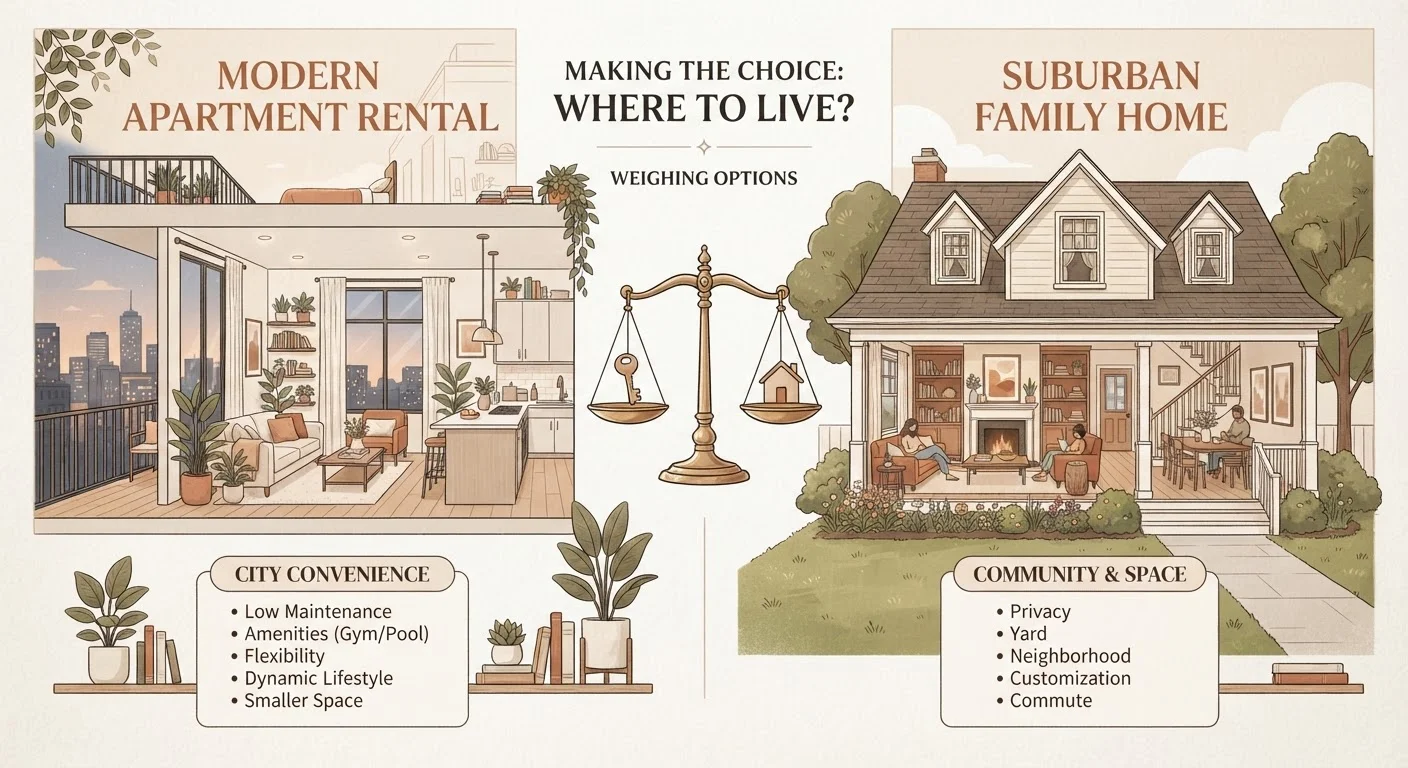
Renting and buying each offer real advantages depending on your financial situation, timeline, and priorities. Buying tends to make stronger financial sense when you plan to stay put for five or more years in a market where prices are reasonable relative to rents. Renting offers lower friction, greater flexibility, and lower financial exposure — advantages that are genuinely valuable for many households.
| Best for | Recommended |
|---|---|
| Those planning to stay in one location for five-plus years | Buying a Home |
| Those who value flexibility or may need to relocate | Renting |
| Those with limited savings or variable income | Renting |
| Those who are financially stable and ready for long-term commitment | Buying a Home |
The 'Throwing Money Away' Myth, Debunked
Few pieces of conventional wisdom are as persistent — or as misleading — as the claim that renting is financially wasteful. The logic sounds intuitive: you pay each month and build no equity. But this framing ignores what renters actually receive in return: housing, maintenance coverage, flexibility, and the freedom to deploy savings elsewhere.
Homeownership, meanwhile, carries costs that rarely appear in casual comparisons. Mortgage interest, property taxes, homeowner's insurance, HOA fees, and maintenance together can represent a significant share of a monthly housing payment. For a fuller picture of these ongoing obligations, see the real price of owning a home.
The honest framing isn't rent versus mortgage — it's two different ways of paying for a place to live, each with its own financial profile and set of trade-offs.
Use a Price-to-Rent Ratio as a Starting Point
Divide a home's purchase price by the annual rent for a comparable property. A ratio below 15 generally favors buying; above 20 often favors renting. This is a rough benchmark, not a decision rule — local conditions, your timeline, and financial situation all matter significantly.
Comparing the Core Financial Trade-Offs
Both renting and buying involve real costs and real benefits. The key is understanding which costs are visible and which are hidden in each path.
| Renting | Buying | |
|---|---|---|
| Upfront costs | Security deposit, first/last month | Down payment, closing costs (6–23% of price) |
| Monthly cost predictability | Fixed term, subject to renewal increases | Fixed mortgage; variable taxes, insurance, repairs |
| Equity building | None directly | Yes, through principal paydown and appreciation |
| Maintenance responsibility | Landlord typically covers most repairs | Owner fully responsible |
| Flexibility to relocate | High — lease terms are relatively short | Low — selling takes time and costs money |
| Customization | Limited by lease terms | Full control within local regulations |
| Market risk exposure | Minimal — no property value risk | Significant — values can fall as well as rise |
Renters generally avoid the large upfront capital outlay of a down payment and closing costs — often 3–6% of the purchase price on top of a 3–20% down payment. That preserved liquidity can be invested or kept as an emergency buffer. For a granular breakdown of how the full financial comparison plays out over time, renting vs. owning beyond the monthly payment is a useful companion read.
Buyers, on the other hand, build equity as they pay down principal and — in appreciating markets — as property values rise. That equity can eventually be tapped or converted into proceeds upon sale. However, appreciation is never guaranteed, and selling a home too soon after purchase often results in a net loss once transaction costs are factored in.
The Time Horizon Question
One of the clearest determinants of which option makes more financial sense is how long you plan to stay. Buying involves substantial transaction costs on both ends — closing costs when you purchase and agent commissions plus transfer taxes when you sell. These costs typically take several years to recoup through equity gains.
A commonly cited guideline suggests that staying in a home for at least five years improves the likelihood that buying will outperform renting financially, though local market conditions matter enormously. In high-cost cities where the price-to-rent ratio is elevated, that break-even point may stretch further. In more affordable markets, the math can tip sooner.
If your career, family situation, or personal goals suggest you may relocate within a few years, renting typically carries lower financial risk. How to think through the rent-or-buy decision explores additional factors worth weighing before committing.
Lifestyle and Non-Financial Considerations
Financial analysis alone doesn't capture the full picture. Homeownership offers stability, the ability to customize your space, and a sense of permanence that many people genuinely value. It also comes with responsibilities: coordinating repairs, managing maintenance reserves, and navigating the administrative demands of property ownership.
Renting offers mobility and a lower administrative burden. When a major appliance breaks or the roof needs repair, those costs fall on the landlord, not the tenant. That said, renters have less control over their housing situation — a landlord can choose not to renew a lease, or sell the property, potentially displacing tenants.
It's also worth noting that renters face their own set of costs beyond base rent. Security deposits, pet fees, renter's insurance, and parking can add up. See the true cost of renting for a full accounting.
Don't Overlook the Cost of Moving Too Soon
Buying a home and selling within a few years can result in a net financial loss once agent commissions, closing costs, and transaction fees are accounted for. Before purchasing, honestly assess how likely you are to remain in the area for at least five years. Relocating sooner can erode or eliminate any equity gains.
Making a Decision That Fits Your Situation
The rent-or-buy decision is genuinely personal. Useful questions to ask include: How stable is my income? Do I have sufficient savings for a down payment and reserves? How long do I expect to stay in this area? What does the local price-to-rent ratio look like?
If you're considering buying, understanding mortgage structures is essential — fixed-rate vs. adjustable-rate mortgages explains the trade-offs each loan type carries. And before assuming you know what homeownership requires, it's worth examining common homebuying myths that can distort expectations.
Neither choice is a permanent identity — many people rent at one stage of life and own at another. What matters is making a decision with clear eyes about the real costs, benefits, and risks on both sides.
This article is for general informational and educational purposes only and does not constitute personalized financial, legal, or real estate advice. Readers should consult a qualified financial adviser or real estate professional regarding their individual circumstances.
The content on this site is for informational purposes only and is not a substitute for professional advice. Always consult a qualified professional for guidance specific to your situation.