

Our Verdict
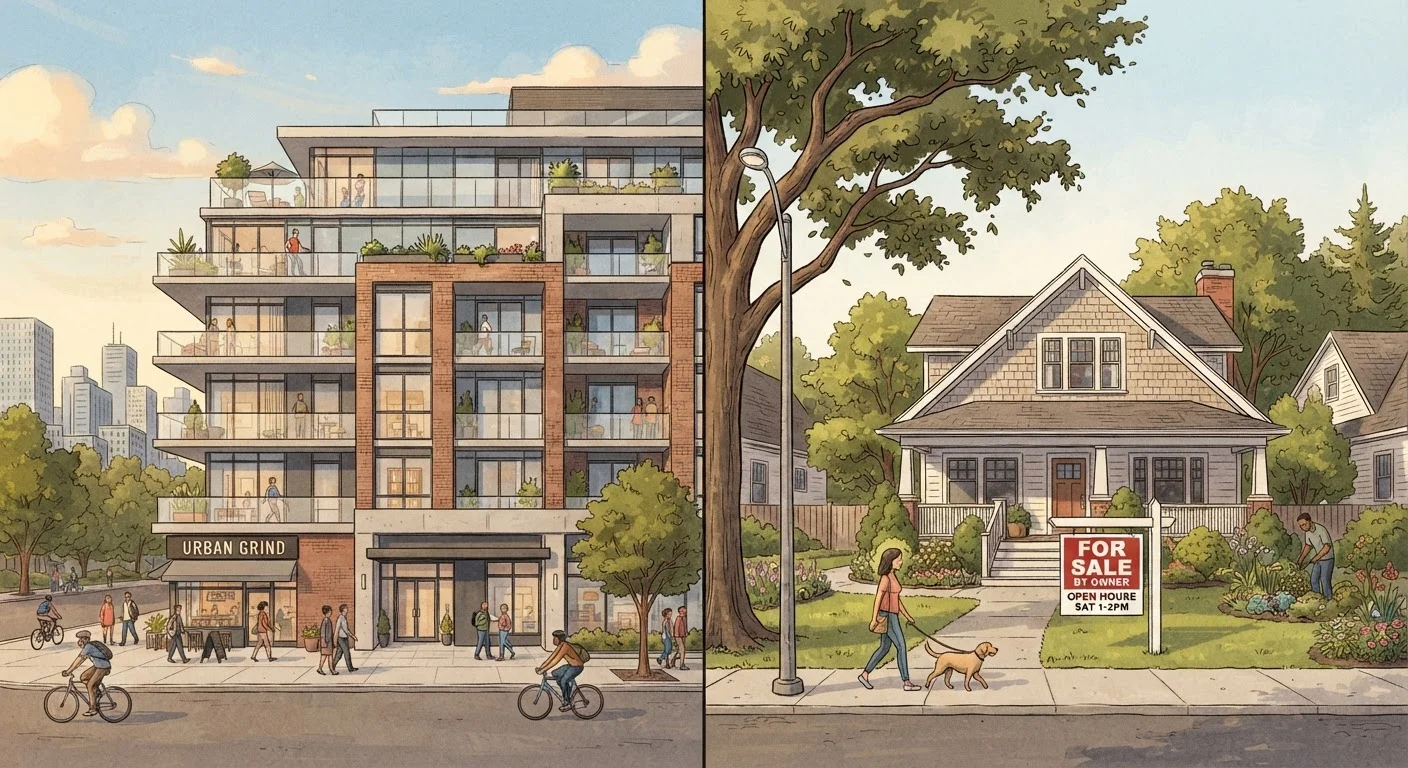
Neither renting nor buying is universally superior - the right answer depends on your financial readiness, how long you plan to stay, and your personal priorities. Buying tends to reward those with stable income, a strong down payment, and a multi-year horizon. Renting suits those who value flexibility, are building savings, or live in high-cost markets where buying pencils out poorly.
| Best for | Recommended |
|---|---|
| Those planning to stay in one location for five or more years | Buying |
| Those who value flexibility or expect to relocate within a few years | Renting |
| Those with strong savings, stable income, and readiness for ongoing maintenance costs | Buying |
| Those still building their financial foundation or living in high-cost markets | Renting |
Why the Monthly Payment Comparison Misleads
Most people begin the renting-versus-buying conversation by comparing a monthly rent payment to a prospective mortgage payment. That comparison is a starting point, not a conclusion. A mortgage payment covers principal and interest - but homeownership adds property taxes, homeowners insurance, private mortgage insurance (if your down payment is below 20%), HOA fees where applicable, and maintenance costs that renters simply don't carry.
Renters pay one monthly figure and walk away. Homeowners face a broader, less predictable cost structure. The full financial comparison beyond the monthly payment commonly estimates maintenance alone at 1-2% of a home's value annually - a meaningful figure on a $350,000 property. Understanding those layers is essential before treating the mortgage payment as a like-for-like substitute for rent.
| Renting | Buying | |
|---|---|---|
| Upfront costs | Security deposit (1-2 months rent) | Down payment plus 2-5% closing costs |
| Monthly cost predictability | Subject to rent increases at renewal | Fixed-rate mortgage holds steady |
| Equity building | None | Yes, over time with each payment |
| Maintenance responsibility | Landlord handles most repairs | Owner bears full cost and responsibility |
| Flexibility to relocate | High - end lease and move | Low - selling takes time and costs money |
| Customization | Limited by lease terms | Full control over modifications |
| Best time horizon | Short to medium term (under 5 years) | Long term (5+ years) |
The Case for Buying
Homeownership offers several genuine financial and lifestyle advantages. Equity accumulation is the most significant: each mortgage payment that reduces your principal balance builds an ownership stake that grows alongside property appreciation. Over a long enough time horizon - typically five years or more - that equity can represent meaningful wealth.
Fixed-rate mortgages also deliver payment stability that rent increases cannot match. A landlord can raise rent at lease renewal; a 30-year fixed mortgage holds its principal-and-interest payment constant throughout. For households planning to stay put, that predictability has real value.
Ownership also confers control. Homeowners can renovate, repaint, adopt pets, and otherwise customize their space without landlord approval. And in some circumstances, the mortgage interest deduction and property tax deductions may reduce federal tax liability - though the actual benefit depends on individual tax situations and whether you itemize. Consult a tax professional for guidance specific to your circumstances.
Run the Numbers for Your Specific Market
National averages rarely capture what renting or buying actually costs in your city or neighborhood. Before deciding, compare realistic all-in costs - mortgage, taxes, insurance, and maintenance versus local rent - for properties at the same quality level. Online rent-vs-buy calculators can help structure that comparison, but treat results as estimates rather than guarantees.
The Case for Renting
Renting is frequently framed as "throwing money away," but that framing is misleading. Common myths about renting obscure a clear reality: rent buys you housing - a real and necessary service. The money that renters don't tie up in a down payment can be invested or kept liquid for other goals.
Flexibility is renting's most underrated advantage. A lease can be ended; a home requires a transaction to exit, which typically costs 6-10% of the sale price in agent commissions and closing costs. For anyone facing career uncertainty, potential relocation, or life transitions, that liquidity is valuable. In high-cost metro areas, renting can also be the financially rational choice simply because price-to-rent ratios make ownership prohibitively expensive relative to income.
For a broader look at the trade-offs, the real trade-offs between renting and homeownership go well beyond the "wasted money" narrative.
~5 years
Typical break-even horizon for buying vs. renting
The exact break-even point varies significantly by local market, purchase price, and mortgage terms.
6-10%
Typical cost to sell a home
Seller-side costs including agent commissions and closing fees reduce the net proceeds from any home sale.
1-2%
Annual maintenance cost estimate for homeowners
Housing researchers commonly use 1-2% of a home's value as a rough annual maintenance benchmark, though actual costs vary.
Key Questions to Frame Your Decision
Rather than asking "which is better," a more useful approach is to ask a set of diagnostic questions about your own situation:
- How long will you stay? The break-even point - when buying becomes cheaper than renting after factoring in all costs - commonly falls between three and seven years depending on local markets. A two-year horizon typically favors renting.
- What is your financial foundation? A conventional mortgage typically requires a 20% down payment to avoid PMI, plus closing costs of 2-5% of the purchase price. Buying before savings are ready can strain household finances.
- How stable is your income? Homeownership is a long-term financial commitment with fixed obligations. Variable income or employment uncertainty increases risk.
- What does the local market look like? Price-to-rent ratios vary enormously by city. In some markets, renting and investing the difference is the stronger financial strategy; in others, buying accelerates wealth building.
This kind of decision framework applies across major financial choices. The financing versus leasing comparison for vehicles surfaces a similar dynamic: headline monthly numbers mask the full picture of ownership costs and long-term value.
Don't Let Social Pressure Drive the Decision
The pressure to buy a home as a milestone of adulthood is real - but buying before you're financially ready can cause lasting harm to your balance sheet. Stretching too thin on a down payment, overextending on a mortgage, or buying in the wrong market at the wrong time can be costly to unwind. Make this decision based on your own financial picture and goals, not on timelines others expect.
Making the Decision With Confidence
There is no universal right answer to the rent-or-buy question. The decision is personal, financial, and local all at once. A household in a stable market with a strong down payment and a five-plus-year plan may find buying clearly advantageous. A household in a high-cost city with career mobility needs may find renting the smarter path for years.
What matters is making the decision with full information rather than defaulting to social pressure or oversimplified comparisons. The renting basics hub and the homeownership costs hub offer deeper context on each side of the equation.
Working with a licensed financial advisor or HUD-approved housing counselor can also help you model the numbers specific to your market, income, and goals before committing to either path.
This article is for general informational and educational purposes only and does not constitute financial, legal, or tax advice. Please consult a qualified financial professional for guidance specific to your situation.
The content on this site is for informational purposes only and is not a substitute for professional advice. Always consult a qualified professional for guidance specific to your situation.