

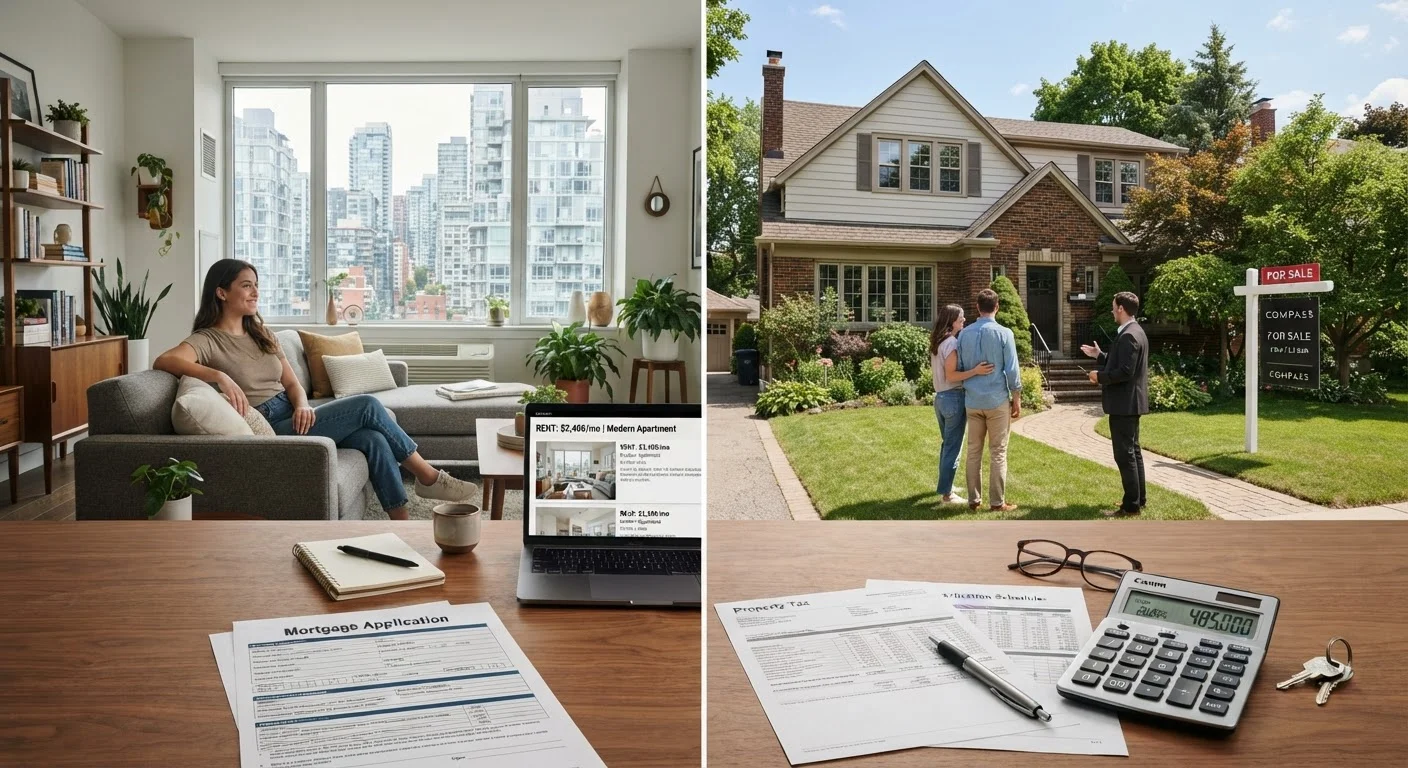
Option A
Renting
The flexible, lower-commitment path with predictable monthly outlay.
Best for: Households prioritizing mobility, lower upfront costs, and freedom from maintenance responsibilities.
Option B
Owning
The long-term wealth-building path with broader financial obligations.
Best for: Households planning to stay put long-term and prepared to absorb the full costs of homeownership.
Why the Monthly Payment Comparison Falls Short
When people compare renting and owning, the conversation almost always starts — and too often ends — with the monthly payment. But stacking a rent check against a mortgage statement is like comparing two restaurant tabs while ignoring the tip, the parking, and the coat check. The full financial picture is significantly more complex for both sides.
For renters, the true cost of renting includes renter's insurance, utilities not covered by the landlord, pet fees, parking, and security deposits. For homeowners, the costs that sit on top of a mortgage payment are numerous and often underestimated. Understanding both sets of costs — not just the headline number — is essential to making a sound financial comparison. This article is general financial education; individual circumstances vary, and a qualified financial adviser can help you model your specific situation.
| Criterion | Renting | Owning |
|---|---|---|
| Upfront costs | Security deposit (1–2 months rent) | Down payment plus 2–5% closing costs |
| Monthly housing payment | Rent (set by lease) | Principal, interest, taxes, insurance |
| Maintenance & repairs | Landlord's responsibility | Owner's responsibility (budget 1–2% of value/year) |
| Property taxes | Not directly paid | Paid by owner; varies by location |
| HOA fees | Rare; some buildings charge fees | Common in planned communities |
| Equity building | None | Yes — through paydown and appreciation |
| Exit costs | Minimal (standard notice period) | 5–8% of sale price in typical transaction costs |
| Exposure to cost increases | Rent increases at lease renewal | Fixed mortgage rate; taxes/insurance can rise |
The True Cost of Renting
Renting offers a relatively contained cost structure. Your largest variable is the rent itself, which is set by a lease agreement. Beyond that, renters typically pay for utilities, renter's insurance (usually $15–$30 per month for basic coverage), and any building-specific fees such as parking or storage. Move-in costs — typically a security deposit equal to one or two months' rent — are real but recoverable.
What renters don't pay is equally important: no property taxes, no homeowner's insurance (which runs significantly higher than renter's insurance), no major repair bills, and no HOA fees. When an appliance breaks, the landlord is responsible. This predictability has genuine financial value. The tradeoff is the absence of equity. Every rent payment transfers wealth to a landlord rather than building an ownership stake. Renters also face the risk of rent increases at lease renewal — a real vulnerability in high-demand markets.
For a deeper look at how lease structures affect your exposure to cost changes, see month-to-month vs. fixed-term leases.
The True Cost of Owning
A mortgage payment covers principal and interest — but homeownership stacks several more ongoing costs on top. Property taxes vary widely by location but often add hundreds of dollars per month to effective housing costs. Homeowner's insurance is required by most lenders and typically costs more than renter's coverage. If the home is in a planned community, HOA fees can range from modest to substantial.
The cost category that surprises most first-time owners is maintenance. A commonly cited rule of thumb is to budget 1–2% of the home's value annually for upkeep and repairs — on a $350,000 home, that's $3,500–$7,000 per year, or roughly $300–$580 per month that doesn't appear anywhere in the mortgage statement. Larger capital expenses — a new roof, HVAC system, or water heater — can cost thousands in a single year.
1–2%
Annual home maintenance budget rule of thumb
Financial planners commonly cite 1–2% of a home's purchase price as an annual maintenance reserve; older homes may require more.
5–8%
Typical total transaction cost when selling a home
Seller-side closing costs, agent fees, and related expenses have historically totaled 5–8% of the sale price, representing a significant break-even hurdle.
5+ years
Common break-even horizon for buying vs. renting
Many financial analyses suggest homeowners typically need five or more years in a home to recover purchase transaction costs through equity and appreciation, though this varies by market.
There are also significant transaction costs at both ends of a purchase. Closing costs typically run 2–5% of the loan amount when buying. Selling involves agent commissions and fees that have historically totaled around 5–6% of the sale price, though this is evolving following recent industry changes. These costs must be recovered through appreciation and equity before ownership becomes financially advantageous over renting — which is why short time horizons often favor renters.
For more on how mortgage structure affects long-term cost, see fixed-rate vs. adjustable-rate mortgages.
Equity, Opportunity Cost, and the Wealth Question
The financial case for owning has historically rested on equity accumulation — the portion of each mortgage payment that reduces your loan balance, combined with property appreciation over time. Over long hold periods in appreciating markets, this has produced meaningful wealth for many households. But it's not automatic, and it's not guaranteed.
Renters who invest the difference between a mortgage payment (including all ownership costs) and their rent can also build wealth — through financial markets, retirement accounts, or other vehicles. Whether they actually do is a behavioral question as much as a mathematical one. The opportunity cost of a down payment is also real: capital tied up in a home cannot be deployed elsewhere.
The honest answer is that neither path is universally superior. Local market conditions — price-to-rent ratios, property tax rates, and historical appreciation — matter enormously. So does how long you stay. Understanding the real trade-offs between renting and buying means setting aside the myth that renting is always "throwing money away" while also not treating homeownership as a guaranteed investment. For personalized guidance, consult a licensed financial adviser who can model your specific numbers.
Building a realistic housing budget for either path starts with budgeting basics — tracking all costs, not just the monthly payment.
The content on this site is for informational purposes only and is not a substitute for professional advice. Always consult a qualified professional for guidance specific to your situation.