

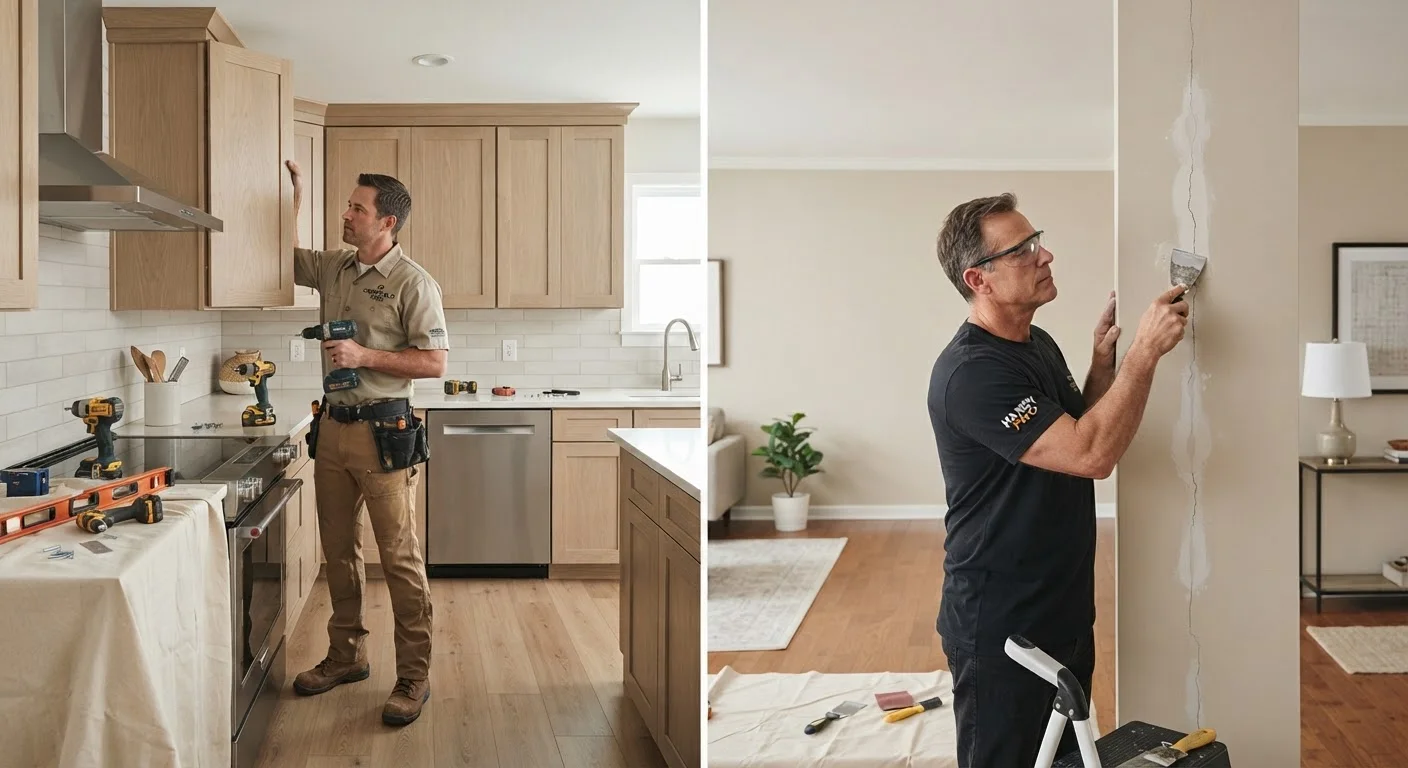
Option A
Capital Improvements
The investment that adds lasting value to your home.
Best for: Homeowners looking to increase property value, extend useful life, or adapt the home to a new use — with potential tax benefits at sale.
Option B
Routine Repairs
The ongoing upkeep that keeps your home functional.
Best for: Homeowners managing day-to-day maintenance costs that restore existing function without materially adding value or extending life.
Defining the Two Categories
At the core of this distinction is a practical question: does the spending add something new or meaningfully better, or does it simply restore what was already there?
A capital improvement is any project that materially adds value to your home, meaningfully prolongs its useful life, or adapts it to a new use. Examples include adding a bedroom, replacing the entire roof system, installing central air conditioning where none existed, or converting a garage into livable space. These are projects that leave the property in a substantially better condition than before.
A routine repair, by contrast, keeps the home in its current condition. Fixing a leaking pipe, patching a section of drywall, replacing a broken window pane, or repainting weathered trim — these restore function without materially upgrading it. Think of repairs as the cost of preserving what you already have. This maps closely to how variable versus fixed expenses work in a household budget — one type is predictable and ongoing, the other is occasional but significant.
The line is not always crisp. Replacing a handful of broken roof shingles is a repair; replacing the entire roof is generally a capital improvement. Scope, permanence, and the degree of enhancement all factor in.
| Criterion | Capital Improvements | Routine Repairs |
|---|---|---|
| Primary purpose | Add value, extend life, or adapt use | Restore existing function |
| Effect on cost basis | Increases adjusted cost basis | No effect on cost basis |
| Typical scale | Larger, less frequent projects | Smaller, recurring expenses |
| Examples | New roof, room addition, HVAC install | Patching drywall, fixing a leak, repainting |
| Rental property treatment | Depreciated over time (IRS schedule) | Deductible as ordinary business expense |
| Documentation needed | Essential — receipts, contracts, permits | Good practice, less critical for taxes |
| Budget planning approach | Planned savings, longer horizon | Maintenance reserve, emergency fund |
Why the IRS Cares — and Why You Should Too
For homeowners, the distinction carries real financial weight when it comes time to sell. The IRS allows you to add documented capital improvements to your home's cost basis — essentially, what you paid for the property. A higher cost basis means a smaller taxable gain when you eventually sell.
For example, if you paid $350,000 for your home and spent $40,000 on qualifying capital improvements over the years, your adjusted cost basis becomes $390,000. If you later sell for $600,000, your gain for tax purposes is $210,000, not $250,000 — a meaningful difference, even with the primary-residence exclusion available to many sellers.
$500,000
Primary-residence capital gains exclusion (married filing jointly)
The IRS allows eligible married couples to exclude up to $500,000 in capital gains from a primary home sale, making cost-basis tracking especially valuable for higher-value markets.
1–4%
Annual home maintenance cost as share of home value
Industry guidance commonly estimates that annual maintenance and repair costs range from 1% to 4% of a home's value, depending on age, location, and condition.
27.5 years
IRS depreciation schedule for residential rental property improvements
The IRS requires that capital improvements on residential rental properties be depreciated over 27.5 years rather than deducted in the year of the expense.
Routine repairs do not adjust your cost basis for personal residences. They are simply costs of ownership, much like utility bills. However, the calculus is different for rental property owners: repairs on a rental may be deducted as ordinary business expenses in the year they occur, while improvements must be depreciated over time according to IRS schedules.
This is general information — tax treatment depends on your individual circumstances, the property's use, and current tax law. Always consult a qualified tax professional before making decisions based on cost basis or deductions.
Common Examples That Trip Homeowners Up
Some spending genuinely straddles both categories, and the IRS acknowledges this complexity. A few scenarios worth understanding:
- HVAC replacement: Replacing an entire system with a new, higher-efficiency unit is typically a capital improvement. Servicing or repairing the existing unit is a routine repair. See our overview of which home systems are expensive to replace and when they typically fail to anticipate when these costs may arise.
- Kitchen updates: Replacing worn cabinet hardware is a repair. A full kitchen remodel with new cabinetry, countertops, and layout changes is a capital improvement.
- Flooring: Patching damaged hardwood is a repair. Installing hardwood throughout a previously carpeted home is an improvement.
- Painting: Interior or exterior painting is generally treated as a repair — unless done as part of a larger qualifying improvement project.
Careful recordkeeping is the practical takeaway. Retain all invoices, contracts, and permits for any project that could qualify as a capital improvement. Without documentation, you cannot support the cost-basis adjustment if your return is ever reviewed.
It is also worth considering how these costs fit into your broader planning. The 1% annual maintenance guideline is often cited as a rough budgeting benchmark, though it has real limitations depending on home age and local market conditions.
Planning Your Home Budget Around Both Categories
Understanding the distinction is not just a tax exercise — it shapes how you plan and save. Capital improvements tend to be larger, less frequent, and ideally scheduled. Routine repairs are smaller but relentless and often unpredictable.
A practical approach is to maintain separate mental — or actual — buckets for each. Your home maintenance reserve should be funded with routine repair costs in mind, sized to handle the breakdowns that happen without warning. Improvement projects, by contrast, often benefit from longer planning horizons: saving deliberately, timing projects to market conditions, and evaluating return on investment before committing.
Integrating both into a broader financial picture is also worthwhile. Your annual home financial review is an ideal moment to assess what improvements are on the horizon, whether your maintenance reserve is adequately funded, and how each category of spending fits into your overall financial picture.
Owners who build these habits early tend to be better positioned over time. For a broader view of how these practices compound over decades, see our piece on long-term financial habits in homeownership.
This article is for general informational and educational purposes only and does not constitute tax, legal, or financial advice. Tax treatment of home expenses depends on individual circumstances, property use, and applicable law. Consult a qualified tax professional or financial adviser for guidance specific to your situation.
The content on this site is for informational purposes only and is not a substitute for professional advice. Always consult a qualified professional for guidance specific to your situation.