

Why the Label Matters More Than the Marketing
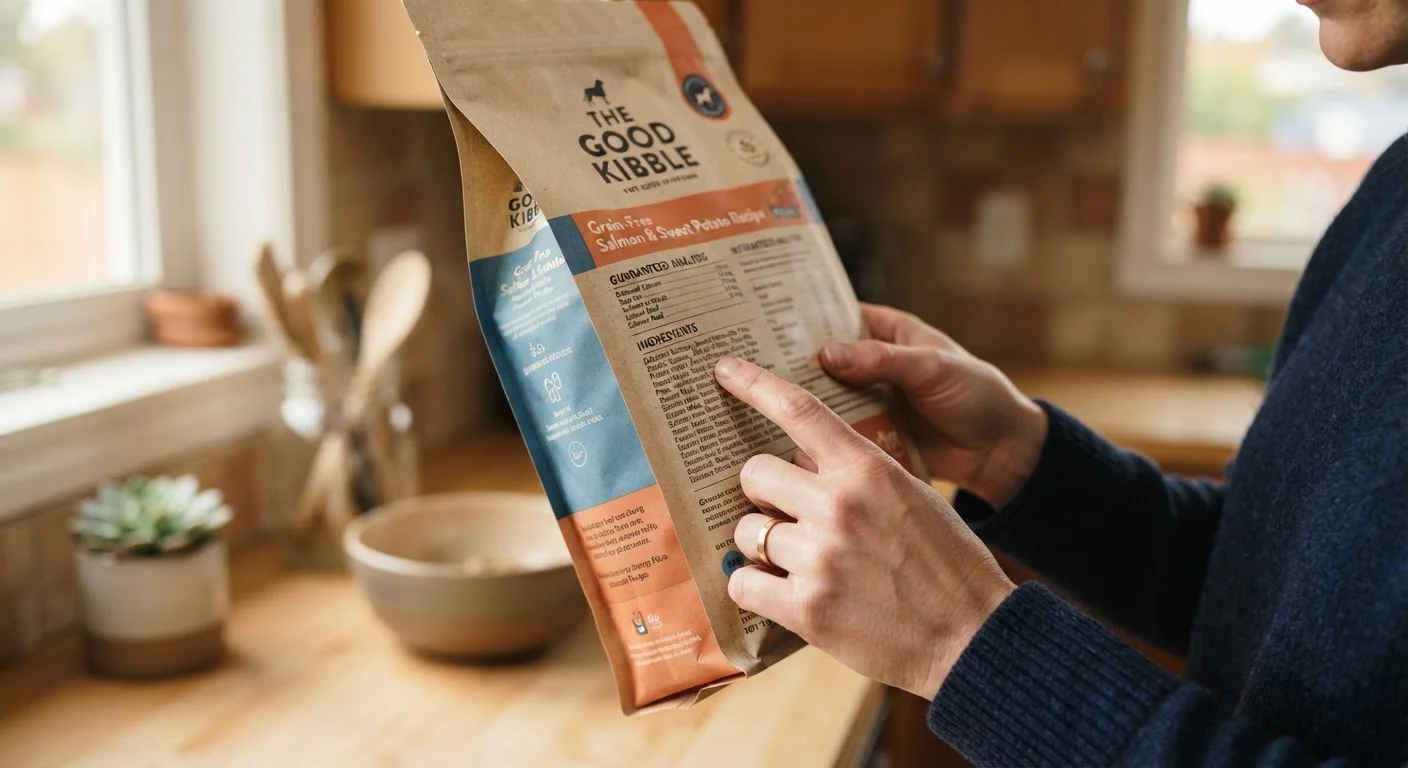
The front of a pet food bag is designed to sell. Words like "premium," "holistic," and "ancestral" are marketing language with little or no regulatory definition. The real information is on the back or side panel, where regulations require specific, standardized disclosures. Learning to read those sections — rather than the imagery and slogans — is what gives you an accurate picture of what you're feeding your pet.
If you've ever wrestled with a human nutrition label, the experience isn't entirely different. For a parallel look at how ingredient and nutrition panels work on food for people, see our guide to reading a Nutrition Facts label. The principles of prioritizing regulated disclosures over front-of-package claims apply in both contexts.
Start with the Regulated Panels, Not the Front
When evaluating a new pet food, flip to the back or side panel first. The ingredient list, guaranteed analysis, and AAFCO statement are the regulated, standardized sections. Front-of-package claims like 'holistic,' 'premium,' or 'ancestral recipe' carry no regulatory definition and should not drive your decision. Use the back panel to evaluate, then use the front for brand identification only.
The Ingredient List: Order, Weight, and What It Signals
Ingredients must be listed in descending order by weight as they arrive at the manufacturing facility — before cooking or processing. This detail matters. Fresh chicken, for example, is roughly 70% water by weight. Once processed, it shrinks considerably. A food listing "chicken" first may actually deliver less protein than one listing "chicken meal" (a pre-dried, concentrated form) in second or third place.
This doesn't make fresh ingredients bad — it just means the ranking alone doesn't tell the whole story. Look at the first five to seven ingredients as a group. They typically account for the bulk of the formula. If a named protein source (chicken, salmon, beef) appears among them, that's a useful signal. If grain or starch dominates before any protein appears, the food leans carbohydrate-heavy.
Ingredient splitting is also worth knowing: manufacturers sometimes separate a single ingredient into multiple forms — for instance, listing "ground corn," "corn gluten meal," and "corn flour" separately — which places each lower on the list than a combined entry would appear. It's not inherently deceptive, but it can make a formula look more protein-forward than it is.
Meat 'Meals' Are Not Low-Quality by Default
Ingredients like 'chicken meal' or 'salmon meal' are rendered, dried forms of animal protein — concentrated sources with higher protein density per pound than fresh meat. The term 'meal' describes a processing method, not a quality judgment. Manufacturer sourcing standards matter more than the presence of the word 'meal' itself.
The Guaranteed Analysis: Minimums, Maximums, and What's Missing
The guaranteed analysis panel lists crude protein (minimum), crude fat (minimum), crude fiber (maximum), and moisture (maximum). These numbers serve a regulatory purpose — they let you confirm a food meets basic standards — but they have real limitations.
"Crude" refers to the measurement method, not quality. Crude protein is measured by detecting nitrogen, which means non-protein nitrogen sources can inflate the number. The guaranteed analysis also doesn't tell you about digestibility, amino acid profiles, or the actual nutrient concentrations after processing. Think of it as a floor check, not a full nutritional report.
One practical use: comparing foods on a dry-matter basis. Because moisture content varies significantly between dry kibble and wet food, direct percentage comparisons can mislead. To make a fair comparison, divide each nutrient percentage by the percentage of dry matter (100 minus moisture %). For a deeper look at how kibble and canned food stack up nutritionally, see our breakdown of dry food vs. wet food.
95%
AAFCO 'named ingredient' rule threshold
Under AAFCO guidelines, if a product is named 'Chicken for Dogs,' chicken must comprise at least 95% of the total product weight (excluding water added for processing).
25%
Minimum for 'dinner,' 'entrée,' or 'formula' products
AAFCO requires that named ingredients in products using terms like 'dinner' or 'entrée' make up at least 25% of the product by weight, excluding added water.
3%
Minimum for 'with' ingredient claims
A label saying 'with real beef' only requires beef to represent 3% of the product under AAFCO's 'with' rule — a much lower bar than the primary name rule.
The AAFCO Statement and Feeding Guidelines
The AAFCO nutritional adequacy statement is one of the most important lines on the label and one of the most overlooked. It tells you two things: whether the food is intended as complete and balanced (or a supplement or treat), and which life stage it's formulated for — typically "adult maintenance," "growth and reproduction" (puppies and kittens), or "all life stages."
A food that says it's formulated for "all life stages" meets the higher nutrient thresholds required for growth and reproduction, which means it's appropriate for puppies and kittens but may deliver more calories and nutrients than a sedentary senior pet needs. A food labeled for "adult maintenance" is not appropriate as the sole diet for a growing puppy.
Feeding guidelines appear as a chart based on body weight. These are population averages — a useful baseline, but not a prescription for your individual pet. A highly active working dog may need more; an indoor cat prone to weight gain may need less. Monitor your pet's body condition score (a hands-on assessment of fat coverage over the ribs and spine) and adjust portions accordingly. Your veterinarian can walk you through that assessment and help you evaluate whether a given food suits your pet's life stage and health status. For more on overall pet health guidance, our pet health hub covers a broad range of care topics.
This article is for general informational purposes only and is not a substitute for veterinary advice. Always consult a licensed veterinarian regarding your pet's diet, health conditions, and nutritional needs.
Frequently Asked Questions
It means the food has been formulated or tested to meet AAFCO nutrient profiles for a specific life stage — such as adult maintenance or growth and reproduction. A food without this statement should not serve as a pet's sole diet. Look for the full AAFCO nutritional adequacy statement on the label for details.
Not necessarily. Ingredients are listed by weight before processing, and fresh meats contain significant moisture that inflates their weight. After cooking, a meat listed first may represent less protein than a dry meal listed lower. Looking at the overall ingredient profile matters more than rank alone.
The guaranteed analysis shows minimum percentages of crude protein and fat, and maximum percentages of moisture and crude fiber. These are regulatory floors and ceilings — not exact nutrient levels. They allow comparison across products but don't tell you about ingredient quality.
Not inherently. By-products such as organ meats can be nutritionally valuable. The term simply refers to parts of an animal other than skeletal muscle. Quality varies by sourcing and manufacturer, but the presence of by-products alone isn't a reliable indicator of poor nutritional quality.
It means the food contains no corn, wheat, rice, or other grains. However, grain-free foods often substitute starches like peas, lentils, or potatoes. The FDA has investigated a potential link between grain-free diets and dilated cardiomyopathy in dogs; consult your veterinarian before choosing a grain-free diet.
Feeding guidelines on pet food are calculated averages based on typical animals at a given weight. Your pet's actual needs depend on age, activity level, metabolism, and health status. Use the guidelines as a starting point and adjust based on your pet's body condition — your vet can help you calibrate.
The content on this site is for informational purposes only and is not a substitute for professional advice. Always consult a qualified professional for guidance specific to your situation.