

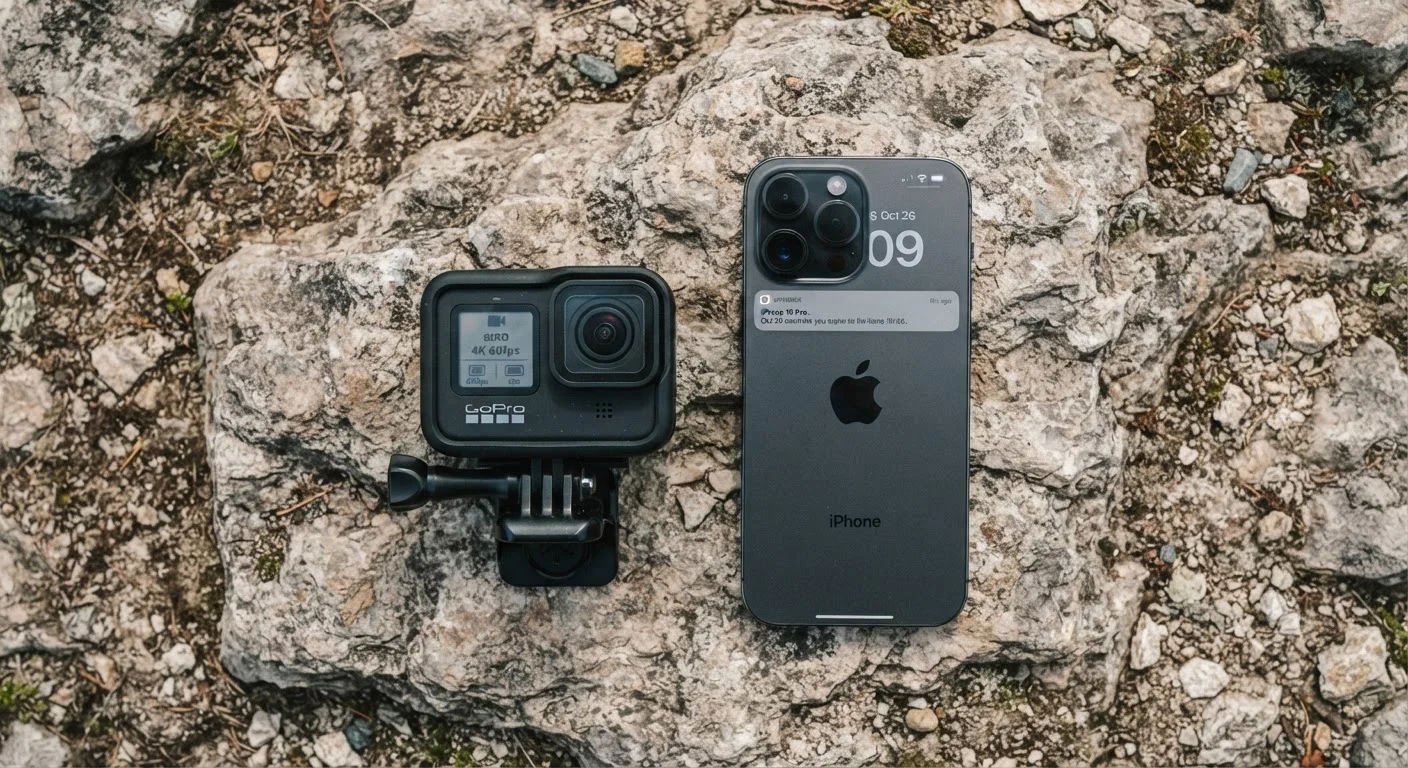
Our Verdict
Smartphones are the stronger all-around video tool for everyday life, social content, and casual travel thanks to their convenience, editing integration, and improving image processing. Action cameras earn their place specifically when physical extremes — water, vibration, mounting constraints, or sustained heat — are part of the shoot. Buying a dedicated action camera without those use cases is rarely justified by video quality alone.
| Best for | Recommended |
|---|---|
| Everyday video, travel vlogs, and social content | Smartphone |
| Water sports, cycling, skiing, and helmet-mounted footage | Action Camera |
| Situations requiring hands-free or body-mounted recording | Action Camera |
| Shooters who need one device for everything | Smartphone |
Why This Comparison Actually Matters
Action cameras are often marketed as the obvious upgrade for anyone who wants better adventure footage. That framing skips the more useful question: what problem are you actually trying to solve? Modern smartphones shoot 4K video with optical stabilization, portrait-style audio, and instant cloud backup. The gap in raw video quality between the two device categories has narrowed considerably — which makes the real differences more about physical design and use context than pure image performance.
Understanding those differences helps you avoid spending money on hardware that duplicates something you already own. For a broader look at how device specs translate into real-world capability, this breakdown of storage, RAM, and processing power explains how internal components shape what any device can actually do.
What Action Cameras Are Actually Built For
The defining feature of an action camera isn't its sensor — it's its body. These devices are engineered around three constraints that smartphones are not: waterproofing to meaningful depths without a case, a form factor small enough to mount on helmets, handlebars, surfboards, or chest harnesses, and thermal tolerance during sustained recording in direct sunlight or freezing temperatures.
The wide-angle fixed lens found on most action cameras is a design choice that supports mounting. When a camera is strapped to your chest or the front of a vehicle, you need a field of view wide enough to capture useful footage without manual framing adjustments. That same lens is a limitation indoors or in low light, where smartphones — with multiple focal lengths and larger sensors — consistently outperform them.
Check Your Actual Shooting Habits First
Before purchasing an action camera, review the video you've shot on your phone over the past six months. If most of it was captured indoors, at events, or on casual trips, an action camera likely won't solve a problem you actually have. The clearest signal that you need one is a specific physical scenario — water, speed, or mounting — that your phone genuinely can't handle.
Action cameras also tend to record continuously for longer without the heat throttling that can affect smartphones during extended 4K sessions. If you're recording an hour-long mountain bike descent or a full surfing session, that sustained recording reliability matters more than specs on a box.
Where Smartphones Have the Advantage
Smartphone video has improved faster than almost any other consumer technology category in recent years. Computational photography — software that processes multiple frames simultaneously to reduce noise, improve dynamic range, and stabilize footage — gives modern phones a significant edge in typical shooting environments: indoors, in mixed lighting, and in unscripted social situations.
The practical advantages go beyond image quality. Smartphones handle audio capture, editing, captioning, and upload in a single workflow. You shoot, edit, and share from the same device without transferring files. For anyone producing content regularly, that friction reduction is genuinely valuable — and it's a category of problem-solving that dedicated hardware rarely matches. This is the kind of tradeoff explored in more depth in our look at gadgets that genuinely solve everyday problems.
| Action Camera | Smartphone | |
|---|---|---|
| Waterproofing | Built-in, often to 30+ feet | Limited or requires a case |
| Mounting flexibility | Designed for helmets, handlebars, etc. | Requires third-party rigs |
| Low-light performance | Limited by small fixed lens | Strong, aided by computational processing |
| Audio capture | Wind-prone, minimal controls | Wind-prone, but more mic options |
| Editing and sharing workflow | Requires file transfer to another device | Shoot, edit, and share on one device |
| Sustained recording reliability | Strong — built for long continuous takes | Can throttle in extended 4K sessions |
| Lens versatility | Fixed wide-angle only | Multiple focal lengths on most models |
The Limitations Both Share
Neither device fully replaces a dedicated video camera in professional or cinema contexts. Both struggle in very low light compared to cameras with larger sensors and faster lenses. Battery life is a genuine constraint for both — action cameras can drain faster than expected during continuous recording, and smartphones balance video demands against simultaneous app activity.
Audio is another shared weakness. Built-in microphones on both devices pick up wind noise easily outdoors, and neither produces broadcast-quality audio without an external microphone attachment. If audio quality is critical to your use case, that's a separate investment regardless of which device you choose.
Just as e-readers and tablets serve genuinely different purposes despite appearing similar on the surface, action cameras and smartphones overlap in output but diverge sharply in design intent. Recognizing that distinction is what makes the choice straightforward.
Don't Assume Waterproof Ratings Are Absolute
Waterproofing ratings on both action cameras and smartphones are tested under controlled conditions and can degrade over time, particularly if housing seals are worn or damaged. Saltwater, pressure changes from diving, and drops can compromise water resistance even on devices rated for submersion. Always verify your device's current rating and inspect seals before any water activity.
The content on this site is for informational purposes only and is not a substitute for professional advice. Always consult a qualified professional for guidance specific to your situation.