

Our Verdict
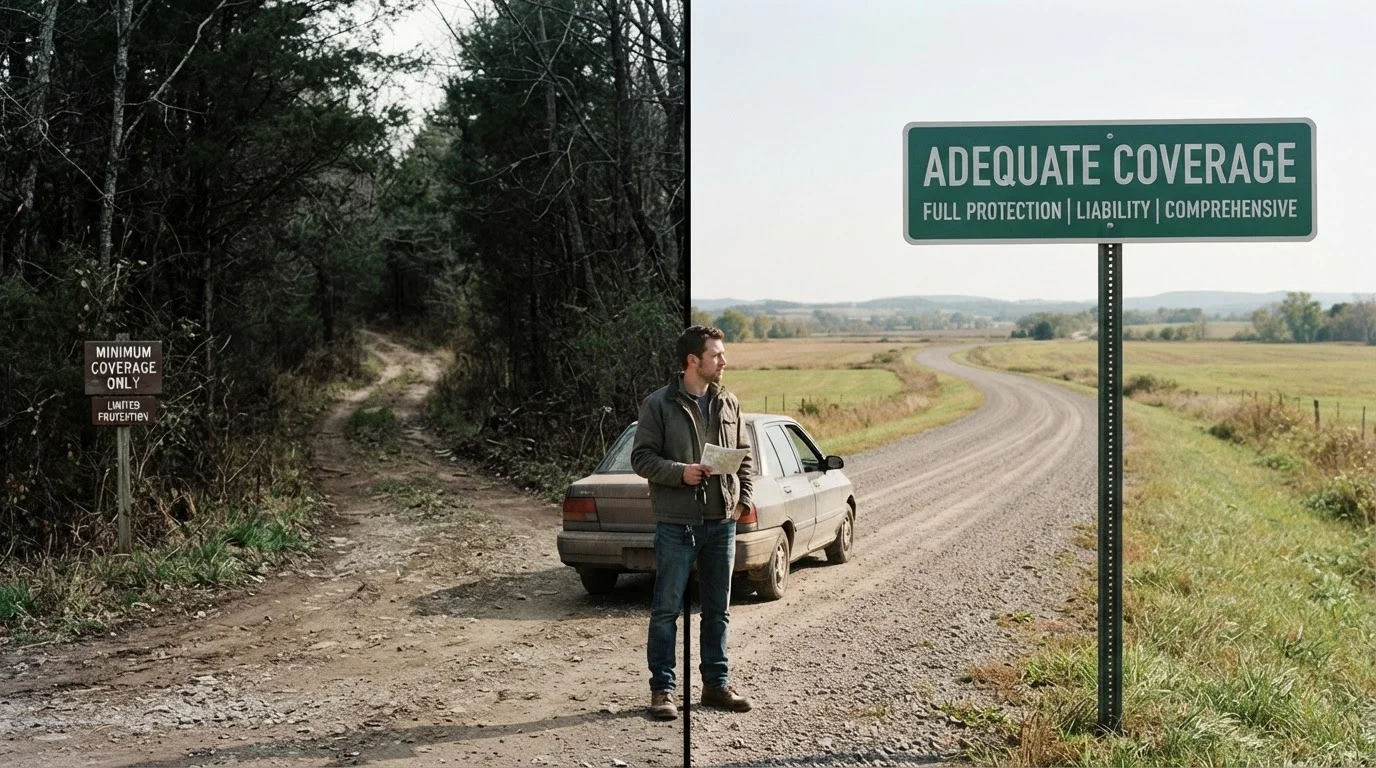
State minimum coverage satisfies the law but routinely falls short in real-world accidents. Drivers with assets to protect, a vehicle worth repairing, or dependents relying on their income generally need coverage limits that exceed state minimums. The right level depends on your individual financial picture, and a licensed insurance professional can help you evaluate it.
| Best for | Recommended |
|---|---|
| Drivers with minimal assets and an older vehicle of low market value | State Minimum Coverage |
| Drivers with savings, property, or significant income to protect | Adequate Coverage |
| Anyone financing or leasing a vehicle | Adequate Coverage |
| Drivers seeking peace of mind against high-cost accident scenarios | Adequate Coverage |
What State Minimums Actually Require
Every U.S. state (and Washington, D.C.) requires drivers to carry at least a baseline level of auto liability insurance before they can legally operate a vehicle. These minimums are expressed as a split limit - for example, 25/50/25 - which represents $25,000 in bodily injury coverage per person, $50,000 per accident, and $25,000 for property damage. A handful of states set even lower thresholds.
What these figures represent is the maximum your insurer will pay on your behalf for injuries or property damage you cause to someone else. They say nothing about your own vehicle, your own medical bills, or what happens when another driver hits you without adequate insurance. For a full breakdown of what each coverage type does and doesn't do, see our plain-language guide to coverage types.
| State Minimum Coverage | Adequate Coverage | |
|---|---|---|
| Legal compliance | Yes - meets the state floor | Yes - exceeds the state floor |
| Liability limits | Low (e.g., 25/50/25) | Higher (e.g., 100/300/100) |
| Your vehicle protected | No - liability only | Yes - with collision & comprehensive |
| Uninsured driver protection | Often not included | Included via UM/UIM coverage |
| Medical expense coverage | Typically not included | Available via MedPay or PIP |
| Out-of-pocket risk in serious accident | High - gaps become personal liability | Lower - limits absorb more costs |
| Typical premium cost | Lower monthly cost | Higher monthly cost |
Where Minimum Coverage Falls Short
The core problem with minimum limits is that they were often set years - sometimes decades - ago and haven't kept pace with the actual cost of accidents. Medical treatment after a multi-injury collision can reach hundreds of thousands of dollars. A newer vehicle struck in a parking lot may cost $15,000-$25,000 to repair or replace. When costs exceed your limits, the difference doesn't disappear - it becomes a personal liability.
Exceeding Your Limits Means Personal Liability
When accident costs exceed your policy limits, your insurer stops paying - but your legal obligation does not. The injured party can pursue you directly for the remaining amount, potentially reaching your savings, property, or future wages. Minimum limits provide no buffer if the accident is serious.
Minimum coverage is also typically liability-only, meaning it covers damage you cause to others but provides no protection for your own vehicle. If your car is totaled and you carry only state-minimum liability, you receive nothing toward replacing it. Drivers navigating the broader liability-versus-full-coverage question will find a detailed comparison in our article Liability vs. Full Coverage: Understanding the Real Difference.
There are also specific situations - rideshare driving, rental cars, vehicles with outstanding loans - where minimum policies leave gaps that surprise drivers at the worst possible moment. Our guide on coverage gaps that catch drivers off guard outlines these scenarios in detail.
What Adequate Coverage Actually Looks Like
"Adequate" isn't a single number - it's a function of your financial exposure. Insurance professionals commonly suggest liability limits of at least 100/300/100 as a starting point for drivers with meaningful assets: $100,000 per person, $300,000 per accident, $100,000 for property damage. Beyond liability, a complete coverage picture often includes:
- Collision coverage - pays for damage to your own vehicle after an accident, regardless of fault.
- Comprehensive coverage - covers non-collision losses like theft, weather damage, or hitting an animal.
- Uninsured/underinsured motorist (UM/UIM) coverage - protects you when the at-fault driver carries no insurance or insufficient limits. Roughly one in seven U.S. drivers is estimated to be uninsured, according to the Insurance Research Council.
- Medical payments (MedPay) or Personal Injury Protection (PIP) - covers your medical expenses and, in some states, lost wages, regardless of fault.
For a fuller explanation of how these coverage types interact, see Auto Insurance Decoded.
1 in 7
U.S. drivers estimated uninsured
According to the Insurance Research Council, approximately one in seven drivers on U.S. roads carries no auto insurance.
$25,000
Common state minimum property damage limit
Many states set property damage liability minimums at $25,000 - an amount that can be consumed by a single newer-vehicle collision.
Deciding Where You Fall on the Spectrum
Evaluating your own coverage needs starts with an honest look at three variables: your assets, your vehicle, and your risk tolerance. If you have significant savings, a home, or future income that could be pursued in a lawsuit, higher liability limits are generally worth the additional premium. If you drive a vehicle with a market value under $4,000-$5,000, adding collision and comprehensive coverage may cost more annually than the car is worth - though that math changes if you couldn't absorb the loss out of pocket.
Drivers who finance or lease their vehicles rarely have a choice: lenders typically require both collision and comprehensive coverage, and many require gap insurance to cover the difference between a vehicle's market value and the outstanding loan balance if the car is totaled.
The smartest approach is to review your coverage limits whenever your financial situation changes meaningfully - after a home purchase, a raise, or acquiring significant savings. Building habits around periodic policy reviews is covered in detail in our article on keeping your auto insurance working in your favor.
This article is for general informational purposes only and does not constitute personalized insurance, financial, or legal advice. Coverage availability, terms, and requirements vary by state and insurer. Consult a licensed insurance professional to evaluate the options appropriate for your individual circumstances.
The content on this site is for informational purposes only and is not a substitute for professional advice. Always consult a qualified professional for guidance specific to your situation.