

The Coverage Types on Your Policy, Explained
Auto insurance policies bundle several distinct coverage types, each designed to handle a different kind of financial risk. Knowing what each one actually does helps you read your declarations page with confidence and make informed choices about what to carry. For a broader overview of how the full system fits together, see The Auto Insurance Landscape, Start to Finish.
| Only mandatory coverage type (most states) | Liability insurance (State insurance regulations, varies by state) |
| Covers your car in a crash | Collision coverage |
| Covers theft, weather, and non-collision damage | Comprehensive coverage |
| Pays your medical bills regardless of fault | PIP or MedPay |
| Protects you from uninsured drivers | UM/UIM coverage (Required in roughly half of U.S. states) |
| Covers the loan-value gap after a total loss | Gap coverage |
Liability Coverage
What it covers: Bodily injury and property damage you cause to other people in an at-fault accident. It pays for the other driver's medical bills, their vehicle repairs, and related legal costs if you're sued - up to your policy limits.
What it doesn't cover: Your own vehicle damage or your own medical bills.
Required? Nearly every U.S. state mandates a minimum level of liability coverage. Minimums vary significantly, and carrying only the state minimum may not be enough to cover a serious accident.
Collision Coverage
What it covers: Damage to your own vehicle when it collides with another car or a stationary object - a guardrail, a utility pole, or a parking barrier, for example - regardless of fault.
What it doesn't cover: Non-collision events such as theft, hail, or flooding.
Required? Not by law, but lenders and leasing companies typically require it when you're financing a vehicle.
Comprehensive Coverage
What it covers: Damage to your vehicle from events outside a collision - theft, vandalism, fire, weather events (hail, flooding, wind), falling objects, and animal strikes.
What it doesn't cover: Collision-related damage or mechanical breakdowns.
Required? Not by state law, but again, typically required by lenders. See how collision and comprehensive compare for a deeper look at both.
Medical, Uninsured Motorist, and Other Key Coverages
Declarations Page
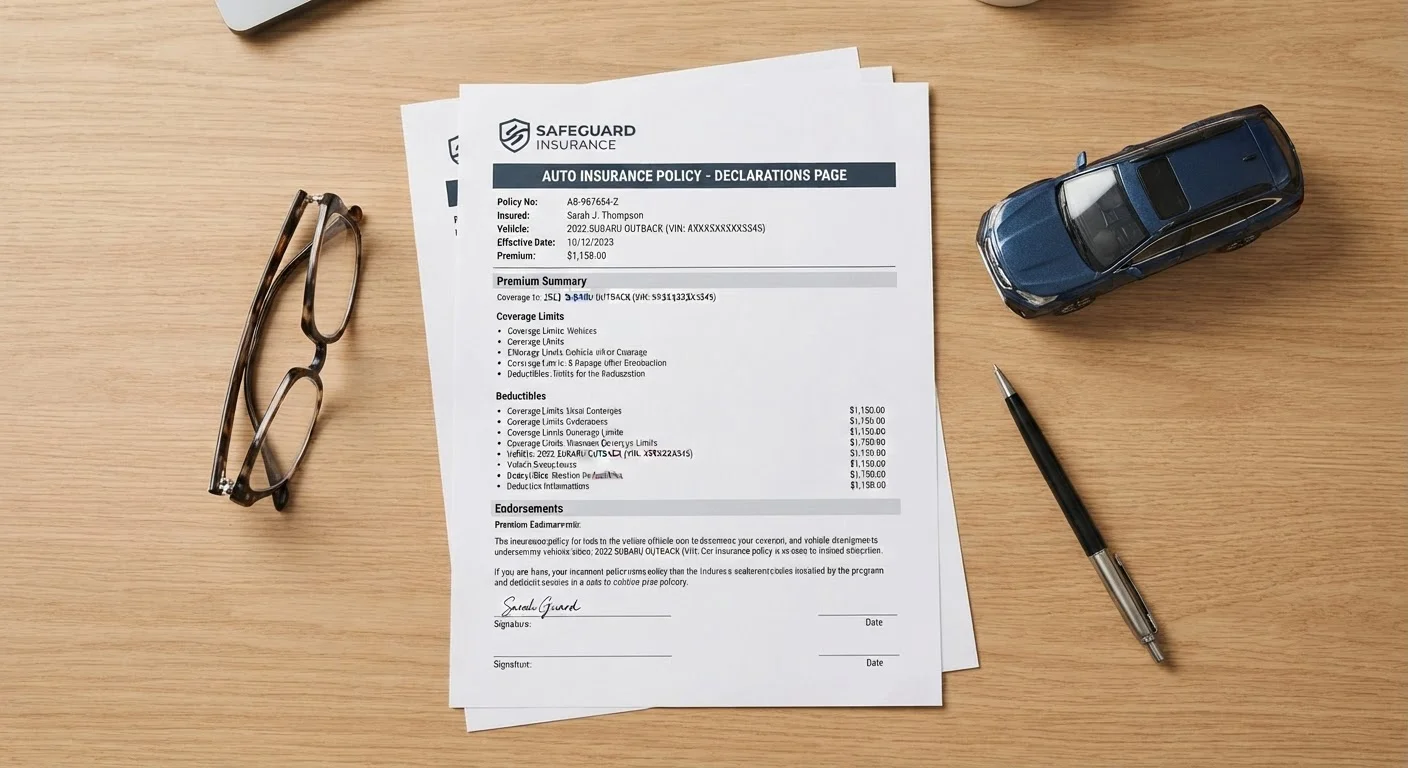
The summary page at the front of your insurance policy that lists your coverages, limits, deductibles, and premium. It's the quickest place to confirm what you're actually carrying.
Deductible
The amount you pay out of pocket before your insurer pays the rest on a covered claim. A higher deductible typically lowers your premium, and vice versa.
Actual Cash Value (ACV)
The market value of your vehicle at the time of loss, accounting for depreciation. This is what most standard policies pay out for a total loss - not the replacement cost of a new vehicle.
Policy Limit
The maximum dollar amount your insurer will pay for a covered claim. Limits are often shown as split limits (e.g., 100/300/100) representing per-person, per-accident, and property damage caps.
No-Fault State
A state where each driver's own insurer pays their medical costs after an accident, regardless of who caused it. Drivers in no-fault states are typically required to carry Personal Injury Protection (PIP).
Total Loss
When the cost to repair a vehicle exceeds a threshold - usually a percentage of its actual cash value - the insurer declares it a total loss and pays out the vehicle's value instead of repair costs.
Personal Injury Protection (PIP)
What it covers: Your own medical expenses - and sometimes lost wages and related costs - after an accident, regardless of who caused it. PIP is sometimes called no-fault coverage because it pays without determining fault first.
Required? Mandatory in states with no-fault insurance laws; optional elsewhere.
Medical Payments (MedPay)
What it covers: Similar to PIP but narrower - medical and funeral expenses for you and passengers after an accident. It generally doesn't cover lost wages or other non-medical costs.
Required? Required in a few states; optional in most.
Uninsured / Underinsured Motorist Coverage (UM/UIM)
What it covers: Protects you if the at-fault driver carries no insurance (UM) or insufficient insurance (UIM) to cover your damages. It can pay for your medical bills and, in some states, your property damage.
Required? Required in roughly half of U.S. states; strongly recommended everywhere given the share of drivers who are uninsured or carry only minimum limits.
Gap Coverage
What it covers: The difference between what your insurer pays out (actual cash value) after a total loss and what you still owe on your auto loan. New vehicles depreciate quickly, which can leave a meaningful gap between the two figures.
Required? Not by law, but worth considering when you owe more than the vehicle's current market value.
If you're buying your first policy and unsure which coverages to prioritize, this roadmap for new buyers walks through the key decisions step by step. For a precise comparison of liability-only versus full coverage combinations, see Liability vs. Full Coverage.
This article is for general informational purposes only and does not constitute personalized insurance advice. Coverage terms, availability, requirements, and exclusions vary by state and provider. Always review your actual policy documents and consult a licensed insurance agent for guidance specific to your situation.
The content on this site is for informational purposes only and is not a substitute for professional advice. Always consult a qualified professional for guidance specific to your situation.