

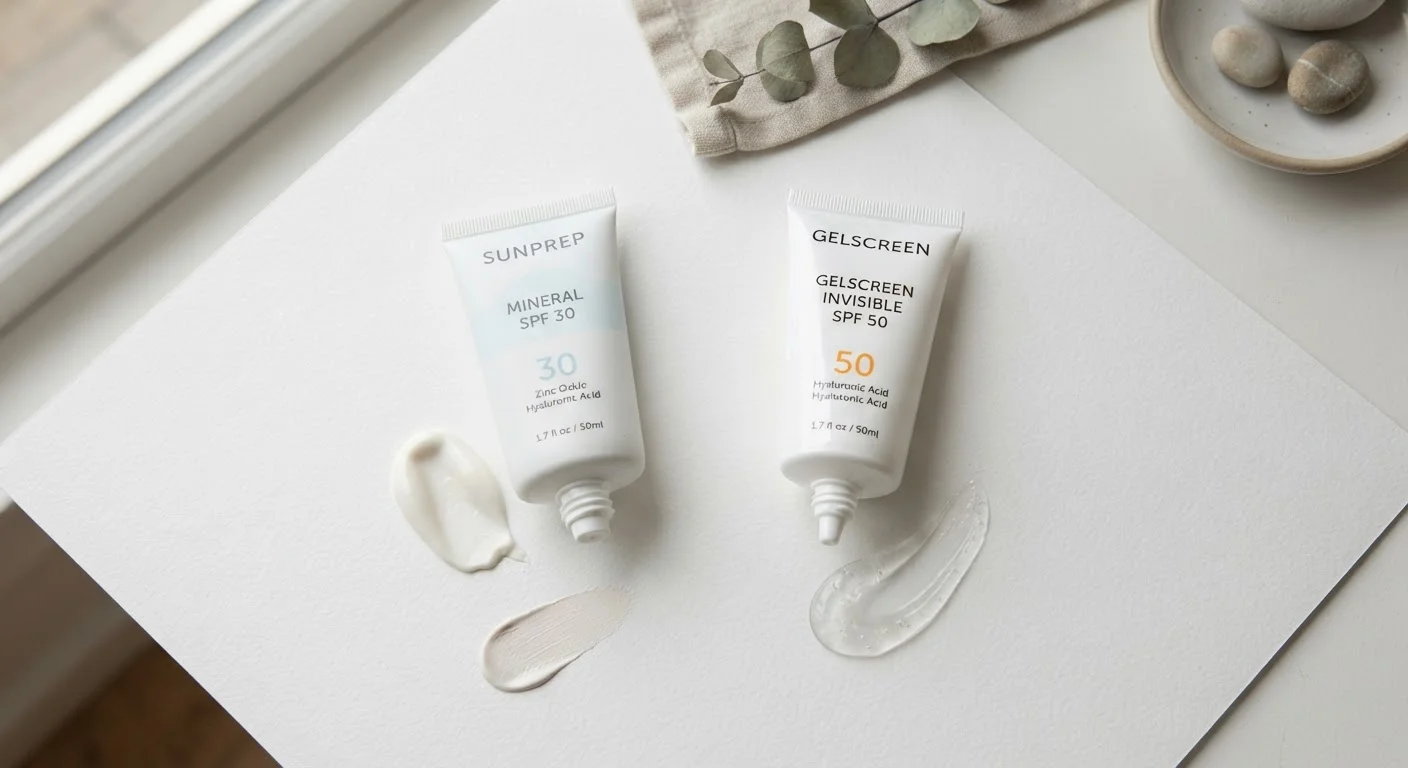
Option A
Physical Sunscreen
The mineral-based barrier that sits on top of skin.
Best for: Sensitive or reactive skin types, and those who prefer immediate protection after application.
Option B
Chemical Sunscreen
The lightweight, skin-absorbing UV filter.
Best for: Those who prefer an invisible, easy-to-layer formula under makeup or in daily wear.
How Each Type of Sunscreen Works
Understanding how sunscreen protects your skin starts with knowing what UV radiation actually does. The sun emits two types of ultraviolet rays that reach the earth's surface: UVA rays, which penetrate deeply and are associated with premature aging, and UVB rays, which affect the outer skin layers and are linked to sunburn. Broad-spectrum sunscreens are formulated to address both. Learn more about what SPF ratings mean and the science behind daily sunscreen use.
Physical sunscreens - also called mineral sunscreens - rely on two active ingredients recognized by the FDA: zinc oxide and titanium dioxide. These minerals remain on the surface of the skin and work by scattering and reflecting UV rays before they can penetrate. Importantly, they are effective immediately upon application.
Chemical sunscreens use organic (carbon-based) filter compounds such as avobenzone, oxybenzone, octinoxate, or octisalate. These ingredients absorb into the upper layers of the skin. When UV rays hit the skin, the chemical filters absorb that energy and release it as heat rather than allowing it to damage skin cells. Most chemical formulas are recommended to be applied roughly 15-20 minutes before sun exposure to allow adequate skin absorption.
| Criterion | Physical Sunscreen | Chemical Sunscreen |
|---|---|---|
| Active Ingredients | Zinc oxide, titanium dioxide | Avobenzone, oxybenzone, octinoxate, others |
| How It Works | Reflects and scatters UV rays | Absorbs UV energy, releases as heat |
| Protection Starts | Immediately upon application | After ~15-20 minutes of absorption |
| Texture | Thicker, sometimes chalky | Lightweight, transparent |
| White Cast | Possible, especially on deeper tones | Generally none |
| Skin Sensitivity | Well-tolerated, lower irritation risk | Some filters may cause reactions |
| Under Makeup | Can affect texture of makeup | Blends seamlessly under makeup |
Texture, Appearance, and Wearability
One of the most practical differences between the two types comes down to how they feel and look on skin. Physical sunscreens have historically had a thicker, sometimes chalky texture, and zinc oxide in particular can leave a visible white cast - a real concern for people with medium to deep skin tones. Newer mineral formulations have improved significantly, with micronized particles that reduce this effect, though some residue may still be visible.
Chemical sunscreens tend to be lighter and more transparent, blending seamlessly into the skin. This makes them a natural fit under makeup - something worth considering if you use a foundation, tinted moisturizer, or BB cream as part of your daily routine. The lighter feel can also make chemical sunscreens more comfortable for extended wear, especially in humid conditions.
However, for those with oily or acne-prone skin, some chemical filters can feel occlusive or may contribute to breakouts. Reading the ingredient list and looking for non-comedogenic labeling is a useful habit regardless of which type you choose. Understanding ingredient labels in general is a skill that pays off across your whole routine - a plain-language guide to common body care ingredients can be a helpful starting point.
2 hrs
Recommended reapplication interval
The American Academy of Dermatology advises reapplying any sunscreen every two hours, or immediately after swimming or heavy sweating.
SPF 30+
Minimum recommended daily SPF
Dermatological guidance generally recommends SPF 30 or higher for daily use, with broad-spectrum coverage for both UVA and UVB protection.
Skin Sensitivity and Formulation Considerations
Skin sensitivity is often the deciding factor for people choosing between physical and chemical sunscreens. Zinc oxide has a long safety record and is frequently used in formulations for infants and individuals with conditions like rosacea or eczema. It is generally considered non-irritating and rarely causes allergic reactions.
Some chemical filter ingredients, particularly oxybenzone, have been associated with contact allergies in certain individuals. Regulatory agencies in the U.S. and abroad continue to evaluate the safety data on several chemical UV filters, particularly regarding systemic absorption - meaning how much the ingredient may enter the bloodstream. The FDA has noted it is still gathering data on this question and has not concluded that currently approved chemical filters are unsafe.
What Ongoing Research Means for Consumers
Regulatory review of chemical sunscreen ingredients - particularly around systemic absorption - is still in progress in the United States. This does not mean current products are unsafe; it means scientists are working to build a more complete picture. If you have concerns, mineral sunscreens with zinc oxide or titanium dioxide have more established safety profiles and remain a well-supported alternative while research continues.
Ultimately, the best sunscreen is one that suits your skin, fits your routine, and - most importantly - one you will actually use consistently. The same logic applies when choosing other formula types in your routine: how powder and liquid formulas behave differently across skin types follows similar principles of matching texture to your skin's needs.
This article is for general informational and educational purposes only and is not a substitute for professional dermatological advice. If you have a skin condition or specific concerns about sunscreen ingredients, consult a qualified dermatologist.
The content on this site is for informational purposes only and is not a substitute for professional advice. Always consult a qualified professional for guidance specific to your situation.