

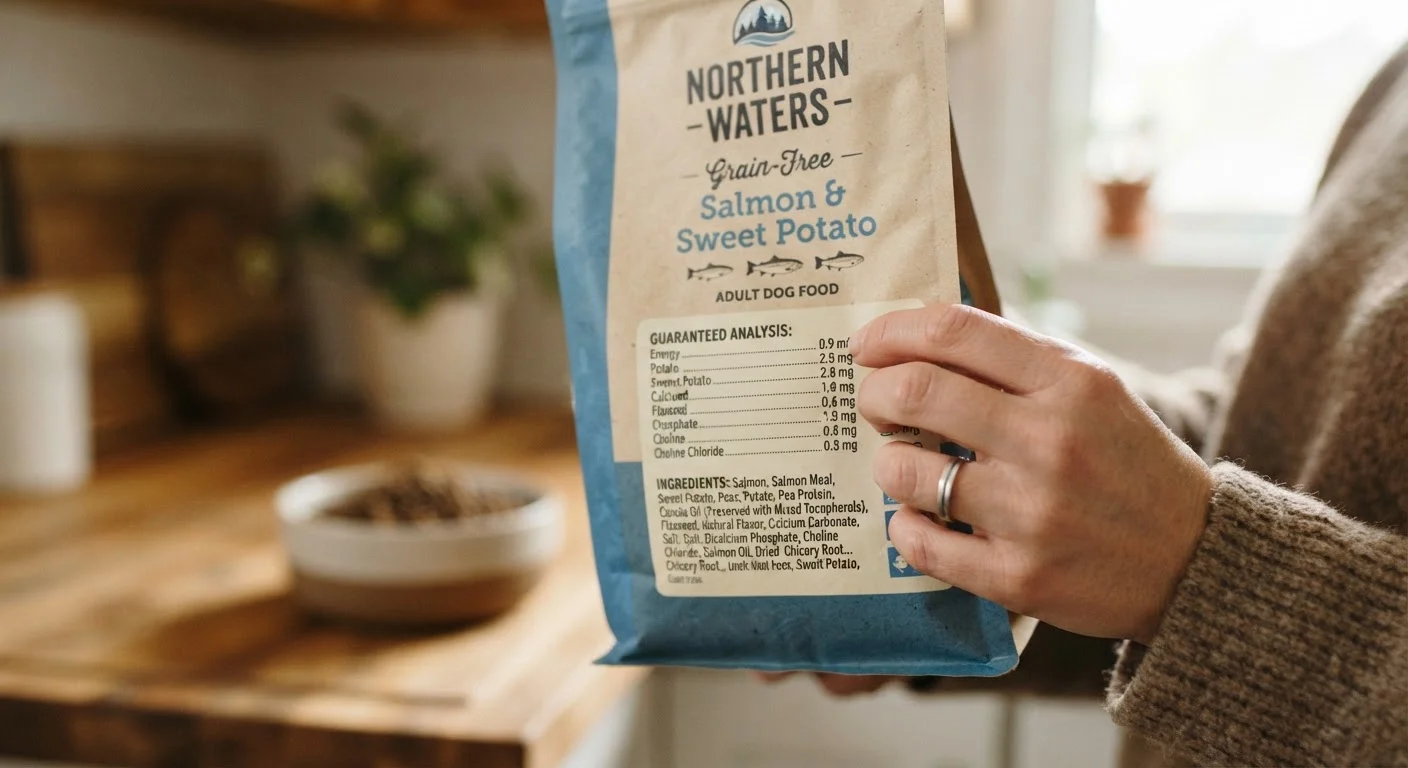
Why Pet Food Labels Are Worth Decoding
Pet food packaging is designed to sell. The front panel — with words like "premium," "natural," or "grain-free" — is largely marketing language, not regulated nutritional information. The real data lives on the back or side of the package, in three specific sections: the ingredient list, the guaranteed analysis, and the AAFCO nutritional adequacy statement. Learning to read those three sections gives you a reliable picture of what you're actually feeding your pet, regardless of how appealing the front-panel claims look.
If you've ever navigated a human nutrition label, the process is similar in structure — though the terminology differs. Our guide to reading a Nutrition Facts label covers the human version for comparison. For pets, the framework below is what matters. This article focuses on dogs and cats, but the same label-reading logic applies broadly across companion animal foods.
What you will need
How to Read a Pet Food Label Step by Step
Work through a bag or can in your hand as you follow these steps. Having the actual package in front of you makes the process stick far faster than reading in the abstract.
Start with the product name — it signals the formula
Regulatory rules govern how animal protein is named on pet food packaging. The percentages below apply to the named ingredient excluding water added for processing:
- 95% rule: If the product is called "Salmon Cat Food," salmon must make up at least 95% of the total product weight.
- 25% ("dinner") rule: Names like "Chicken Dinner," "Beef Entrée," or "Turkey Platter" require only 25–95% of that protein.
- 3% ("with") rule: "Cat Food with Tuna" needs only 3% tuna.
- Flavor rule: "Bacon Flavor" requires no minimum percentage — just enough for detectable flavor.
Knowing which rule applies tells you how much of the headline protein is actually in the bowl before you read a single ingredient.
Read the ingredient list top to bottom
Ingredients are listed in descending order by pre-cooking weight. A named animal protein — "chicken," "salmon," "beef" — appearing first is a good sign. However, keep two things in mind:
- Raw meats are heavy because they contain water. After cooking, a meat listed first may weigh less than a grain or meal listed second or third. "Chicken meal" (a concentrated, moisture-removed protein) can actually deliver more protein per pound than raw chicken listed above it.
- Look at the first five to seven ingredients — they account for the bulk of the formula. Ingredients appearing near the bottom of a long list contribute very little by weight.
Ingredients you generally want to see early: a named protein source (not just "meat" or "poultry"), and recognizable whole-food components. Ingredients worth noting but not automatically avoiding: by-products (organ meats and other parts that carry real nutritional value) and "meals" (concentrated protein sources). Their quality depends on the sourcing, which labels don't always disclose.
Interpret the guaranteed analysis panel
The guaranteed analysis lists four required nutrients: crude protein (minimum %), crude fat (minimum %), crude fiber (maximum %), and moisture (maximum %). Some manufacturers voluntarily list additional nutrients such as omega fatty acids or ash.
Two important caveats:
- These are guarantees, not exact measurements. "Minimum 26% crude protein" means at least 26% — the actual amount could be higher.
- The percentages are expressed on an as-fed basis, meaning they reflect the food as it comes out of the package, including its moisture content. This makes direct comparisons between wet and dry foods misleading without a dry-matter calculation (covered in the next section).
Find and understand the AAFCO statement
The Association of American Feed Control Officials (AAFCO) sets the nutritional standards that most U.S. states use to regulate pet food. Look for a statement that reads something like: "[Product name] is formulated to meet the nutritional levels established by the AAFCO [Dog/Cat] Food Nutrient Profiles for [life stage]."
Two types of statements carry meaningfully different weight:
- "Formulated to meet" statement: The food was formulated on paper to hit AAFCO nutrient minimums. No feeding trial was required.
- "Animal feeding tests" statement: The food was tested in actual animals using AAFCO protocols before going to market. This is a higher bar.
Also check the life stage. A food labeled for "all life stages" must meet the most demanding profile — puppy or kitten — which may mean excess nutrients for a healthy adult animal. If your pet is an adult, a food formulated specifically for adult maintenance is often more appropriate.
Check the feeding guidelines and adjust for your pet
Feeding guidelines on the package are starting points based on average animals of a given weight. Your individual pet's needs depend on age, activity level, body condition, and health status. Treat the label serving as a baseline, monitor your pet's body condition over several weeks, and adjust up or down accordingly.
Your veterinarian can help you identify the right body condition score for your pet and refine feeding amounts — especially for animals with medical conditions, weight concerns, or life-stage transitions such as pregnancy, nursing, or senior status.
Front-Panel Claims Are Not Regulated Like Ingredient Data
Words such as "natural," "holistic," "premium," and "human-grade" have no standardized legal definition in pet food labeling at the federal level. Some terms (like "natural") have AAFCO guidelines, but enforcement varies by state. Focus your evaluation on the ingredient list, guaranteed analysis, and AAFCO statement — not the front panel. Think of front-panel language the way you'd think of any product marketing copy: it is designed to attract attention, not to convey precise nutritional information.
Once you're comfortable reading labels, you'll also want to consider format — kibble and canned food present nutritional trade-offs that go beyond ingredients alone. See our article on dry food vs. wet food for a practical breakdown.
Common Label Traps and How to Avoid Them
Even after you understand the mechanics of a label, a few persistent patterns can lead you astray.
- Ingredient splitting: A manufacturer can list several forms of a lower-quality ingredient separately — for example, "ground corn," "corn gluten meal," and "corn flour" — so that each appears lower on the list than a single combined entry would. Taken together, those ingredients might outweigh the named protein at the top.
- "With" claims: FDA rules mean a product labeled "Dog Food with Chicken" needs to contain only 3% chicken. A product labeled "Chicken Dog Food," by contrast, must contain at least 95% chicken (excluding water). The single word "with" signals a dramatically different formulation.
- Moisture and dry-matter comparison: A canned food listing 10% protein and a kibble listing 30% protein aren't directly comparable — canned food contains roughly 75–80% water. To compare on equal footing, you need to calculate the dry-matter basis by dividing each nutrient percentage by the percentage of dry matter (100 minus moisture %). This math is worth doing when you're evaluating foods side by side.
Trending Diets May Lack Long-Term Evidence
Grain-free, raw, and novel-protein diets have grown in popularity, but some lack the long-term feeding research behind conventional formulations. The FDA has investigated a potential link between grain-free diets and dilated cardiomyopathy (a serious heart condition) in dogs, though research is ongoing and no definitive cause-and-effect has been established. Before switching your pet to any trendy or non-mainstream diet, discuss the decision with your veterinarian rather than relying solely on label claims.
Label literacy is one piece of responsible feeding. For a broader picture of daily routines and potential pitfalls, our article on common feeding habits that creep up on pet owners is a useful companion read. And for a full overview of day-to-day pet care, see Everyday Pet Care: A Complete Overview for Confident Owners.
This article is for general informational purposes only and is not a substitute for professional veterinary advice. Consult your veterinarian with questions about your specific pet's dietary needs or health conditions.
The content on this site is for informational purposes only and is not a substitute for professional advice. Always consult a qualified professional for guidance specific to your situation.