

Option A
Alternating Current (AC)
The long-distance traveler powering your home grid.
Best for: Delivering electricity efficiently across long distances and running high-power appliances like refrigerators, HVAC systems, and washing machines.
Option B
Direct Current (DC)
The steady, controlled flow every digital device depends on.
Best for: Powering batteries, microchips, and any electronics that require a stable, regulated voltage — from smartphones to laptops to LED lights.
What AC and DC Actually Mean
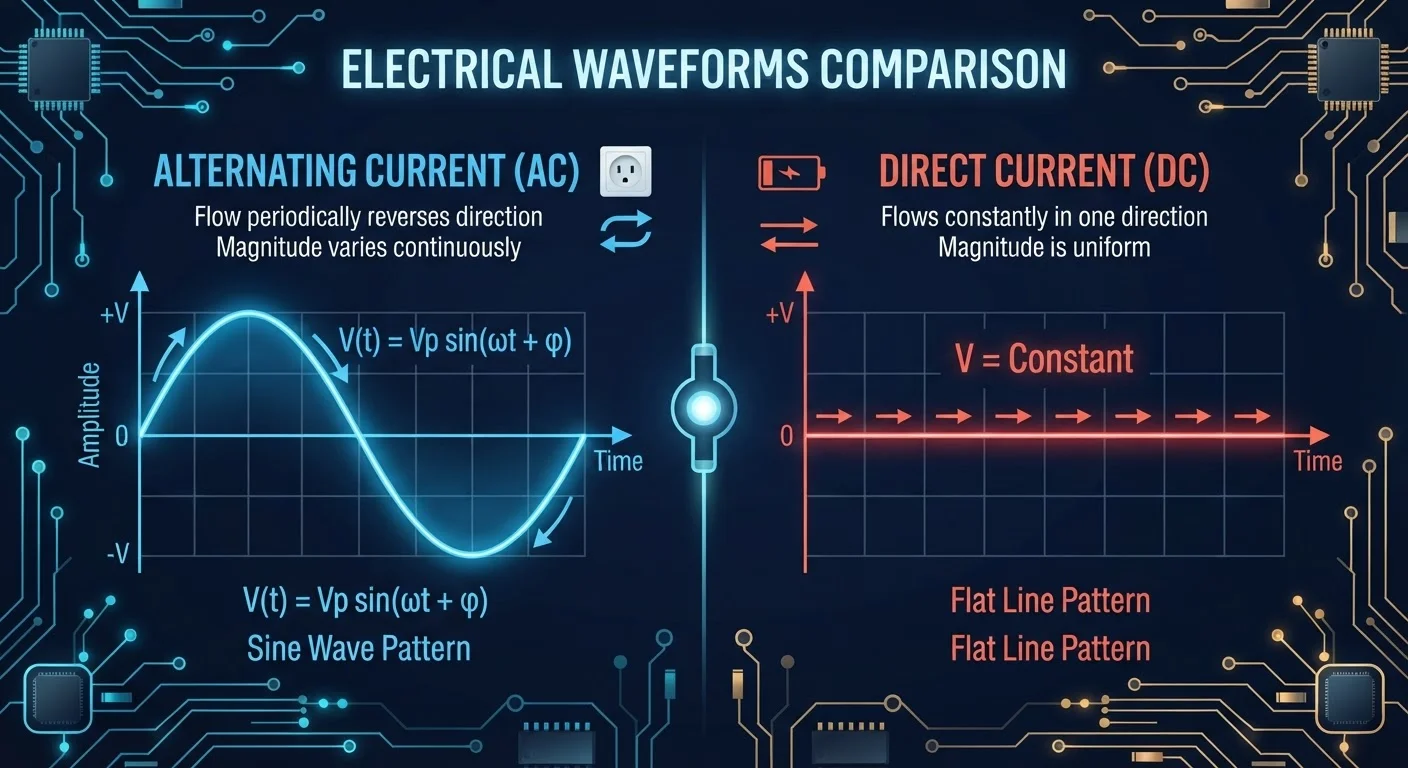
Electricity is the movement of electrons through a conductor. Alternating current (AC) reverses the direction of that electron flow many times per second — in the United States, 60 times per second (60 Hz). The result is a sine wave pattern: voltage rises, peaks, falls, reverses, and repeats. Direct current (DC) is far simpler: electrons travel steadily in one direction, at a consistent voltage level.
Neither is inherently superior — each excels in a specific context. The key is knowing which context you're in. To understand how electricity behaves the moment it leaves a wall outlet, see what actually happens when you plug something in.
| Criterion | Alternating Current (AC) | Direct Current (DC) |
|---|---|---|
| Electron flow direction | Reverses periodically (60 Hz in U.S.) | One direction, constant |
| Voltage pattern | Sine wave — rises and falls | Flat, regulated level |
| Primary use | Grid transmission, large appliances | Batteries, chips, digital electronics |
| Where you encounter it | Wall outlets, power strips | Phone internals, laptops, EVs |
| Long-distance efficiency | High — easily stepped up/down via transformers | Lower — historically loses more over distance |
| Conversion needed? | Must be converted for digital devices | Must be sourced from AC or stored in battery |
Why the Grid Uses AC and Devices Use DC
The U.S. electrical grid runs on AC for a practical engineering reason: AC voltage can be stepped up or down efficiently using transformers. High-voltage AC loses far less energy traveling hundreds of miles of transmission lines than low-voltage current would. Once it reaches your neighborhood, transformers step it back down to the 120V AC that comes out of your wall outlets.
Your smartphone, laptop, and wireless earbuds, however, run on DC internally. Microchips and batteries require a stable, one-directional voltage to function. This mismatch is exactly why every charger and power adapter exists — they are AC-to-DC converters, also called rectifiers. The brick on your laptop cable isn't just a safety feature; it's a small power-conversion machine.
60 Hz
AC frequency from U.S. wall outlets
The U.S. grid alternates direction 60 times per second; most of Europe and Asia use 50 Hz systems.
120V / 240V
Standard U.S. household AC voltages
Standard outlets deliver 120V AC; large appliances like dryers and EV chargers typically use 240V AC circuits.
~85–95%
Typical efficiency of modern AC-to-DC adapters
Modern switch-mode power supplies (the type inside most charger bricks) convert AC to DC with roughly 85–95% efficiency; the remainder is released as heat.
For a deeper look at the measurements — volts, watts, and amps — that govern this conversion, our consumer's field guide to electrical units walks through each one clearly.
Batteries, Chargers, and What This Means for Your Devices
Batteries store chemical energy and release it as DC. When you charge a device, your charger converts AC from the wall into DC to replenish the battery. When the device runs off the battery, it draws that DC directly. The conversion step disappears entirely in battery-powered operation.
This also explains a common source of device damage: using a charger with the wrong voltage or amperage output disrupts the regulated DC supply a device expects. Quality chargers regulate their DC output precisely; cheap or counterfeit adapters often do not.
If you want to understand how charging habits affect long-term battery health, common battery myths worth unlearning addresses the most persistent misconceptions. And for broader habits that extend device life, see practices that measurably extend how long gadgets last.
What About Solar Panels and EVs?
Solar panels generate DC electricity directly from sunlight. To feed that power into your home's AC grid or appliances, an inverter converts the DC output back to AC. Electric vehicles store energy as DC in their battery packs, but many public fast-charging stations use DC fast charging (DCFC) to bypass the vehicle's onboard charger and deliver power directly to the battery — which is why DC fast chargers can replenish a battery significantly faster than standard AC Level 2 chargers.
The content on this site is for informational purposes only and is not a substitute for professional advice. Always consult a qualified professional for guidance specific to your situation.