

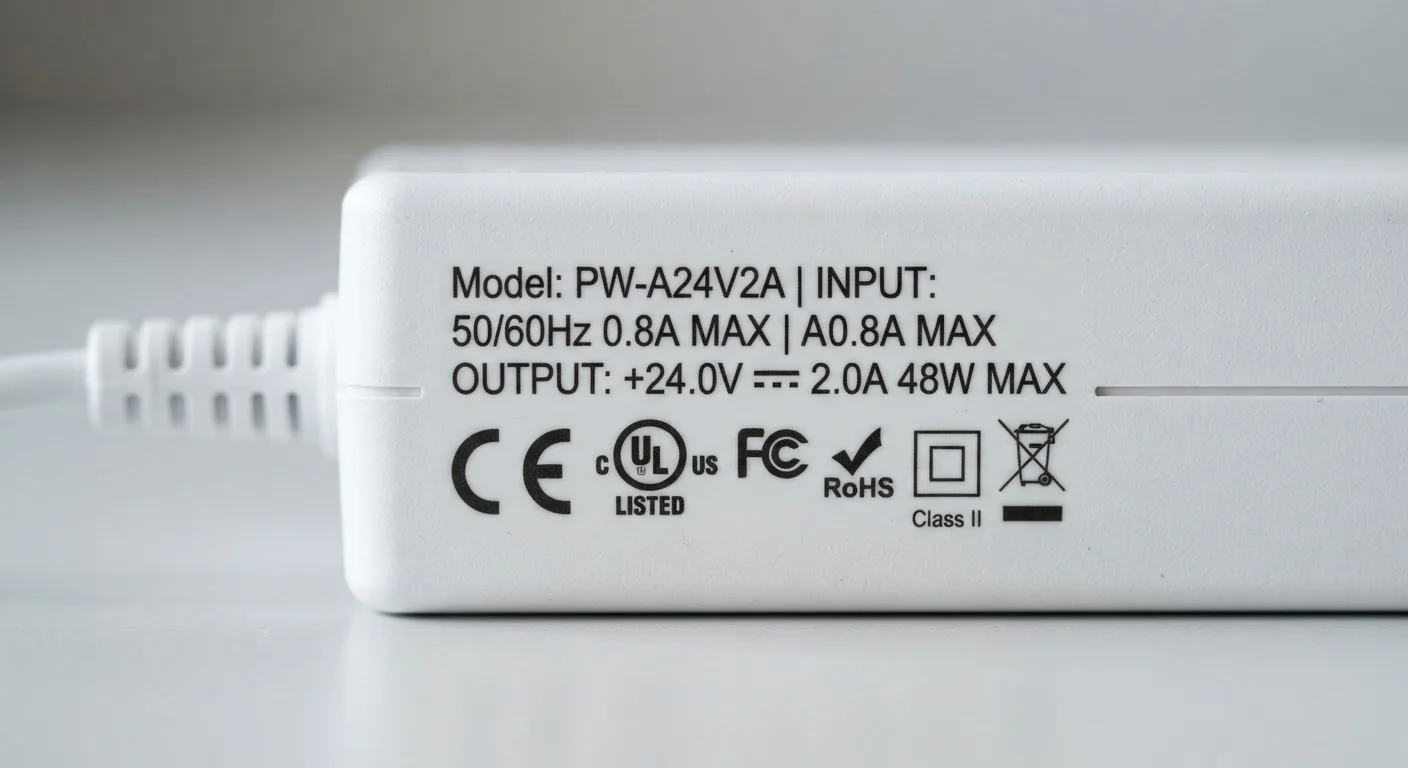
Why Three Numbers Show Up on Everything
Look at the bottom of a laptop charger, the back of a microwave, or the side of a power strip and you'll see a cluster of measurements: 120V, 2.5A, 300W. These aren't marketing figures — they're engineering specifications that describe exactly how electricity moves through that device.
Understanding what each one means doesn't require an electrical engineering background. Volts, amps, and watts describe three related properties of electricity, and once you grasp how they relate to each other, you'll read product labels with genuine confidence rather than guesswork.
| Standard U.S. outlet voltage | 120V (National Electrical Code (NEC)) |
| Large-appliance circuit voltage (U.S.) | 240V (National Electrical Code (NEC)) |
| Power formula | Watts = Volts × Amps (Ohm's Law derivation) |
| Typical U.S. household circuit breaker rating | 15A or 20A (National Electrical Code (NEC)) |
| Energy billing unit | Kilowatt-hour (kWh) (U.S. Energy Information Administration) |
| Common international outlet voltage | 220–240V (IEC global standards) |
For a broader look at how electricity travels from your wall outlet to your devices, see what actually happens when you plug something in.
Volts, Amps, and Watts — Each Explained
Voltage (V) is electrical pressure — the force pushing electrical charge through a circuit. Think of it like water pressure in a pipe. Standard U.S. household outlets deliver 120 volts; large appliances like dryers and electric ranges use a dedicated 240-volt circuit. Plugging a 120V device into a 240V outlet without an adapter can damage or destroy it.
Amperage (A or amps) is the flow rate — how much electrical charge is moving per second. Continuing the water analogy, if voltage is pressure, amps are the volume of water flowing through. A phone charger might draw 1–3 amps; a window air conditioner can draw 8–15 amps. Your home's circuit breakers are rated in amps (typically 15A or 20A per circuit) to prevent overloads.
Wattage (W) is the total power consumed — it's the result of voltage multiplied by amperage (W = V × A). Watts are the most practical number for understanding energy use and cost. A 60-watt bulb consumes 60 watts; a gaming console might draw 150–200 watts under load. Your electricity bill is calculated in kilowatt-hours (kWh) — one kilowatt-hour equals 1,000 watts running for one hour.
Volt (V)
The unit of electrical pressure, or potential difference. It measures the force that drives electrical current through a circuit. U.S. standard outlets are 120V; large-appliance circuits are typically 240V.
Ampere / Amp (A)
The unit of electrical current — the rate at which electrical charge flows. Higher amperage means more charge moving per second. Circuit breakers are rated in amps to protect household wiring from overload.
Watt (W)
The unit of electrical power, calculated as volts multiplied by amps (W = V × A). Watts measure how much energy a device consumes per second and are the basis for electricity billing.
Kilowatt-Hour (kWh)
A unit of energy equal to 1,000 watts operating for one hour. Electric utilities use kilowatt-hours to measure and bill household electricity consumption.
Dual-Voltage Device
A device that can operate on both 110–120V and 220–240V electrical systems. The label typically reads 'Input: 100–240V.' These devices need only a plug adapter when used abroad, not a voltage converter.
Circuit Breaker
A safety switch that automatically trips and cuts power when electrical current in a circuit exceeds its rated amperage. It protects wiring from overheating caused by overloaded or short-circuited circuits.
Because watts tie directly to energy consumption, they're the number to focus on when evaluating energy efficiency ratings on home electronics.
Practical Situations Where This Knowledge Pays Off
Loading a power strip: Every power strip has a maximum wattage rating. If you're powering a monitor (75W), a desktop (150W), a desk lamp (40W), and a speaker (30W), that's 295W total. A strip rated for 300W is at its limit — adding more devices risks overloading it. Reading a power strip's specifications before loading it with devices is a straightforward safety habit.
Charging devices faster: Fast-charging depends on higher wattage delivered to your device. A charger rated 5V/1A delivers 5 watts; a 9V/3A charger delivers 27 watts. The device's own circuitry regulates how much it actually accepts, so using a higher-wattage charger than needed is generally safe — the device draws only what it requires.
Using devices abroad: Most countries outside North America use 220–240V at the wall. A device labeled Input: 100–240V is dual-voltage and only needs a plug adapter. A device labeled Input: 120V only requires a voltage converter — not just an adapter — to operate safely.
Plug Adapters vs. Voltage Converters
These two travel accessories solve different problems. A plug adapter changes the physical shape of the plug to fit a foreign outlet — it does not change the voltage. A voltage converter (or transformer) actually steps down 220–240V to 120V for devices that require it. Using only a plug adapter on a 120V-only device in a 240V country can permanently damage the device. Always check the input voltage rating on the label before traveling.
For a deeper look at how wall power is converted inside your devices, AC vs. DC power shapes every device you own explains the conversion process in plain terms. You can also explore reading an electronics label room by room to decode every symbol and rating you'll encounter at home.
The content on this site is for informational purposes only and is not a substitute for professional advice. Always consult a qualified professional for guidance specific to your situation.