

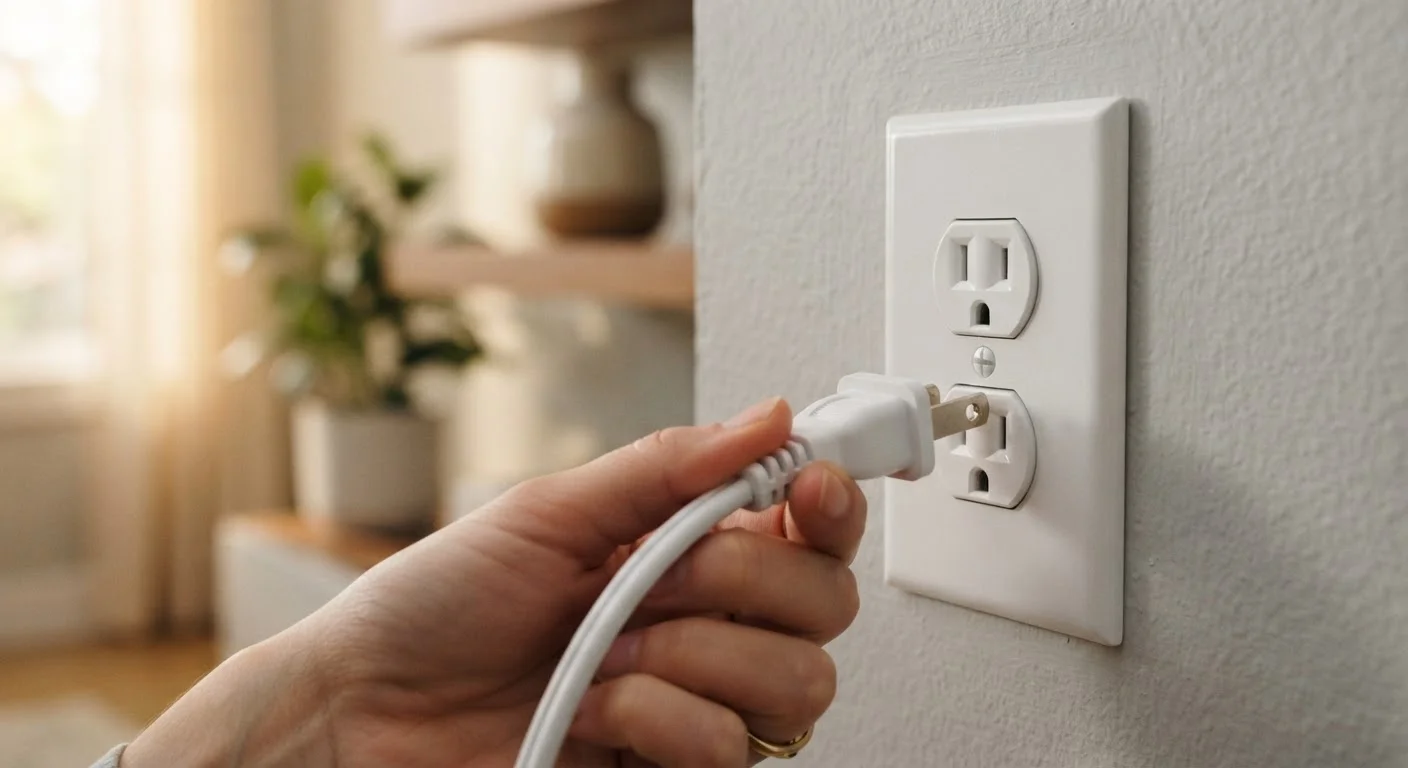
The Moment the Plug Meets the Outlet
Nothing electrical happens in your home until a circuit is complete. Think of electricity like water in a pipe: it needs a full loop to flow. Your home's wiring forms two halves of that loop — one side carries current toward the outlet (the hot wire), and the other returns it back to the source (the neutral wire). A third wire, the ground, provides a safety path in case something goes wrong.
When you insert a plug, the prongs make contact with metal contacts inside the outlet, bridging those two halves. The circuit closes, and current begins to flow. Before that moment, the outlet is energized but idle — like a hose with the tap open but no path for water to go.
To understand the measurements involved — how much voltage is present, how much current your device draws, and what wattage that translates to — see our consumer's field guide to volts, watts, and amps.
From the Grid to Your Wall: The Path Power Takes
The electricity at your outlet originates at a power plant or renewable generation source, travels through high-voltage transmission lines, and is stepped down through a series of transformers before reaching your neighborhood. A utility transformer — often the green box or pole-mounted cylinder near your home — reduces voltage to a level suitable for residential wiring.
Inside your home, the main electrical panel (breaker box) distributes power across multiple circuits. Each circuit is protected by a circuit breaker: a switch that automatically opens — cutting power — if current exceeds the circuit's safe limit. This protects both your wiring and your devices.
120V / 60 Hz
Standard U.S. residential outlet specification
This is the regulated standard for North American household outlets, maintained by the electrical grid and enforced through building codes.
5–10%
Estimated home energy used by standby ('phantom') loads
The U.S. Department of Energy has noted that standby power consumption across all devices can account for a meaningful share of a typical household's annual electricity use.
15–20 amps
Typical residential circuit breaker rating
Most standard bedroom and living area circuits in U.S. homes are rated at 15 amps; kitchen and bathroom circuits are often 20 amps to accommodate higher-draw appliances.
U.S. standard outlets operate at approximately 120 volts AC at 60 Hz (cycles per second). Larger appliances like dryers and electric ranges typically use dedicated 240-volt circuits. The type of current — alternating current (AC) — is explained in more depth in our article on AC vs. DC power.
What Your Device Does With That Power
Most consumer electronics — phones, laptops, televisions — cannot run directly on 120V AC. Their internal components operate on much lower voltages of direct current (DC). Bridging that gap is the job of the device's power supply or external adapter.
Inside that adapter or built-in power supply, a transformer steps voltage down, and a rectifier converts the alternating current waveform into steady direct current. Capacitors smooth out any remaining fluctuations. What enters your device's circuit board is clean, low-voltage DC — often 5V, 12V, or 19V depending on the device.
Check the Label Before You Plug In
The input specification on a charger or adapter (e.g., 'Input: 100–240V ~ 50/60Hz') tells you whether it's designed to work with international voltages or only domestic ones. A dual-voltage rating means the adapter handles conversion internally — no separate voltage converter needed. A single-voltage rating means using it outside that range risks damage to the adapter or device.
This is also why the label on a charger matters. It specifies exactly what input it accepts and what output it delivers. Mismatches can stress components or prevent proper charging. For help decoding those labels, our guide to reading an electronics label walks through every number and symbol room by room.
Safety Systems That Work in the Background
Several layers of protection operate silently every time you use an outlet. At the panel level, circuit breakers interrupt dangerous current surges. At the outlet level, GFCI outlets (Ground Fault Circuit Interrupter — the ones with the test/reset buttons found in kitchens and bathrooms) detect tiny imbalances between hot and neutral current, which can indicate electricity is leaking through an unintended path — like a person. They cut power within milliseconds.
Power strips add another layer, though their protection varies significantly. Understanding what joule ratings and surge protection specifications actually mean before you depend on a power strip for expensive electronics is worth the effort. Our article on reading a power strip's specifications covers exactly that.
These systems don't eliminate all risk, but they substantially reduce it when devices are used as intended and electrical installations are up to code.
Frequently Asked Questions
Many devices draw a small amount of power even in standby mode — enough to maintain settings, enable remote wake, or keep indicator lights on. This idle draw, sometimes called 'phantom load,' generates a small amount of heat. It's generally harmless but does add to your electricity bill over time.
For most well-designed, certified devices, continuous connection is safe. However, older, damaged, or uncertified equipment carries higher risk. Using outlets and power strips that match your device's requirements, and replacing frayed cords promptly, keeps risk low.
The device will receive half the voltage it expects, which typically means it won't operate correctly — most will simply not turn on or will run very slowly. The reverse scenario (plugging a 120V device into 240V) is more dangerous and can damage or destroy the device.
Each circuit in your home is rated for a maximum current draw, measured in amps. When total demand exceeds that rating, the breaker trips to prevent the wiring from overheating. This is a safety feature, not a malfunction — it means your electrical system is working as intended.
A power adapter (the brick on your laptop charger, for example) contains a transformer and rectifier circuit. The transformer steps the voltage down from 120V to something lower, and the rectifier converts AC to DC — the form of electricity your device's internal components actually use.
Yes, though the savings per device are small. Standby power draw across many devices can add up to a measurable portion of a household's annual electricity consumption. Unplugging or using a smart power strip eliminates phantom load entirely.
The content on this site is for informational purposes only and is not a substitute for professional advice. Always consult a qualified professional for guidance specific to your situation.