

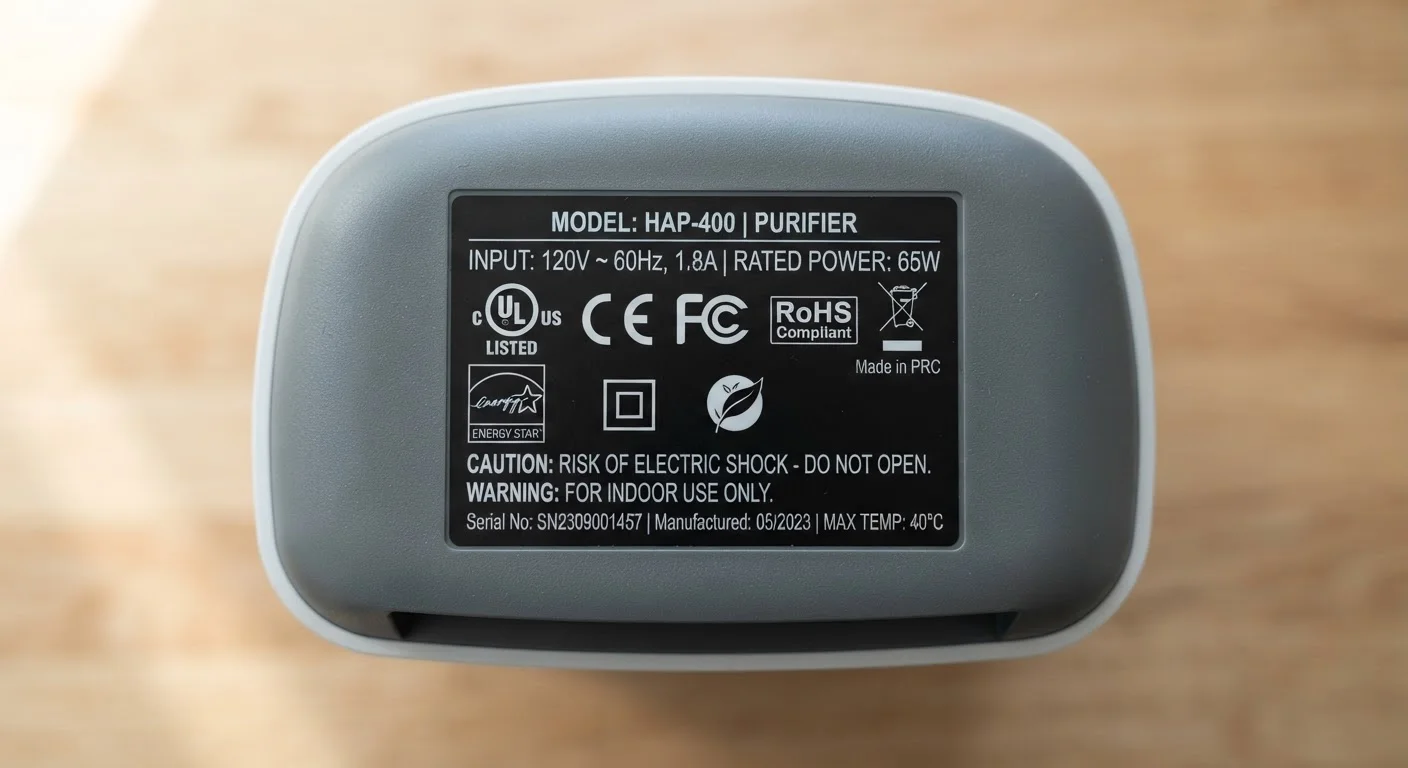
What's Actually on That Label?
Flip almost any household electronic device over and you'll find a label packed with numbers, abbreviations, and small symbols. Most consumers ignore this information entirely — but it contains everything you need to know about whether a device is safe for your home's electrical system, how much it costs to run, and whether it meets U.S. safety standards.
| Standard U.S. household voltage | 120V AC at 60Hz |
| Symbol for alternating current (AC) | ~ (tilde) |
| Symbol for direct current (DC) | ⎓ (straight line with dashes) |
| Class II insulation symbol | Square inside a square |
| U.S. NRTL safety marks (examples) | UL, ETL (Intertek) (OSHA NRTL Program) |
| Energy Star administrator | U.S. Environmental Protection Agency (EPA) |
Labels typically include four categories of information: electrical specifications (voltage, current, wattage), energy efficiency data, safety certifications, and regulatory compliance marks. Understanding each category helps you use devices safely and interpret what you're actually paying for on your electricity bill. For a deeper look at the three core electrical measurements — volts, watts, and amps — see our consumer's field guide to electrical measurements.
Electrical Specifications: Room by Room
Different rooms carry different electrical loads, and the devices in each space reflect that.
Kitchen
High-draw appliances like microwaves and coffee makers typically show labels reading 120V ~ 60Hz. The tilde (~) means alternating current (AC) — the standard in U.S. homes. The 60Hz is the frequency of that current. A label reading 1200W on a microwave tells you it draws 1,200 watts at peak operation. Connecting a 220–240V device (common on imported appliances) to a standard U.S. outlet without a converter can damage both the device and the outlet.
Home Office
Laptops and monitors often list an input range like 100–240V ~ 50–60Hz, meaning the power adapter handles voltages from around the world automatically — useful to know when traveling. The output side of a charger label (e.g., 5V ⎓ 3A) uses a straight-line symbol indicating direct current (DC), which is what the device's battery actually uses. See our guide to power strip specifications for how to calculate safe total loads when running multiple office devices from one strip.
Living Room
Televisions and audio equipment often carry both a wattage figure and a separate standby power figure — sometimes listed as Standby: 0.5W. This standby draw is sometimes called a "phantom load" and runs continuously whenever the device is plugged in. Our overview of energy efficiency ratings explains how to use these numbers to estimate annual operating costs.
Bedroom
Chargers and small personal electronics frequently show Class II insulation notation — a small square inside a square — indicating the device doesn't require a ground connection because its housing is fully insulated. This is common and safe for low-voltage devices like phone chargers and electric toothbrushes.
Safety Certifications and Regulatory Marks
Alternating Current (AC)
The type of electrical current that flows from standard wall outlets in U.S. homes, represented by a tilde (~) on device labels. The current alternates direction 60 times per second (60Hz) in the U.S.
Direct Current (DC)
Electrical current that flows in one direction only, represented by a straight line with dashes (⎓) on labels. Batteries and most rechargeable devices run on DC; power adapters convert AC from the wall to DC for the device.
Nationally Recognized Testing Laboratory (NRTL)
An independent organization accredited by OSHA to test products against established U.S. safety standards. UL and Intertek (ETL) are well-known examples. A product certified by an NRTL has been evaluated for electrical and fire hazards.
Standby Power
The electricity a device consumes while plugged in but not actively in use — sometimes called a phantom load or vampire power. This figure appears on many modern electronics labels and contributes to ongoing electricity costs.
Class II Insulation
A safety classification indicating that a device is double-insulated and does not require a grounding connection. Shown as a small square within a larger square on product labels, it is common on low-voltage consumer electronics.
FCC ID
A unique identifier required by the Federal Communications Commission on any device that intentionally transmits or receives radio frequency signals. It confirms the device is authorized for use in the U.S. and does not address electrical safety.
The most consequential symbols on any electronics label are its safety certifications. In the U.S., the most widely recognized marks come from Nationally Recognized Testing Laboratories (NRTLs) — independent organizations accredited by OSHA to test and certify products against established safety standards.
- UL Mark: Issued by Underwriters Laboratories, one of the oldest and best-known NRTLs. A circled UL on a label means the product has been tested and certified to specific U.S. and Canadian safety standards.
- ETL Listed: The ETL mark, issued by Intertek, carries equivalent weight to UL in the U.S. market. Both marks signal that a product has been tested by an OSHA-recognized lab.
- FCC ID: Required on any device that emits radio frequency energy — smartphones, Wi-Fi routers, Bluetooth speakers. The FCC ID means the device has been authorized for sale in the U.S. under Federal Communications Commission rules. It does not indicate electrical safety testing.
- Energy Star: A voluntary program administered by the U.S. Environmental Protection Agency. Products earn this mark by meeting specific energy efficiency thresholds — usually consuming significantly less energy than the minimum required by federal standards.
- CE Mark: A European conformity mark. Its presence on a device sold in the U.S. does not indicate U.S. safety certification — it signals the product meets European Union standards, which differ from domestic requirements.
If a device lacks any recognized NRTL certification mark, that absence is worth noting — particularly for high-draw appliances or anything used near water. You can look up any FCC ID in the FCC's public database to confirm its authorization details.
Understanding these labels is also useful context when evaluating early warning signs that a device is failing — uncertified or misused devices tend to show stress symptoms earlier.
The content on this site is for informational purposes only and is not a substitute for professional advice. Always consult a qualified professional for guidance specific to your situation.