

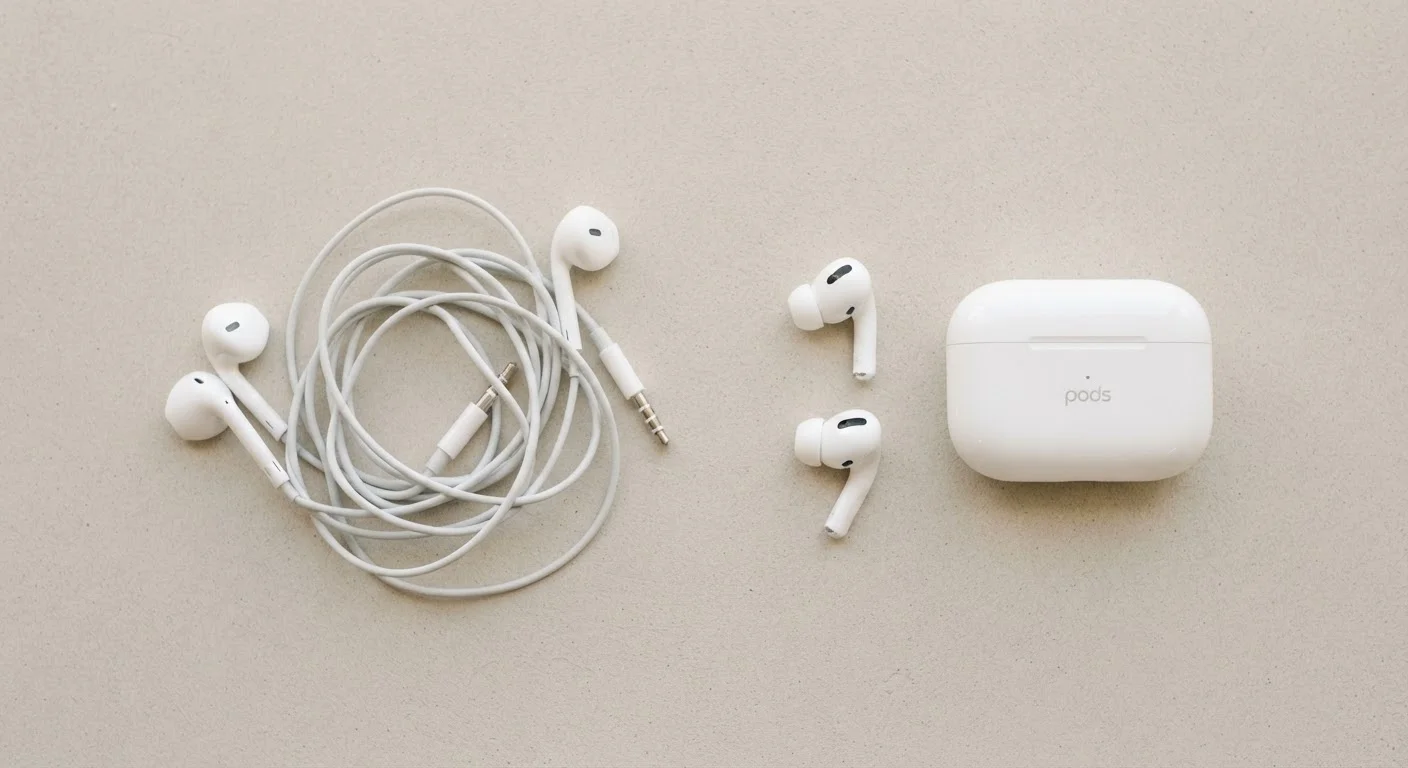
Option A
Wired Earbuds
The analog constant — no charging, no pairing, no signal overhead.
Best for: Listeners who want consistent, zero-latency audio with no dependency on battery life or wireless connectivity.
Option B
Wireless Earbuds
The cable-free experience — portable freedom with trade-offs worth knowing.
Best for: Active users and commuters who prioritize physical freedom and convenience over a fully passive audio chain.
The Core Difference: How Audio Actually Travels
With wired earbuds, audio leaves your device as an electrical signal — either analog through a headphone jack or digital through USB-C — and arrives at the earbud driver with minimal transformation. The signal path is short and passive.
Wireless earbuds do something fundamentally different. Your device compresses the audio into a Bluetooth data stream, transmits it wirelessly, and the earbud's onboard chip then decodes and converts that stream back into sound. That added processing chain is why every wireless earbud contains a battery, a radio antenna, and a digital-to-analog converter (DAC) — components that wired earbuds either exclude or leave to the source device.
Understanding this chain matters because it explains most of the real-world differences between the two formats: latency, audio quality ceiling, battery dependency, and component complexity. For a broader look at why the nature of electrical signals shapes device behavior, see our explainer on AC vs. DC power and device design.
| Criterion | Wired Earbuds | Wireless Earbuds |
|---|---|---|
| Audio latency | Near zero (< 5ms) | 40–200ms depending on codec |
| Battery required | None | Yes — onboard + charging case |
| Active noise cancellation | Passive isolation only | ANC available on many models |
| Audio quality ceiling | Higher at equivalent price | Competitive with high-res codecs |
| Repairability | Generally easier (cable, driver) | Difficult — sealed, proprietary parts |
| Physical freedom | Limited by cable length | Full — no cable tethering |
| Device compatibility | Depends on jack availability | Bluetooth — nearly universal |
Latency, Audio Quality, and What Codecs Actually Change
Latency is the gap between a sound being produced by your device and reaching your ears. Wired earbuds have latency measured in fractions of a millisecond — effectively imperceptible. Bluetooth audio, depending on the codec and device, typically introduces latency ranging from roughly 40ms to over 200ms. For music listening, this is irrelevant. For watching video or gaming, it can cause visible lip-sync issues.
Modern Bluetooth codecs have meaningfully compressed this gap. aptX Low Latency targets under 40ms; aptX Adaptive and LC3 (used in Bluetooth LE Audio) push further. However, both your source device and your earbuds must support the same codec — compatibility isn't guaranteed.
Audio fidelity was once a clear win for wired connections, but the gap has narrowed. Codecs like LDAC (developed by Sony) and aptX HD support high-resolution audio transmission. That said, the quality ceiling for wired earbuds is still technically higher at any given price point, because wireless earbuds must budget internal components across audio, radio, battery, and controls simultaneously. To understand what wireless standard generations actually change in practice, our article on wireless standards and what each generation changes provides useful context.
~40ms
Minimum Bluetooth audio latency (aptX Low Latency)
The Bluetooth Special Interest Group (SIG) cites aptX Low Latency as targeting sub-40ms round-trip audio delay under ideal conditions.
990 kbps
LDAC maximum bitrate for wireless audio
Sony's LDAC codec supports up to 990 kbps transmission — roughly three times the bandwidth of standard SBC — enabling high-resolution audio over Bluetooth.
300–500
Typical charge cycles before noticeable battery degradation
Lithium-ion batteries in consumer electronics generally retain around 80% of original capacity after 300–500 full charge cycles, a commonly cited industry benchmark.
Battery, Durability, and Long-Term Ownership
Battery life is the most consequential practical difference for most users. Wired earbuds have no battery — they cannot run out of power, cannot degrade with charge cycles, and don't require a charging case. Wireless earbuds carry lithium-ion cells that lose capacity over hundreds of charge cycles. After two to three years of regular use, most wireless earbuds will hold noticeably less charge than when new.
This connects directly to repairability. Wired earbuds fail primarily at mechanical stress points: the cable near the jack, or the driver housing. These are often inexpensive to replace. Wireless earbuds contain miniaturized batteries, soldered electronics, and proprietary firmware — components that are difficult and sometimes impossible to service independently.
Environmental considerations follow the same logic. A wired earbud that fails at the cable can sometimes be repaired; a wireless earbud with a dead battery typically cannot be economically serviced and becomes electronic waste. Our piece on habits that extend device life covers charge practices and storage habits that can slow battery degradation in wireless earbuds specifically.
For a wider view of how wired and wireless formats compare across other device categories — not just audio — see our overview of wired vs. wireless trade-offs for device buyers.
The Headphone Jack Is Not Universal
Many current smartphones no longer include a 3.5mm headphone jack, which affects wired earbud compatibility directly. Wired earbuds with a USB-C connector work with most modern Android devices and newer iPads, but not iPhones (which use Lightning or USB-C depending on generation). 3.5mm-to-USB-C and 3.5mm-to-Lightning adapters exist, but add a conversion step. Checking connector compatibility before assuming wired earbuds will 'just work' with your device is worthwhile.
The content on this site is for informational purposes only and is not a substitute for professional advice. Always consult a qualified professional for guidance specific to your situation.