

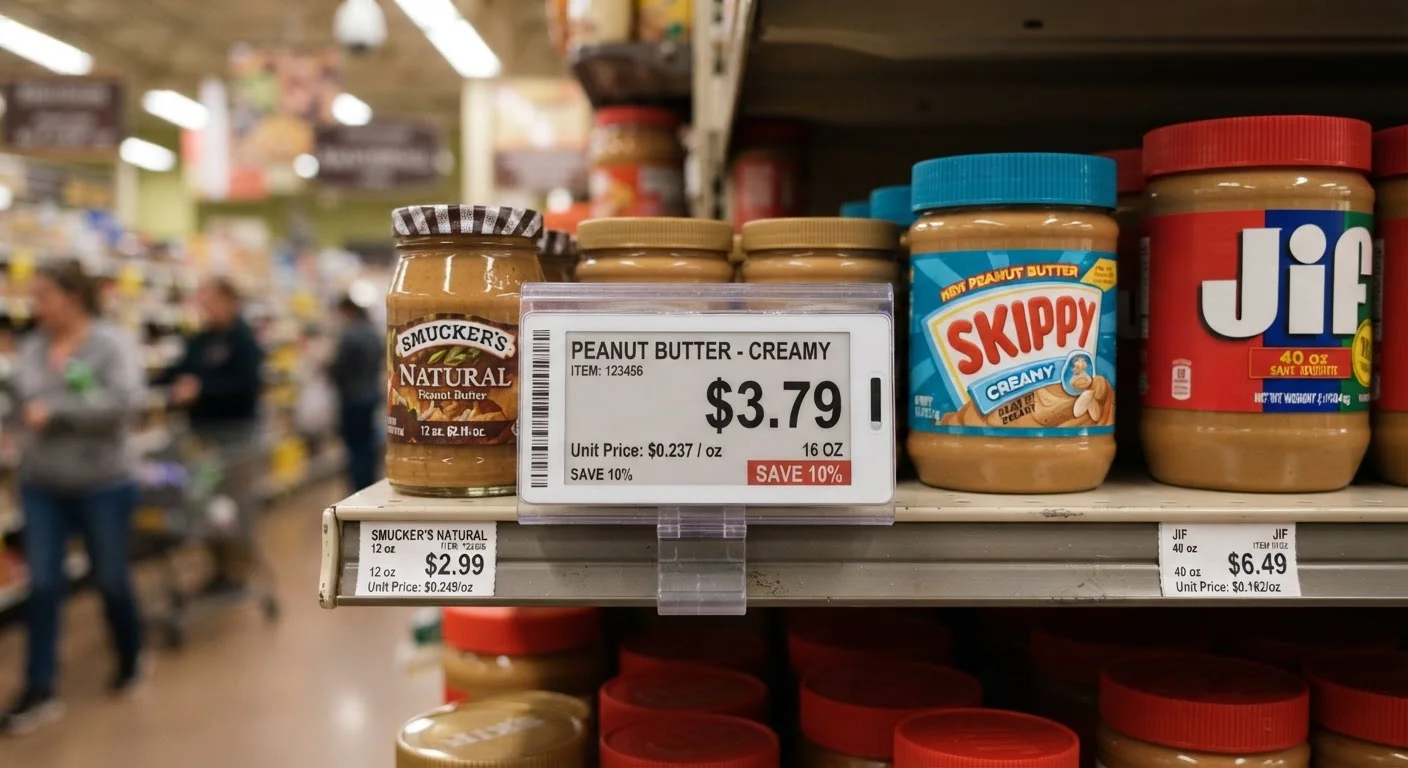
Why the Big Number on the Tag Can Mislead You
Grocery stores stock the same product in half a dozen sizes, and the total price tells you almost nothing useful. A 12-ounce jar priced at $3.49 and a 20-ounce jar priced at $5.29 are not obviously comparable until you strip out the packaging and ask: what does one ounce actually cost?
That calculation is unit pricing — dividing the total price by the quantity inside. Retailers in many U.S. states are legally required to display a unit price on the shelf tag, typically printed in smaller type above or below the larger retail price. Learning to find and read that figure is one of the most direct ways to avoid common spending patterns that quietly cost more than they appear.
Unit pricing also cuts through promotional packaging. Manufacturers routinely change container sizes without changing the retail price — a practice sometimes called "shrinkflation." The sticker price stays flat; the unit price rises. Without checking the per-unit figure, that shift is nearly invisible at the shelf.
Unit Price Is Your Anchor Number
Train yourself to glance at the unit price before the retail price on every shelf tag. It takes less than a second once it becomes habit, and it reframes the entire shelf from a collection of prices into a set of comparable values. Over a full grocery run, those comparisons can add up to meaningful savings.
What the Shelf Label Actually Shows — and When to Do Your Own Math
A standard U.S. grocery shelf tag typically shows the retail price prominently, with the unit price in smaller print, expressed as a cost per ounce, pound, count, fluid ounce, or other standard measure. The measure used matters: two competing products are only comparable if the label uses the same base unit.
When unit price labels are missing, inconsistent, or use different base units, use your phone's calculator: divide the retail price by the quantity on the package. For example, $4.79 ÷ 18 oz = approximately $0.266 per ounce. Do this for each size and the comparison becomes immediate.
Sale Tags Don't Guarantee a Lower Unit Price
A promotional sticker draws the eye but doesn't necessarily mean the unit price has dropped. Some "sale" prices reflect temporary reductions on the larger retail price while the unit cost remains equal to or above a competing size. Always compute or check the unit price independently before assuming a promotion represents genuine savings.
This habit pairs naturally with a broader awareness of retail pricing tactics. Sale stickers and strikethrough prices, for instance, don't automatically signal a lower unit price — something explored in detail in our guide to manufactured discounts and reference pricing. A product marked "25% more free" may still carry a higher unit cost than the standard size sitting next to it.
Understanding unit pricing is also a foundational skill within broader budgeting basics — it's one of the few grocery-store habits that requires no willpower, just attention.
Step-by-Step: How to Compare Products Using Unit Price
What you will need
Locate the unit price on the shelf tag
Look for small print on the shelf label — usually in a corner box or above the retail price. It will read something like $0.28/oz or $1.14/lb. This is the figure you want to compare across products, not the larger price.
Confirm all competing products use the same base unit
Unit prices are only directly comparable when they share the same measure. If one label reads per ounce and another reads per pound, convert before comparing: multiply the per-ounce price by 16 to get the per-pound equivalent.
Calculate unit price manually when the label is missing
Find the net weight or count on the package (usually near the bottom of the front panel or on the side). Then divide the retail price by that quantity: Price ÷ Quantity = Unit Price. Record the results for each size you're comparing.
Factor in practical considerations before choosing the lowest unit price
The lowest unit price is the best value only if you will actually use the product before it expires or spoils. For perishables, a slightly higher unit price in a smaller package may cost less overall than waste from an oversized one.
Common Situations Where Unit Pricing Catches You Off Guard
Bulk vs. standard size: Warehouse club packages often but not always offer a lower unit price. Compare against your regular supermarket's unit price before assuming the larger package wins.
"Family size" and "value size" labeling: These marketing terms carry no legal definition. Verify the unit price rather than trusting the label descriptor.
Multipack promotions: A "2 for $5" deal works out to $2.50 each. Divide by the unit quantity in each package to get the true per-unit figure, then compare against the single-unit shelf price.
Store brands: Private-label products frequently carry a lower unit price than national equivalents, but not universally. Check both. If you're evaluating pet food by the same logic — weighing cost against ingredient quality — the same label-reading discipline applies; our guide on reading a pet food label walks through that process in detail.
Retailers also use deliberate placement and package design to steer attention away from unit pricing. Understanding how anchoring and decoy pricing operate in stores makes unit-price comparison an even more powerful counterweight to those tactics.
The content on this site is for informational purposes only and is not a substitute for professional advice. Always consult a qualified professional for guidance specific to your situation.